
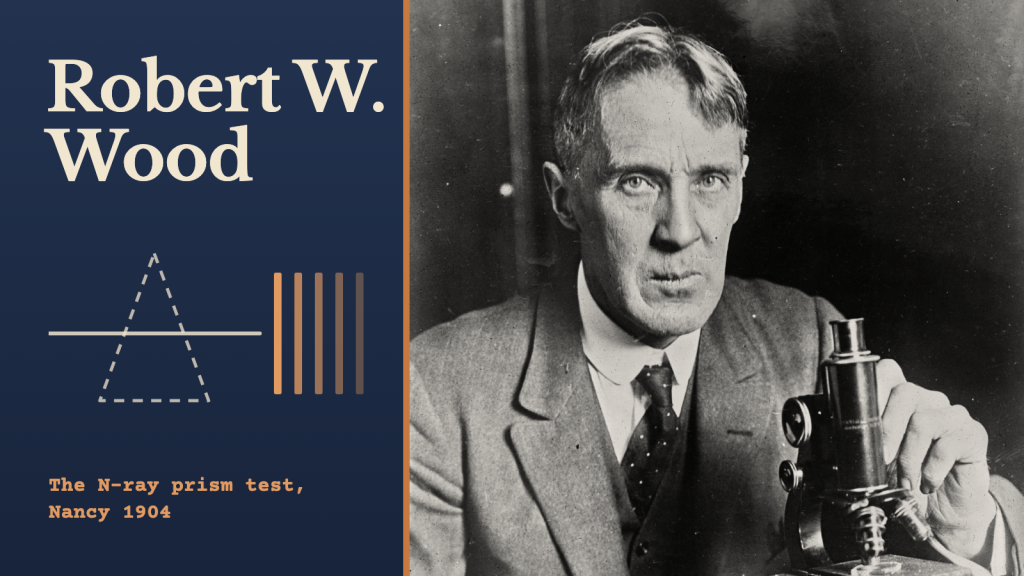
In September 1904, in a darkened laboratory in Nancy, France, the American physicist Robert W. Wood reached over and lifted the aluminum prism out of René Blondlot’s spectroscope. The prism was supposed to bend N-rays, the radiation Blondlot had announced the year before, into a spectrum. Blondlot went on measuring the spectrum anyway and read off the same numbers as before.
N-rays could not be seen directly. A narrow line of luminous paint, moved along by a fine screw, was said to glow brighter wherever it crossed a band of their spectrum. Without the prism, nothing in the instrument could form a spectrum at all.
That is the scene as Wood told it decades later, in William Seabrook’s 1941 biography Doctor Wood. His report at the time, a letter printed in Nature on September 29, 1904, was drier. It named neither Blondlot nor Nancy, and said removing the prism “did not seem to interfere in any way” with where the bright and dark bands were found. Its verdict was blunt: the few experimenters who had obtained positive results “have been in some way deluded.”
A respected physicist and a new kind of ray
Blondlot was not a fringe figure. In 1893 he had measured the speed of electric waves along wires and found it practically equal to the speed of light, work the French Academy of Sciences later praised. In February 1903, while testing whether X-rays could be polarized, he noticed that a small electric spark seemed to brighten in the beam. By spring he had concluded that a new kind of radiation was responsible, and in May he named it “n” rays, “from the name of the town of Nancy.”
By the historian Mary Jo Nye’s count, at least 40 people “observed” N-ray effects, and some 100 scientists analyzed them in about 300 papers. Many others found nothing. In Wood’s later account, the Berlin physicist Heinrich Rubens had spent two weeks failing to demonstrate the rays for the Kaiser. After the British Association’s 1904 meeting in Cambridge, Rubens asked Wood to go to Nancy and test the experiments himself.
Wood’s tests: a hand, a prism and a file
Wood spent “three hours or more” watching demonstrations, and in most of his tests he changed something the observers could not see. First came a small spark that was supposed to brighten when N-rays were focused on it. Wood saw no change and was told his eyes were not sensitive enough. So he asked the observers to call out, from the glow alone, when he put his hand into the path of the rays. “In no case was a correct answer given,” he wrote.
Then came the prism from the opening scene. The rays passed through a slit about 3 millimeters wide, yet the bands of their spectrum were said to lie less than a tenth of a millimeter apart. When Wood expressed surprise, he was told the mismatch was one of the “inexplicable and astounding properties of the rays.” Asked to tell from the glowing line whether Wood had set the prism with its edge to the right or to the left, the experimenter and his assistant got it wrong in all three trials. The failure was put down to fatigue.
Last came a steel file, said to give off N-rays. Held near the eyes, it was supposed to make the hands of a clock easier to see in a dim room. Wood quietly swapped the file for a piece of wood “of the same size and shape,” and the observer still reported the effect.
The assistant who saw nothing
Wood’s 1941 account adds a scene that, by his own admission, he left out of the letter. He says he put the prism back before the lights came up. Blondlot’s assistant, by now suspicious, asked to repeat the reading. In the dark, Wood stepped toward the prism with audible footsteps but did not touch it. The assistant turned the screw and said, as Wood rendered it: “I see nothing; there is no spectrum. I think the American has made some dérangement.” The prism was in place.
If Wood’s recollection, published 37 years later, is accurate, the same error ran in both directions. Expecting the rays, Blondlot found a spectrum with no prism; expecting sabotage, his assistant lost it with the prism in place.
What the popular retellings get wrong
A widely repeated version has Wood pocketing the prism. The chemist Irving Langmuir told it that way in a 1953 talk on “pathological science”: “R. W. Wood put the prism in his pocket.” Wood’s letter mentions no pocket, and in his later account he put the prism back.
The pocket does appear in Doctor Wood, but as a jibe the book attributes to a correspondent it names only as Le Bel. After the French weekly Revue scientifique printed a translation of Wood’s letter and asked French scientists whether N-rays were real, Le Bel mocked a French scientist measuring spectrum lines “while the prism reposes in the pocket of his American colleague!”
The same book says the exposure “eventually led to Blondlot’s madness and death.” The dates do not fit: Blondlot remained a professor in Nancy until he retired early, in 1909 or 1910 depending on the source. He died there in 1930, aged 81, 26 years after Wood’s letter.
Nor did the French Academy of Sciences drop him. On December 19, 1904, nearly three months after Wood’s letter, it gave Blondlot the 50,000-franc Leconte Prize for his work as a whole. The report, written by the mathematician Henri Poincaré, admitted that circumstances had not allowed every committee member to gain “the conviction that only personal observation can give” about N-rays. The committee, it said, wanted to affirm its confidence in the experimenter.
What the missing prism shows about testing a measurement
Langmuir’s 1953 list of symptoms of pathological science includes “Claims of great accuracy.” The N-ray spectrum fits that symptom: bands said to lie less than a tenth of a millimeter apart, read by eye, in the dark, from a beam 3 millimeters wide.
Wood’s letter also shows how honest experimenters could produce such results. The photographs of the spark, offered as objective proof, compared two images, one with N-rays and one without. Each was built from five-second exposures, with the plate holder shifted back and forth by hand. Because the experimenter knew which image was which, Wood wrote, he “may be unconsciously influenced to hold the plate holder a fraction of a second longer on one side than on the other.”
Wood’s proposed remedy was a blind test with two sealed screens, one that should block the rays and one that should not. One person would swap the screens and keep the record; another would expose the plates, “ignorant of which screen was used in each case.”
The prism test carries over to a benchmark, a dashboard or an A/B test: a result that survives the quiet removal of its supposed cause was never measuring that cause. Wood did not need a theory of N-rays to test them. He needed a dark room, a prism he could lift and an observer who did not know it was gone.
Related stories
Sources
- R. W. Wood, “The n-Rays,” Nature 70, 530–531, September 29, 1904
- William Seabrook, Doctor Wood, 1941 (Wood’s own account of his visit to Nancy)
- Comptes rendus de l’Académie des sciences 139, annual public session of December 19, 1904: Prix Leconte report by Henri Poincaré
- René Blondlot, “N” Rays, translated by J. Garcin, 1905 (Wikisource)
- Irving Langmuir, “Pathological Science,” talk of December 18, 1953, transcribed by R. N. Hall
- Mary Jo Nye, “N-Rays: An Episode in the History and Psychology of Science,” Historical Studies in the Physical Sciences 11(1), 1980 (abstract)
- Wikipedia, “Prosper-René Blondlot” (dates of retirement and death)
- Jean-Michel Bloch, “René Blondlot et les rayons N,” 1986 (retirement in 1909)
- Featured image: Robert W. Wood in February 1927, press photograph by Agence Rol, Bibliothèque nationale de France, via Wikimedia Commons, public domain
 SIGNAL TITANS
_-_btv1b531746617.jpg)
Leave a Reply