
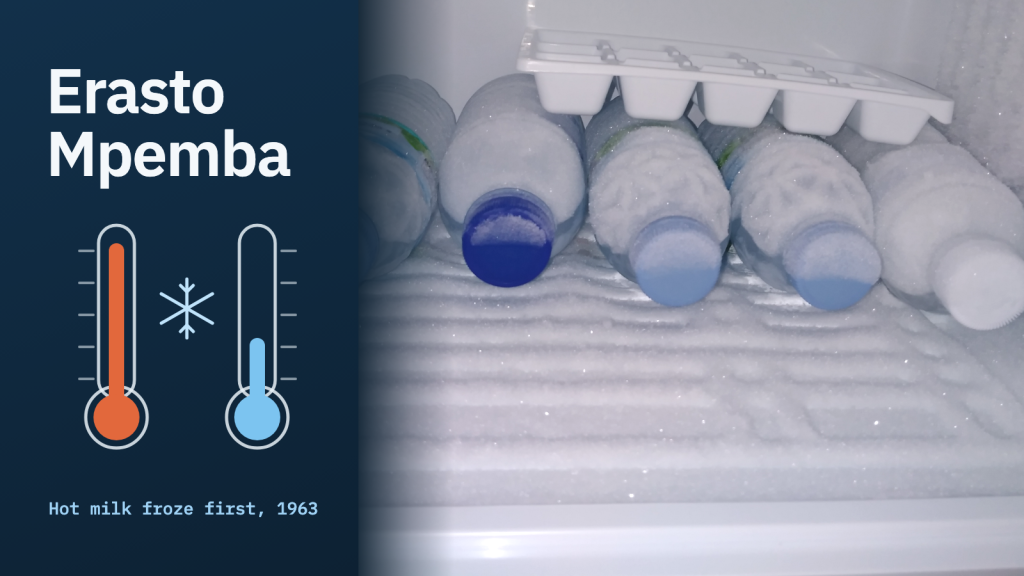
In 1963, Erasto Mpemba, a pupil at Magamba Secondary School in what is now Tanzania, put a hot ice-cream mix into a refrigerator, and it froze before another boy’s cooler mix — the puzzle now called the Mpemba effect. He had not planned an experiment. He wanted the last ice tray.
The boys at his school made ice cream by boiling milk, mixing in sugar and letting it cool nearly to room temperature before it went into the freezing chamber. Space was short. When another boy saw Mpemba boiling his milk, he hurried his own unboiled mix into an ice tray. Rather than lose the last tray, Mpemba decided, in his words, “to risk ruin to the refrigerator” and put his milk in hot.
An hour and a half later, his tray had frozen into ice cream. The other boy’s was “still only a thick liquid, not yet frozen.” Mpemba asked his physics teacher why. The answer: “You were confused, that cannot happen.” Mpemba later wrote: “Then I believed his answer.”
How “Mpemba’s physics” became a classroom joke
Ice-cream sellers in the town of Tanga later told him they put their mix in hot because it froze quicker. At Mkwawa High School in Iringa, his next school, he raised the question again while the class studied Newton’s law of cooling. “I do not think so, Mpemba,” the teacher replied. Mpemba said he had done it himself. The teacher’s final answer: “Well, all I can say is that that is Mpemba’s physics and not the universal physics.” The class adopted the line. Whenever Mpemba got something wrong, classmates said “That is Mpemba’s …” — whatever the thing was.
He tried again alone, with two beakers of water, one hot and one cold, in a laboratory refrigerator. An hour later, the beaker that had started hot held more ice — a result he called “not really conclusive.”
What happened when Mpemba asked a visiting physicist
Then Denis Osborne, a physicist from University College in Dar es Salaam, came to speak at the school. During the questions, Mpemba asked: “If you take two similar containers with equal volumes of water, one at 35 °C and the other at 100 °C, and put them into a refrigerator, the one that started at 100 °C freezes first. Why?”
Osborne smiled and asked him to repeat it, then asked whether he had done it himself. When Mpemba said yes, Osborne answered: “I do not know, but I promise to try this experiment when I am back in Dar es Salaam.” The next day, classmates told Mpemba he had shamed them with the question.
Osborne’s own account is candid: “I confess that I thought he was mistaken but fortunately remembered the need to encourage students to develop questioning and critical attitudes.” He added a rule of his own: “No question should be ridiculed.”
With a refrigerator lent by the head of the school’s kitchen staff, Mpemba tested the claim again, first alone and then with three boys who had scorned his question. “We found that ice started to form first from the hot milk,” he wrote. When Mpemba told the head of the physics department that it had worked, the department head answered, “It should not, I will have a go at it this afternoon” — and later found the same result. In Dar es Salaam, a young technician who tested it for Osborne also found that the water that started hot froze first. Then, in what Osborne called “a moment of unscientific enthusiasm,” the technician added: “But we’ll keep on repeating the experiment until we get the right result.”
What the 1969 paper claimed, and what it did not
In 1969, Mpemba and Osborne published the story as “Cool?” in the journal Physics Education. Mpemba, by then at the College of African Wildlife Management in Moshi, told his part in his own words. Osborne’s second-year university students had frozen 70 cubic centimeters of water in glass beakers in a domestic refrigerator. The finding was worded carefully: water that starts hotter “may freeze first.”
The paper spelled out why a trained physicist might be surprised: the hotter liquid “has to pass through intermediate temperatures before freezing.” Its tentative explanation concerned where the heat sits, not only how much there is. Water in a beaker loses heat mainly from its top surface. In a sample that started hot, convection keeps that surface warm, so the sample can keep losing heat faster than one that started cooler, even after both reach the same average temperature. Such samples, the paper says, “are not described adequately by a single temperature.” The tests also showed that evaporation could account for no more than 30% of the cooling, and using recently boiled water in every trial removed dissolved air as a factor.
The paper called the explanation “a tentative one” and the experiments “relatively crude.” “More sophisticated experiments are needed,” it concluded, “to provide a more certain answer to the question.”
Why scientists still disagree about hot water
The claim itself was old: Aristotle wrote that “the fact that the water has previously been warmed contributes to its freezing quickly,” and Francis Bacon and René Descartes made similar claims. Physicists now call it the Mpemba effect, and it is sometimes stated as settled fact. A 2013 Physics Today news story ran under the headline “Why hot water freezes faster than cold water.”
The careful work is less tidy. Studies have timed different moments — the first ice, a fully frozen sample, the point when the water reaches 0 °C — and water can supercool, staying liquid below 0 °C before freezing at a temperature that varies from run to run. Evaporation can help in open containers; the roles of dissolved gases, convection and frost remain disputed.
In 2016, Henry Burridge and Paul Linden reported in Scientific Reports that their readings depended on where the thermometer was placed; moving it by about a centimeter could produce false evidence of the effect. They wrote: “We conclude, somewhat sadly, that there is no evidence to support meaningful observations of the Mpemba effect.”
The name has found firmer footing elsewhere. In 2020, Avinash Kumar and John Bechhoefer reported in Nature a controlled demonstration of the Mpemba effect in a colloidal system — a microscopic glass bead in water — in which, with carefully chosen settings, a hot start cooled exponentially faster than a warm one. For water itself, Quanta Magazine summed up the state of play in 2022: “Whether hot or cold water freezes faster remains unknown.”
What Osborne did when others dismissed the question
Mpemba’s teacher in Iringa, and his classmates with him, judged his observation against Newton’s law of cooling, which describes a cooling body by a single temperature. Osborne told the students that the facts surprised him, but that the rate of cooling “might be affected by some factor I had not considered.” Osborne’s university students then found one candidate: the temperature differences inside a beaker that a single number hides.
When a result “cannot happen,” the model is a suspect, not only the person who reported it. Osborne’s promise to test it is what turned a classroom joke into a published paper.
Mpemba’s classmates meant “Mpemba’s physics” as a put-down. In physics journals the phrase lives on, more politely, as the Mpemba effect — named after a boy who put hot milk in a freezer to keep the last ice tray.
Related stories
Sources
- E. B. Mpemba and D. G. Osborne, “Cool?”, Physics Education 4, 172–175 (1969)
- Monwhea Jeng, “The Mpemba effect: When can hot water freeze faster than cold?”, American Journal of Physics 74, 514 (2006)
- Henry C. Burridge and Paul F. Linden, “Questioning the Mpemba effect: hot water does not cool more quickly than cold”, Scientific Reports 6, 37665 (2016)
- Avinash Kumar and John Bechhoefer, “Exponentially faster cooling in a colloidal system”, Nature 584, 64–68 (2020)
- Adam Mann, “Does Hot Water Freeze Faster Than Cold? Physicists Keep Asking”, Quanta Magazine, June 29, 2022
- “Why hot water freezes faster than cold water”, Physics Today, November 4, 2013
- Featured image: bottles of water and an ice-cube tray in a frosted freezer (illustrative photo, not from Mpemba’s school), by Philsacor, via Wikimedia Commons, CC0
 SIGNAL TITANS
Leave a Reply