

In 1963, ecologist Gene Likens collected rainwater samples in the White Mountains of New Hampshire that registered roughly 100 times more acidic than anticipated. Likens and his colleagues had been monitoring the water chemistry of the Hubbard Brook Experimental Forest since 1953. They approached the forest ecosystem like physicians treating a patient, analyzing stream water and precipitation much like blood and urine tests to evaluate the environment's health. The unexpectedly sharp acidity of the rain at Hubbard Brook presented a startling mystery, with no clear indication of where the acid originated or how long it had been falling.
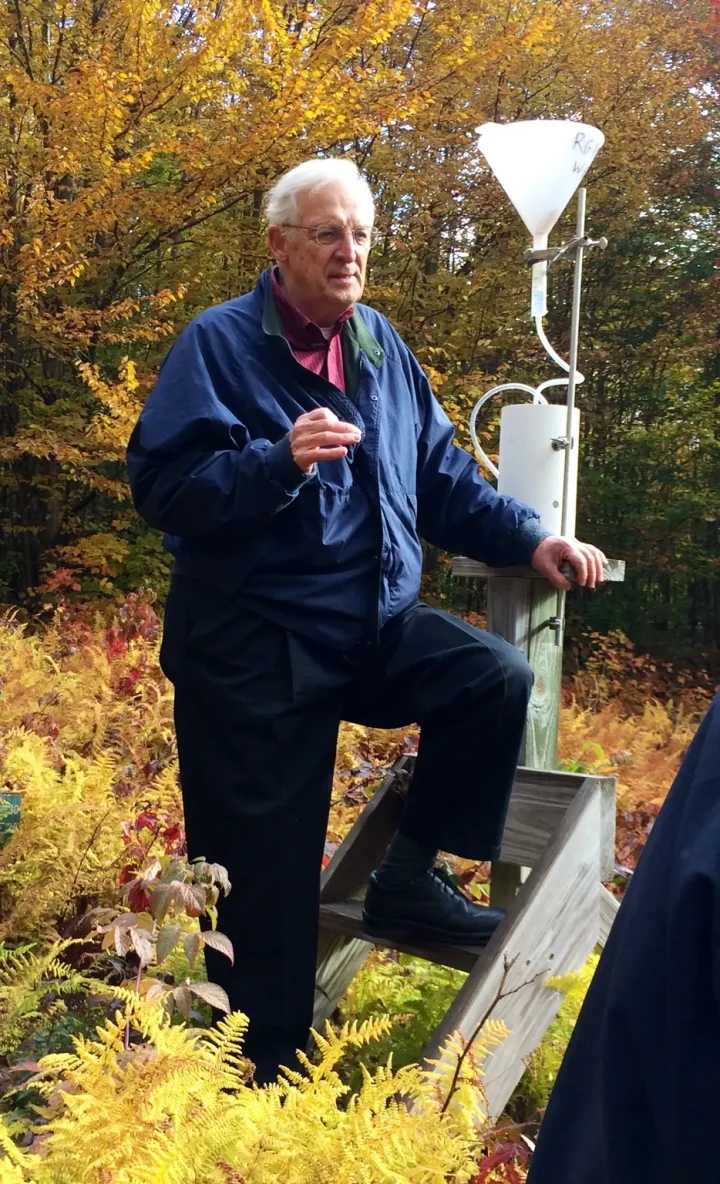
The Patient in the New Hampshire Woods
To understand the scope of the problem, Likens needed to determine whether the acidic rain was an isolated local anomaly or part of a broader atmospheric trend. At Hubbard Brook, the long-term chemical baseline established since 1953 allowed researchers to track changes in water composition over time. However, identifying the source of the acidity required looking beyond the boundaries of the New Hampshire forest.
The Overnight Train to Oslo
A critical breakthrough occurred during a chance encounter in Europe. While traveling on an overnight train from Stockholm to Oslo, Likens met Swedish scientist Svante Odén, who suggested that air pollution in Scandinavia was being transported from industrial centers elsewhere in Europe. This insight prompted Likens to investigate long-distance pollution transport in North America.
Midwestern power plants had erected increasingly tall coal smokestacks following a deadly 1948 smog disaster in Donora, Pennsylvania, which had killed 20 people and sickened 7,000 residents. While those tall chimneys cleared immediate air hazards from local communities, they discharged sulfur and nitrogen oxides high into the atmosphere, where prevailing winds carried them hundreds of miles eastward before rain and snow deposited them in New England. In 1974, Likens and his colleague Herbert Bormann published their findings in the journal Science in a landmark paper titled "Acid Rain: A Serious Environmental Problem."
Finding the Global Baseline
The 1974 Science paper reached the front page of the New York Times, sparking worldwide public interest and intense scientific debate. To verify that North American precipitation was genuinely abnormal, Likens embarked on global expeditions to establish a natural baseline for rainwater pH. He collected samples from unpolluted remote locations across the globe, including Southern Chile, China, Australia, and Amsterdam Island in the Indian Ocean. From these far-flung expeditions, Likens determined that natural precipitation has a baseline pH of 5.1, proving that rain in the northeastern United States was indeed dramatically corrupted by industrial emissions.
The Corporate Bounty
The findings provoked strong resistance from the fossil fuel industry. The Edison Electric Institute's research arm, the Electric Power Research Institute (EPRI), launched a campaign to counter the evidence, offering a $400,000 call seeking researchers who could explicitly refute Likens's conclusions and discredit his work. Despite this concerted pushback, Likens continued gathering field evidence.
According to the Distillations podcast, Gene Likens's decades of systematic field measurements ultimately established the reality of long-distance acid precipitation. By demonstrating how Midwestern power plant emissions altered the chemistry of distant ecosystems, his research forced regulators and energy companies to acknowledge cross-regional air pollution, permanently shifting how atmospheric contamination is monitored and managed.
Cover: AI-generated editorial illustration; not a documentary photograph.
Source: Distillations podcast
Whatever Happened to Acid Rain?
 SIGNAL TITANS
Leave a Reply