
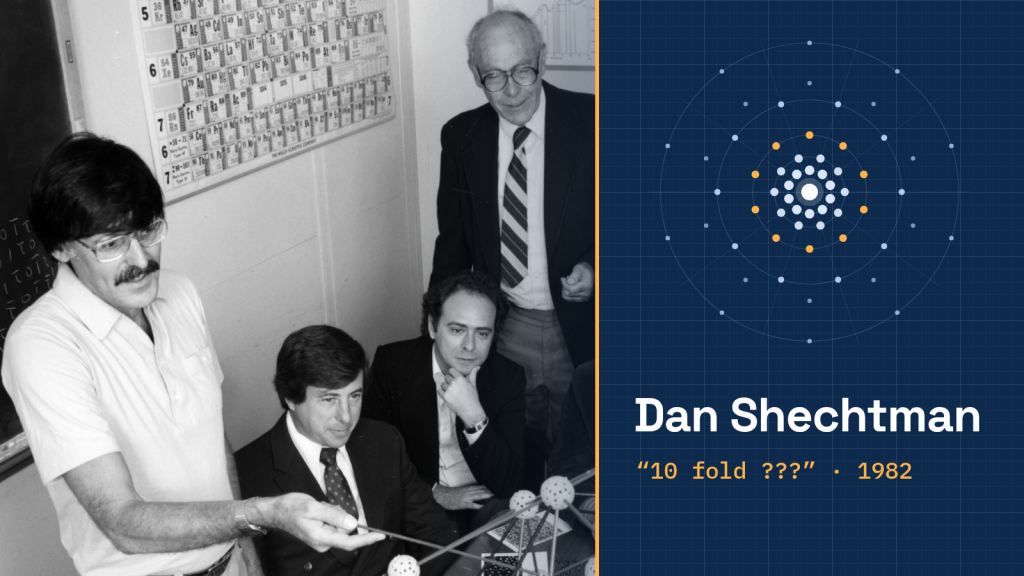
On the morning of 8 April 1982, Dan Shechtman was studying an aluminum-manganese alloy under an electron microscope when a pattern appeared that his field said could not exist: the signature of what would later be called a quasicrystal.
“And I counted, and there were 10 spots,” he later recalled. He counted the other way and got ten again. “This cannot be!”
What he did next matters as much as what he saw. He spent the afternoon trying to prove himself wrong. In his notebook, beside sample number 1725, he wrote: “(10 fold ???)”
Why ten was impossible
Shechtman, an Israeli materials scientist from the Technion, was a guest researcher at the U.S. National Bureau of Standards (NBS), now the National Institute of Standards and Technology (NIST), on a two-year sabbatical. He was looking at diffraction patterns: the bright spots electrons form after passing through a solid, which reveal how its atoms are arranged.
By the textbook definition of the time, a crystal was periodic: its atoms formed one small pattern repeated in every direction, like tiles on a floor. That repetition limits the symmetry a crystal can have. Rotate a periodic crystal and it can only look the same after a half, a third, a quarter or a sixth of a turn. NIST explains the limit in tiling terms: with any other symmetry, one repeated shape cannot fill space “without leaving some gaps in the pattern.” You can cover a bathroom floor with squares or hexagons, but never with regular pentagons alone.
A ring of ten spots looks the same after a tenth of a turn. That meant the alloy had a symmetry no periodic crystal could have. Either the textbooks were wrong, or the sample was lying to him.
What he actually did
The alloy itself was a deliberate choice. He worked in a group whose project, funded by the U.S. defense research agency DARPA, studied rapidly solidified alloys that might help companies improve products such as airplane parts. But he was also free to pursue his own lines of research. Frank Biancaniello, a member of the lab, made the samples by melt spinning, a technique that can cool a sample by more than 1,000 degrees Celsius per second. Shechtman chose to make the aluminum-manganese series even though he expected some of the alloys to be too brittle to use. “But I also prepared alloys that were not useful, but were interesting,” he told NIST.
Faced with the impossible pattern, he went after the most likely culprit. Two or more crystals can grow fused together at different angles, a phenomenon called twinning, and twins can produce a diffraction pattern that imitates a forbidden symmetry. “I wanted to find the twins, record them and forget about it,” he recalled in NIST’s account. His notebook shows him trying one microscope technique after another to find them.
He did not find them. Physics Today later reported that even when the electron beam was focused on an area just 20 nanometers across, the full pattern still appeared. The symmetry was not coming from a patchwork of crystals. It was in the material itself.
The cost of being right too early
Colleagues were slow to believe him. John Cahn, a senior NBS scientist, later described his initial reaction to the results: “Go away, Danny. These are twins and that’s not terribly interesting.”
The doubt turned personal. The Royal Swedish Academy of Sciences, which awards the chemistry Nobel, notes that while defending his findings he was asked to leave his research group. He recalls the group’s head telling him, “You are a disgrace to our group, and I cannot bear this disgrace.” Accounts differ on whether this happened at NBS or back in Israel.
He finished his appointment and went home to the Technion in 1983, where his colleague Ilan Blech built a computer model of a structure that could produce such a pattern. Their paper went to the Journal of Applied Physics, which rejected it as unlikely to appeal to physicists.
The turn came in the summer of 1984, when Shechtman returned to NBS and showed Cahn the rejected manuscript. This time Cahn was persuaded. He brought in Denis Gratias, a crystallographer at France’s National Centre for Scientific Research (CNRS). Shechtman, Blech, Gratias and Cahn wrote a short paper for Physical Review Letters, published in November 1984. Its title said exactly what was strange: “Metallic Phase with Long-Range Orientational Order and No Translational Symmetry.” In plain words: ordered, but not repeating. Cahn later said he worked on nothing else for the next five years.
Weeks after the paper appeared, Dov Levine and Paul Steinhardt published a theory and a name: quasicrystals.
The myth: a lone genius against the world
The Nobel announcement said Shechtman “had to fight a fierce battle against established science.” The fight was real, but the phrase is easy to hear as one man against everyone. Linus Pauling, a two-time Nobel laureate whom NIST calls “a powerful figure with outsized influence,” argued in Nature in 1985 that the pattern came from multiple twinning, and he died unconvinced in 1994. Shechtman recalls him saying, “There is no such thing as quasicrystals, only quasi-scientists,” though that line survives only in recollections and its wording varies.
But the record also shows three co-authors, a senior skeptic who changed his mind and a theory within weeks. The mathematics was not unthinkable either. In 1982, the crystallographer Alan Mackay had shown that a model based on Penrose tilings, which cover a floor without gaps but never repeat, would produce a tenfold pattern of diffraction spots. What Shechtman showed was that a real alloy produced one.
The definition changed
In 1992 the International Union of Crystallography rewrote the definition of a crystal. The new definition, “any solid having an essentially discrete diffraction diagram,” requires sharp spots, not repetition, so it includes quasicrystals. Natural ones turned up too: in 2009, researchers reported a quasicrystal in a rock from Russia’s Koryak Mountains and later traced the rock to a meteorite.
On 5 October 2011, Shechtman was named the sole winner of the Nobel Prize in Chemistry, “for the discovery of quasicrystals.” By then they had been found in a durable steel made by a Swedish company and were being tried in frying pans and diesel engines.
A mental model worth keeping
The symmetry rule was not wrong as mathematics. It was a theorem about periodic patterns. The mistake was a silent assumption on top of it: that ordered means repeating.
Shechtman’s order of operations is the useful part. First he attacked his own result with the most boring explanation available. Only when it survived did he argue with the rule. Programmers know the same discipline from the suspected compiler bug: first rule out your own mistake, which is almost always the answer, and only then blame the compiler. Once in a while, the compiler really is wrong.
So when your data breaks a rule, try to break the data first. If it survives, find the assumption the rule was quietly standing on.
Related stories
Sources
- NIST, “The Nobel Moment: Dan Shechtman”
- NIST, “Context of a Discovery: Dan Shechtman”
- NIST, “NIST Colleagues Congratulate Shechtman on Nobel Chemistry Prize” (13 October 2011)
- Royal Swedish Academy of Sciences, press release on the 2011 Nobel Prize in Chemistry (5 October 2011)
- D. Shechtman, I. Blech, D. Gratias, J. W. Cahn, “Metallic Phase with Long-Range Orientational Order and No Translational Symmetry,” Physical Review Letters 53, 1951 (1984)
- D. Levine, P. J. Steinhardt, “Quasicrystals: A New Class of Ordered Structures,” Physical Review Letters 53, 2477 (1984)
- Ashley G. Smart, “Nobel Prize in Chemistry honors the discovery of quasicrystals,” Physics Today (December 2011)
- Richard Harris, “Nobel-Winning Chemist Fought Hard For Acceptance,” NPR (5 October 2011)
- NPR, “Israeli Chemist Wins Nobel Prize For Quasicrystals” (5 October 2011)
- L. Pauling, “Apparent icosahedral symmetry is due to directed multiple twinning of cubic crystals,” Nature 317, 512 (1985)
- L. Bindi et al., “Natural Quasicrystals,” Science 324, 1306 (2009)
- L. Bindi et al., “Evidence for the extraterrestrial origin of a natural quasicrystal,” PNAS 109, 1396 (2012)
- Featured image: Dan Shechtman (left) with collaborators at NBS in 1985, cropped. H. Mark Helfer/NIST (listed on Wikimedia Commons as Phillip Westcott, NIST), via Wikimedia Commons, Public domain
 SIGNAL TITANS
Leave a Reply