
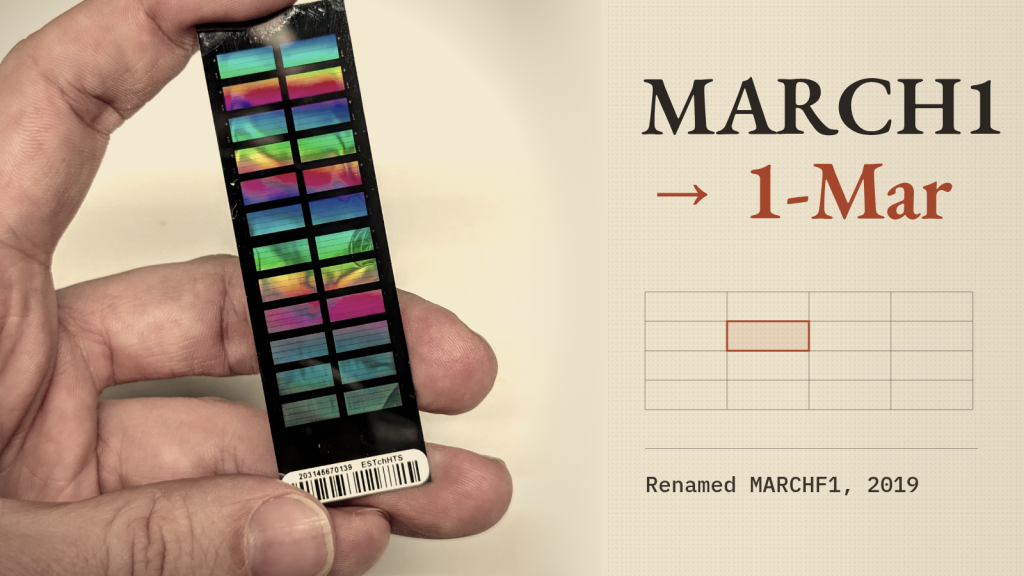
In 2019, the HUGO Gene Nomenclature Committee (HGNC), the body that approves official names for human genes, renamed SEPT1, MARCH1 and other genes for a reason that came from software, not biology: Microsoft Excel’s defaults kept turning their symbols into dates.
Type MARCH1 into a cell and Excel shows 1-Mar; SEPT2 becomes 2-Sep. The replacements, SEPTIN1 and MARCHF1, keep the family names but no longer look like dates. When the committee published updated naming guidelines in Nature Genetics in 2020, it listed the change under “symbols that affect data handling and retrieval,” noting that “all symbols that auto-converted to dates in Microsoft Excel have been changed.” The committee did not wait for the software to change.
A problem first reported in 2004
The trouble had been documented fifteen years earlier. Barry Zeeberg and colleagues at the US National Cancer Institute were beta-testing two of their own bioinformatics programs on microarray data when, as they wrote in BMC Bioinformatics in 2004, “some gene names kept bouncing back as ‘unknown.’” A little detective work traced the problem to Excel’s default conversions. The candidate tumor suppressor gene DEC1 was being turned into “1-DEC.” Clone identifiers from RIKEN, a Japanese research institute, fared no better: Excel read the E in codes such as 2310009E13 as an exponent and turned them into floating-point numbers.
The paper counted at least 30 gene names hit by the date conversion and at least 2,000 identifiers hit by the number conversion once RIKEN codes were included. “These conversions are irreversible; the original gene names cannot be recovered,” the authors warned. The error had even reached LocusLink, a carefully curated public gene database. The work-arounds they listed included putting a space or an apostrophe in front of each name, or marking a column as text when importing a file. All of them, the authors wrote, “require continued attention on the part of the user.” What they hoped for was a change in Excel itself: “We hope the date and floating-point conversions will be made non-default options.”
One in five papers with Excel gene lists
Twelve years later, Mark Ziemann, Yotam Eren and Assam El-Osta, researchers in Melbourne, Australia, measured how far the problem had spread. Using a set of shell scripts, they screened 35,175 supplementary Excel files from 18 journals published between 2005 and 2015. They found gene lists attached to 3,597 papers and confirmed gene name errors in files from 704 of them, or 19.6 percent.
The denominator matters. The figure covers papers that shared gene lists as Excel files in those 18 journals, not all genetic data. When The Verge reported the renaming in 2020, its article described the study accurately as roughly one-fifth of 3,597 papers, but a pull quote on the page widened the claim to “a fifth of genetic data in papers.” Even the narrower figure is serious: as the authors noted, supplementary files “are an important resource in the genomics community that are frequently reused.”
Renaming the genes
According to HGNC’s records, SEPT1 became SEPTIN1 on April 4, 2019, along with the other septin genes. MARCH1 became MARCHF1 on July 9. Elspeth Bruford, the HGNC coordinator, told The Verge that some 27 genes had been renamed this way over the past year. The committee consulted the research communities involved and notified researchers who had published on those genes, she said.
The formal guidelines followed in 2020. Their heading on data handling and retrieval also covered genes for transfer RNA (tRNA) synthetases, a family of enzymes, whose symbols were common words that caused false hits in searches: WARS became WARS1, and CARS became CARS1.
Why change the genes rather than the spreadsheet? Microsoft did not respond to The Verge’s request for comment. Bruford’s own theory was practical. “This is quite a limited use case of the Excel software,” she said. “There is very little incentive for Microsoft to make a significant change to features that are used extremely widely by the rest of the massive community of Excel users.”
Errors kept growing after 2016
New names do not repair old files, and human genes are only part of the picture. In 2021, Ziemann and three colleagues published a broader scan titled “Gene name errors: Lessons not learned.” Among genomics articles in PubMed Central from 2014 to 2020 that had supplementary Excel gene lists, their improved software found errors in 30.9 percent, 3,436 of 11,117. The new scan drew on a different sample and also caught gene names that had become five-digit numbers — the internal format in which Excel stores dates — so the 30.9 percent is not directly comparable with the 19.6 percent from 2016. The authors’ summary was blunt: “gene name errors continued to accumulate unabated in the period after 2016.”
Human and mouse SEPT and MARCH genes had been renamed, but gene names in many other organisms had not: when the authors imported every eukaryotic gene name in the Ensembl genome database into Excel, 1,544 names from 104 taxa turned into dates.
The switch Excel rolled out in 2023
In October 2023, Microsoft made its Automatic Data Conversion settings broadly available in Excel for Windows and Mac, “based on your feedback.” Users can now switch off several conversions, including one that turns “a continuous string of letters and numbers” into a date — the MARCH1 case. A second switch covers digits around the letter E, which Excel otherwise reads as scientific notation — the RIKEN case. The conversions are still on by default, the opposite of what Zeeberg’s team had hoped for in 2004.
Microsoft lists a known issue: the settings cannot disable conversions while a macro runs. Its documentation also warns that values with spaces or other characters, “such as JAN 1 or JAN-1,” may still be treated as dates.
Why Excel’s default mattered more than the gene names
Excel’s guess exists for good reasons. Microsoft’s support pages describe it as a way to make dates easier to enter: type 12/2 and Excel shows 2-Dec. For people entering dates, that saves keystrokes. For geneticists, the same silent guess changed data they never meant to change, and each work-around depended on someone remembering it every time. Microsoft controlled the default. The committee controlled the names, and it changed the part it owned.
For anyone who designs identifiers, the lesson is short: if your names look like something else, some tool will eventually read them that way.
In 2004, DEC1 was the gene Zeeberg’s team used to show the problem: a candidate tumor suppressor that Excel turned into 1-DEC. Since October 2019, its official symbol has been DELEC1. Excel’s default guess has stayed the same. The gene’s name changed.
Related stories
Sources
- Barry R. Zeeberg et al., “Mistaken Identifiers: Gene name errors can be introduced inadvertently when using Excel in bioinformatics,” BMC Bioinformatics 5:80, 2004
- Mark Ziemann, Yotam Eren and Assam El-Osta, “Gene name errors are widespread in the scientific literature,” Genome Biology 17:177, 2016
- Elspeth A. Bruford et al., “Guidelines for human gene nomenclature,” Nature Genetics 52:754–758, 2020
- HGNC, symbol record for SEPTIN1 (previous symbol SEPT1)
- HGNC, symbol record for MARCHF1 (previous symbol MARCH1)
- HGNC, symbol record for DELEC1 (previous symbol DEC1)
- Mandhri Abeysooriya, Megan Soria, Mary Sravya Kasu and Mark Ziemann, “Gene name errors: Lessons not learned,” PLOS Computational Biology, 2021
- James Vincent, “Scientists rename human genes to stop Microsoft Excel from misreading them as dates,” The Verge, August 6, 2020
- Chirag Fifadra, “Control data conversions in Excel for Windows and Mac,” Microsoft 365 Insider Blog, October 19, 2023
- Microsoft Support, “Data import and analysis options in Excel”
- Microsoft Support, “Stop automatically changing numbers to dates”
- Featured image (illustrative): a DNA microarray chip, Illumina Global Screening Array. Photo by ErikAbner, via Wikimedia Commons, CC BY 4.0
 SIGNAL TITANS
Leave a Reply