
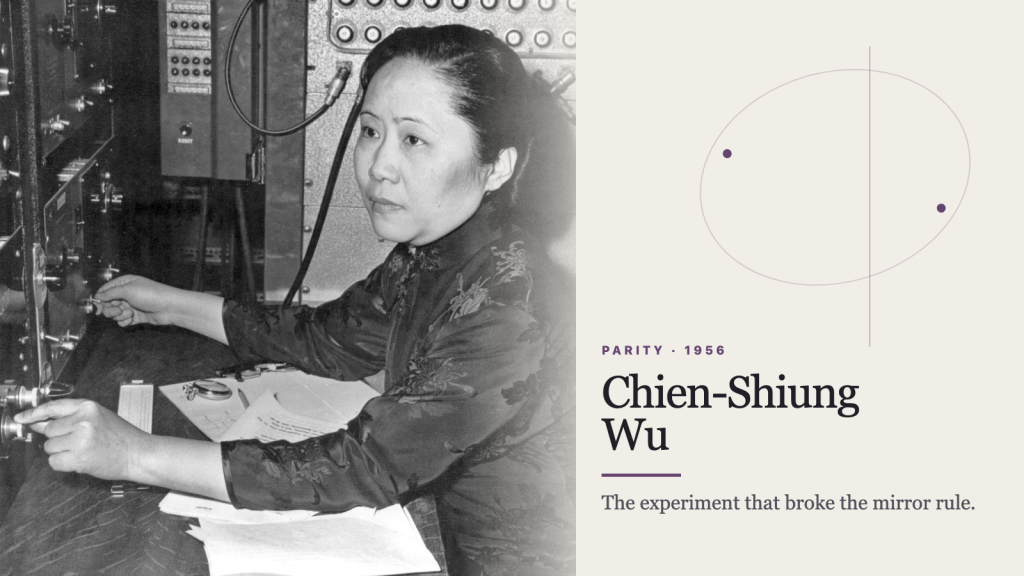
For decades, physicists assumed that nature should not care whether an experiment was viewed directly or in a mirror.
Then, in 1956, Chien-Shiung Wu built an experiment designed to ask nature the question rather than trust the assumption.
Her team cooled cobalt-60 nuclei to extremely low temperatures, aligned them in a magnetic field and watched the direction in which electrons emerged during beta decay.
The result was not symmetric.
One of physics’ most comfortable rules had failed.
Parity looked so natural that few people questioned it
In physics, parity is a way of asking whether the laws describing a process remain unchanged when spatial coordinates are reversed, roughly like comparing an event with its mirror image. For familiar forces, parity appeared to be conserved. By the mid-1950s many physicists treated that symmetry almost as a basic property of nature.
But puzzling observations involving particles called theta and tau created a problem. Tsung-Dao Lee and Chen Ning Yang examined the evidence and noticed something important: parity had been tested extensively in electromagnetic and strong interactions, but not convincingly in the weak interaction.
They proposed experiments that could decide the issue.
One of the scientists who knew how to build such an experiment was Chien-Shiung Wu, a Columbia University physicist already renowned for precision work in beta decay.
The experiment depended on controlling orientation
Wu worked with researchers at the National Bureau of Standards, now NIST, including Ernest Ambler, Raymond Hayward, Dale Hoppes and Ralph Hudson. The experiment used cobalt-60, whose nuclei undergo beta decay.
The challenge was not simply to detect electrons. The team needed the nuclei to point in a known direction so that “left” and “right” had a physical meaning in the measurement.
They cooled the cobalt sample to a tiny fraction of a degree above absolute zero and used a magnetic field to align the nuclear spins. Then they measured how the emitted electrons were distributed relative to that orientation.
If parity were conserved in the weak interaction, the mirrored version of the process should be equally likely. The experiment showed a strong asymmetry instead.
The mirror image was not equivalent
The result meant that the weak interaction distinguishes between arrangements that would be mirror images of one another. Nature, at least in this process, does care about handedness.
NIST’s historical account describes the finding as the “fall of parity.” The assumption had been treated as comparable in status to other conservation ideas. After the Wu experiment and related confirmation, it could no longer be used as a universal rule.
This was not a minor correction to a table of constants. It changed how physicists thought about fundamental symmetry.
Wu’s strength was experimental judgment
The story is sometimes simplified into a dramatic contest between theory and experiment. The more useful version is about how difficult it is to make a decisive test.
Lee and Yang identified the theoretical gap and proposed ways to test it. Wu recognized that a cobalt-60 beta-decay experiment could provide a clean answer and had the experimental expertise to make it work under demanding low-temperature conditions.
That matters because scientific progress often depends on the ability to convert an abstract question into an observable difference. “Does parity hold?” is philosophical until an apparatus turns it into counts of electrons emitted in one direction versus another.
Wu’s contribution was not simply taking a measurement. It was engineering a situation in which the measurement could actually decide the question.
The Nobel Prize went to the theorists
Lee and Yang received the 1957 Nobel Prize in Physics for their investigation of parity laws. Wu was not included in the prize.
That fact has become part of the way her career is remembered, but it should not eclipse the experiment itself. Contemporary and later accounts from NIST, the American Physical Society and Columbia describe her as a central experimental figure in establishing parity violation.
Her broader career included major work on beta decay and nuclear physics, and she became one of the most respected experimental physicists of the twentieth century.
The useful lesson is to test the assumption everyone stopped seeing
The parity story is powerful because the failed assumption was not foolish. It was elegant, consistent with many observations and deeply embedded in theory.
That is exactly why it was dangerous to leave untested.
In engineering, science and organizations, the hardest assumptions to examine are often the ones that have become invisible because they have worked for so long. A good experiment makes the hidden assumption explicit and creates a result that can prove it wrong.
Wu did not win by arguing harder that parity might fail.
She built a situation in which nature had to answer.
Sources
- NIST — The Fall of Parity
- American Physical Society — Lee, Yang and the parity experiment
- NIST — Nobel connections and the 1956 experiment
- U.S. Department of Energy — Chien-Shiung Wu
- Columbia University — Chien-Shiung Wu, renowned physicist
- Featured image — Chien-Shiung Wu, Smithsonian Institution Archives, via Wikimedia Commons. No known copyright restrictions.
 SIGNAL TITANS
Leave a Reply