
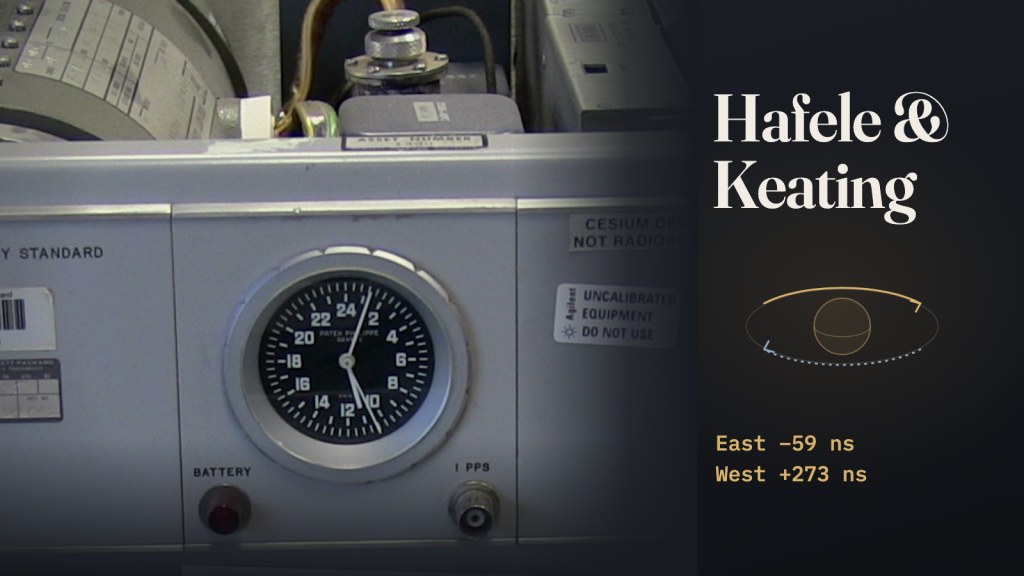
In October 1971, physicist Joseph Hafele and astronomer Richard Keating flew four atomic clocks around the world on scheduled airliners to test Einstein’s theories of relativity. Most of their $8,000 budget went on airline tickets — for the two scientists and for the clocks.
They went around twice, first eastward, then westward. Before the first trip, between the trips and after the second, they compared the flying clocks with the atomic time scale of the US Naval Observatory in Washington, D.C. On the eastward trip, the clocks lost 59 billionths of a second, or nanoseconds. On the westward trip, they gained 273.
Hafele and Keating’s relativity calculations had predicted a loss of about 40 nanoseconds and a gain of about 275. No passenger would notice a few hundred billionths of a second, but the difference was enough to show that clocks carried along different paths do not keep the same time.
Keating, who worked with atomic clocks at the observatory, put his view bluntly years later on NOVA, a science series on the US public broadcaster PBS: “I don’t trust these professors who get up and scribble in front of blackboards, claiming they understand it all.” The best proof, he said, was to measure the effect.
Why the eastbound clocks lost time and the westbound clocks gained it
Two effects were at work, and the experiment measured their sum.
The first is gravity. General relativity predicts that a clock higher up, where gravity is slightly weaker, runs a little faster than one on the ground. At the eastward trip’s average height of about 8,900 meters, over 41.2 hours in the air, Hafele and Keating predicted a gain of 144 nanoseconds. On the longer, slightly higher westward trip, they predicted 179.
The second is speed, and it depends on direction. Special relativity says a moving clock runs slow, but “moving” needs a reference. Hafele and Keating used a frame of reference centered on Earth that does not rotate with it — picture a camera far above the North Pole that does not turn with the planet and watches it spin below. In that frame, the ground clocks in Washington are themselves moving, carried east by Earth’s rotation.
A plane flying east adds its speed to that rotation, so its clocks move faster than the ground clocks and fall behind them: the predicted loss was 184 nanoseconds. A plane flying west subtracts its speed, so its clocks move more slowly than the ground clocks and pull ahead of them: the predicted gain was 96 nanoseconds.
Adding the two effects gave the overall predictions. Eastward, the 144-nanosecond gain and the 184-nanosecond loss netted out to −40 ± 23 nanoseconds. Westward, gains of 179 and 96 added up to +275 ± 21. The measured values, −59 ± 10 and +273 ± 7, agreed with these predictions within the experiment’s error bars.
What Hafele and Keating actually did
Hafele, an assistant professor of physics at Washington University in St. Louis, first thought of the experiment while preparing notes for a lecture. In 1970 he had published a paper in Nature on the relativistic behavior of moving clocks on Earth. Keating, an astronomer in the Naval Observatory’s Time Service Department, had attended one of Hafele’s lectures and had connections with the Office of Naval Research. He obtained the $8,000 from that office, and most of the money paid for airline tickets: seats for the two men and the seats needed for four HP 5061A cesium-beam clocks, a model made by Hewlett-Packard.
The eastward trip began on October 4, 1971, and took 65.4 hours, 41.2 of them in the air. The westward trip began on October 13 and took 80.3 hours, 48.6 of them in the air.
The complication: four imperfect clocks
In the journal Science, in July 1972, the result sounded definitive. The two scientists called it “an unambiguous empirical resolution of the famous clock ‘paradox’ with macroscopic clocks.”
Eight months earlier, Hafele’s technical report from November 1971 had been more careful: “Although the performance of these clocks was found to be noticeably degraded during the trips, we also found that the ensemble of four flying clocks produces consistent time differences which are difficult to explain without invoking relativistic effects.” The result rested on the four clocks together, not on any single one.
Popular retellings say the flights proved Einstein right. The real result was more modest: the experiment’s accuracy was only about 10%. Physicist Benjamin Crowell notes in his textbook on general relativity that the experiment did not completely separate the speed and gravity effects, and that the effect it measured was small. Later tests went much further. In a 1976 experiment called Gravity Probe A, a probe carrying a hydrogen maser clock was launched straight up, and the result matched the relativistic prediction to 0.01%.
Where the same two effects matter today: GPS
The two effects whose sum Hafele and Keating measured also matter for the Global Positioning System (GPS). For a GPS satellite clock, the gravity effect is larger than the slowing from its speed, so a clock in orbit runs fast compared with clocks on the ground. As physicist Neil Ashby explains in a review of relativity in GPS, the satellite clocks are adjusted lower in frequency, and the adjustment is made on the ground before each clock is placed in orbit.
What the flying clocks show
“Moving” only means something relative to a frame. The eastbound loss and the westbound gain make sense once you measure both planes and the ground clocks from the same frame — Hafele and Keating used one centered on Earth and not rotating with it.
An ensemble can measure what one instrument cannot. The clocks’ performance was noticeably degraded on the trips. Four of them together still gave consistent time differences.
A cheap test can still be a real test. Seats on scheduled flights were enough to detect a loss eastward and a gain westward, as relativity predicted.
In 1971, the clocks needed their own airline seats. Today, GPS satellite clocks are set to run slow on the ground before launch, so that in orbit they keep time with the clocks below.
Related stories
Sources
- J. C. Hafele and Richard E. Keating, “Around-the-World Atomic Clocks: Predicted Relativistic Time Gains,” Science 177(4044): 166–168, July 14, 1972
- J. C. Hafele and Richard E. Keating, “Around-the-World Atomic Clocks: Observed Relativistic Time Gains,” Science 177(4044): 168–170, July 14, 1972
- U.S. Naval Observatory, release on the 50th anniversary of the Hafele–Keating experiment, October 15, 2021
- J. C. Hafele, “Performance and Results of Portable Clocks in Aircraft,” Washington University, November 1971 (TRID record)
- HyperPhysics, Georgia State University, “Hafele and Keating Experiment”
- Benjamin Crowell, General Relativity, section 1.2, “Experimental Tests of the Nature of Time” (LibreTexts)
- NOVA, “Time Travel,” transcript, PBS, 1999
- Neil Ashby, “Relativity in the Global Positioning System,” Living Reviews in Relativity 6, 2003
- J. C. Hafele, “Relativistic Behaviour of Moving Terrestrial Clocks,” Nature 227: 270–271, 1970
- BGR, “Einstein’s Theories About Time Were Actually Proven True By Commercial Airlines In 1971” (example of the “proved Einstein right” framing)
- Featured image: an HP 5061A cesium-beam frequency standard, the clock model Hafele and Keating flew (illustrative), by Binarysequence, via Wikimedia Commons, CC BY-SA 3.0
 SIGNAL TITANS
Leave a Reply