
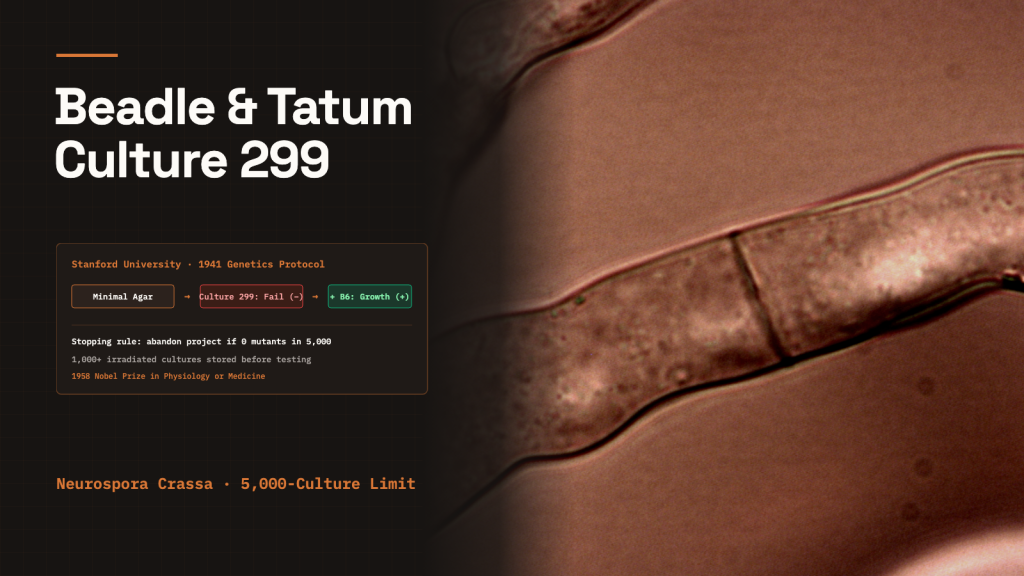
In 1941, George Beadle and Edward Tatum found a red bread mold culture that could grow when supplied with vitamin B6 but failed on its usual minimal diet. Culture 299 gave them a way to connect a genetic mutation to a specific nutritional failure. They had agreed to abandon the search if they found no nutritional mutant within 5,000 cultures.
That stopping rule appears in the Cold Spring Harbor Laboratory DNA Learning Center’s biographies of both researchers. Its account of Beadle adds an important detail: they had collected and stored more than 1,000 irradiated cultures before testing any of them. The successful culture’s number was 299; it was not a count of every culture they had prepared.
The experiment made a difficult question testable. Genes were known to shape inherited traits, but could researchers work backward from a missing chemical product to understand what a gene helped a cell do?
A simpler organism for a difficult question
Beadle had already investigated the connection between genes and chemistry through fruit-fly eye color. In Paris, he worked with Boris Ephrussi on pigment development. At Stanford University, Beadle and Tatum tried to isolate and identify the substances involved. Another group reached that goal first, according to the DNA Learning Center’s historical account.
Beadle turned to a simpler experimental system. In 1940, he converted his fruit-fly laboratory to work with Neurospora crassa, a red bread mold. For most of its life cycle, the fungus has just one copy of each gene. That made the consequences of a mutation easier to study without a second copy masking its effects.
The fungus also offered a useful chemical starting point. Ordinary Neurospora could grow on minimal medium containing simple sugars, inorganic salts and the vitamin biotin. From those ingredients, its cells could make the other vitamins and amino acids needed for growth. Enzymes, proteins that catalyze chemical reactions, made those conversions possible.
Keeping the failures alive
Beadle and Tatum reasoned that a mutation affecting an enzyme might interrupt one of those conversions. The resulting strain would fail on minimal medium. Supplying the missing product could allow it to grow again.
But searching only on minimal medium would create a problem: the mutants they wanted were precisely the cultures unable to grow there. Their procedure first gave the offspring of X-ray-treated Neurospora complete medium, containing vitamins and amino acids. That richer diet allowed nutritionally deficient strains to grow before the researchers tested their requirements.
They then tested cultures on minimal medium. Most grew. Culture 299 did not. This failure became informative because the researchers could compare its growth under different conditions, rather than treating the absence of growth as the end of the experiment.
One supplement narrowed the failure
The next step separated two possibilities. Culture 299 failed on minimal medium supplemented with amino acids, but grew when vitamins were supplied. The researchers then tested individual vitamins. Vitamin B6 allowed it to grow.
The DNA Learning Center’s reconstruction presents this as their first Neurospora nutritional mutant. The result pointed to a defect in the pathway for making B6: the culture could use the vitamin when it was supplied, but could not meet that need on its own.
Adding B6 compensated for the nutritional consequence of the mutation. It did not repair the gene. That distinction explains the method’s power: changing the growth medium let researchers investigate an inherited defect without first having to fix it.
The later experiment that separated pathway steps
Beadle and Tatum published their results in 1941. Their work helped establish the connection remembered as “one gene–one enzyme”: a mutation in a particular gene could affect a particular enzyme-dependent chemical step.
A related experiment made the step-by-step logic especially clear. In 1944, their colleagues Adrian Srb and Norman Horowitz studied Neurospora strains requiring the amino acid arginine. The DNA Learning Center distinguishes this later work from the original B6 experiment.
In the pathway described in its account, a precursor becomes ornithine, then citrulline, then arginine. Different mutant strains could grow when supplied with different substances along that sequence. A supplement downstream of a blocked step could bypass the nutritional problem. The pattern of successful supplements helped locate the interruption.
What the model explained
“One gene–one enzyme” is not a complete definition of a gene. The National Human Genome Research Institute’s glossary includes genes whose products are functional ribonucleic acid, or RNA, molecules rather than proteins. The historical experiment’s value lies in the specific connection it made between inheritance and a cell’s chemical work.
Beadle and Tatum shared the 1958 Nobel Prize in Physiology or Medicine with Joshua Lederberg. Beyond the award and the slogan, the experimental logic is simple: preserve the organism, change what it receives, and compare the outcomes.
Culture 299 supplied a concrete answer. On minimal medium it failed; with vitamin B6 it grew. A carefully chosen supplement turned a failure to grow into evidence about the chemistry of inheritance.
Related stories
Sources
- Cold Spring Harbor Laboratory DNA Learning Center: George Wells Beadle biography
- Cold Spring Harbor Laboratory DNA Learning Center: reconstruction of the Neurospora experiments
- Cold Spring Harbor Laboratory DNA Learning Center: Edward Lawrie Tatum biography
- Nobel Prize: George Beadle, biographical account
- National Human Genome Research Institute: Gene
- Featured image: Roland Gromes; Wikimedia Commons; CC BY-SA 3.0 (adapted from the original)
 SIGNAL TITANS

Leave a Reply