
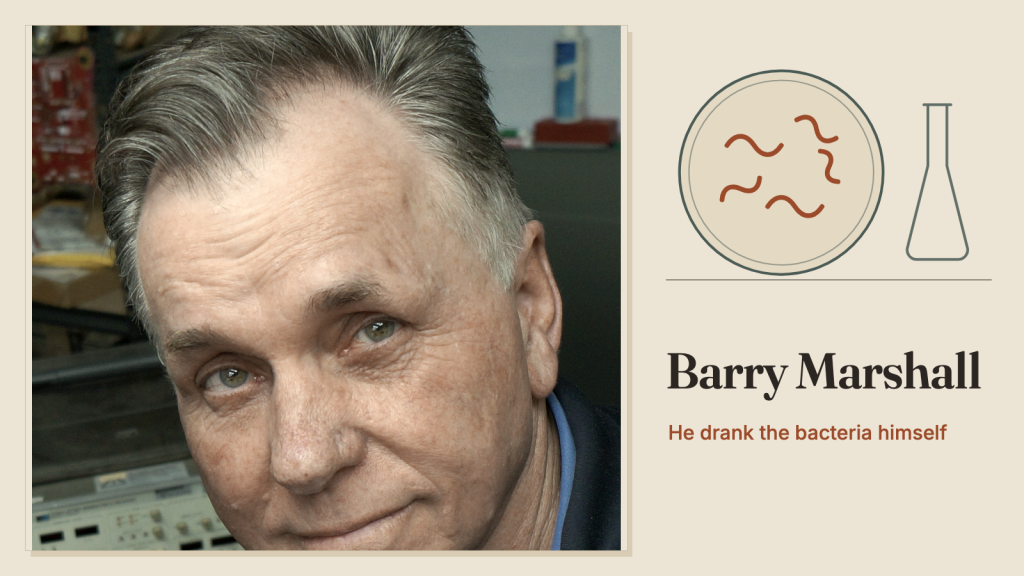
In mid-1984, a doctor in Perth, Australia, drank a liquid made from two culture plates of bacteria.
He had already checked that his own stomach was clean. He had already checked that the strain could be killed with antibiotics. He had not told his wife. He had not told his research partner either.
His name was Barry Marshall. He wanted to show that a bacterium, not stress and not simply excess acid, was behind one of the most common diseases in medicine. The usual retelling says he gave himself an ulcer and proved everyone wrong. That is not what happened. What actually happened is more useful.
A thin blue line nobody wanted to see
The story starts with a pathologist, Robin Warren. In June 1979, looking at a stomach biopsy in Perth, he saw what he later called “a funny-looking thin blue line stuck on the surface of the cells.” They were curved bacteria, living in a place where textbooks said bacteria could not survive. Next to them, he kept finding inflammation.
Few people cared. “Basically no-one believed the work that I was doing,” Warren recalled. “I could show them beautiful pictures of the bacteria and they simply didn’t want to see them.”
The ruling idea had deep roots. “No acid, no ulcer” was a slogan from 1910, and from the 1950s psychological stress became a popular explanation too. Treatment matched the theory: drugs that cut stomach acid. They became a huge business: Tagamet is widely described as the first drug to pass $1 billion in annual sales, in 1986.
Marshall, a younger doctor who heard about the work almost by chance, was the first colleague who took Warren seriously. Warren later said Marshall “was the first person who actually was interested in what I was doing.”
The Easter mistake
For months the pair could not grow the bacteria in the lab. “We couldn’t grow it for eight months or so,” Marshall said.
Then came Easter 1982. A biopsy was taken on the Thursday before the holiday. As Marshall tells it, the technician who should have checked the plate on the Saturday “was too busy.” The plate stayed in the incubator through the long weekend. When the lab came back, colonies had grown. The organism, it turned out, needed more time than the usual routine gave it.
The result went into a 1984 paper in The Lancet. Of 100 consecutive patients examined by gastroscopy, 58 had the curved bacilli. The bacteria were “present in almost all patients with active chronic gastritis, duodenal ulcer, or gastric ulcer,” the authors wrote, and “thus may be an important factor” in causing those diseases.
Note the word may. Association was not proof. To argue cause, Marshall needed the classic test for an infectious agent, known as Koch’s postulates: take the organism from a sick person, put it into a healthy host, and show the disease appears.
He tried animals first. “We could not make the human bacteria infect animals such as rats or pigs,” he said. That left one healthy host he could use without anyone else’s permission.
What he actually did
Marshall prepared like an engineer running a risky test. In early July 1984, a colleague performed an endoscopy that confirmed he was not infected. The bacteria he would swallow came from a patient with gastritis who, Marshall noted, “didn’t actually have an ulcer.” He had confirmed that antibiotics could clear that strain.
Then he drank “a suspension of two culture plates of the organism.”
After five days, he wrote, he felt bloated after evening meals and lost his appetite. “My breath was bad and I vomited clear watery liquid, without acid, each morning at approximately 06:00.” A follow-up endoscopy showed “severe active gastritis.” His stomach had stopped producing acid.
After 14 days he repeated the endoscopy and started antibiotics, “on my wife’s orders!” The biopsy no longer showed the bacteria, so, as he admits, he “might have already had a spontaneous cure.”
Warren had declined the invitation to join in. “I thought it was a daft idea,” he said.
The ending the legend gets wrong
Marshall did not get an ulcer. He got acute gastritis, an inflamed stomach lining, which is what he expected; an ulcer, if it came at all, would have taken much longer. What the experiment showed was narrower and still important: a healthy stomach exposed to this organism became acutely inflamed.
He was so uneasy about the method that the 1985 paper describing it was written in the third person. He was “embarrassed to admit that it was a self-experiment,” he wrote decades later.
The self-experiment also did not win the argument on its own. What changed practice were treatment studies. As the Nobel committee later put it, peptic ulcer disease “can be cured by a short regimen of antibiotics and acid secretion inhibitors.” By Marshall’s own account it took about five years before journals would print the word “cure” for duodenal ulcer, and almost a decade before mainstream American journals accepted the link. In 1994 a US National Institutes of Health consensus panel concluded that ulcer patients with H. pylori “require treatment with antimicrobial agents in addition to antisecretory drugs.”
In 2005, Marshall and Warren shared the Nobel Prize in Physiology or Medicine “for their discovery of the bacterium Helicobacter pylori and its role in gastritis and peptic ulcer disease.” The citation is about the discovery, not the drink.
One more correction: they were not the first to see spiral bacteria in a stomach. Researchers had reported them since the 1890s, and a 1975 report was dismissed as contamination. Their 1984 paper itself says such organisms had been seen and forgotten for decades. Marshall and Warren’s contribution was to culture the bacterium, connect it systematically to disease, and then show that killing it changed outcomes.
The mental model
The story is often told as one brave gulp beating a stubborn establishment. The record shows something more ordinary and more instructive: a careful baseline, a planned exit, a modest claim, and years of slower evidence.
The dramatic test drew attention. The boring tests changed medicine.
So when you are sure an accepted explanation is wrong, ask yourself two questions. What is the smallest experiment that would show I am right? And what evidence would still persuade people who do not trust me?
Sources
- The Nobel Prize in Physiology or Medicine 2005, press release, NobelPrize.org
- B. J. Marshall and J. R. Warren, “Unidentified curved bacilli in the stomach of patients with gastritis and peptic ulceration,” The Lancet, 16 June 1984
- B. J. Marshall and P. C. Adams, “Helicobacter pylori: A Nobel pursuit?,” Canadian Journal of Gastroenterology, 2008
- B. J. Marshall, “Helicobacter pylori: what does it taste like?,” Medical Journal of Australia, 2014
- Interview with Professor Barry Marshall, Australian Academy of Science
- Interview with Dr Robin Warren, Australian Academy of Science
- “The Remarkable Discovery of Helicobacter pylori,” ReachMD interview with Barry Marshall
- G. Watts, “Nobel prize is awarded to doctors who discovered H pylori,” BMJ, 2005
- B. M. Radomski, D. Šešelja and K. Naumann, “Rethinking the history of peptic ulcer disease and its relevance for network epistemology,” History and Philosophy of the Life Sciences, 2021
- V. Kate et al., “Helicobacter pylori Eradication: Our Experience” (summary of the 1994 NIH Consensus Statement)
- Featured image: Dr Barry Marshall, 2005 Nobel laureate. Binarysequence, via Wikimedia Commons, CC BY-SA 4.0
 SIGNAL TITANS
Leave a Reply