
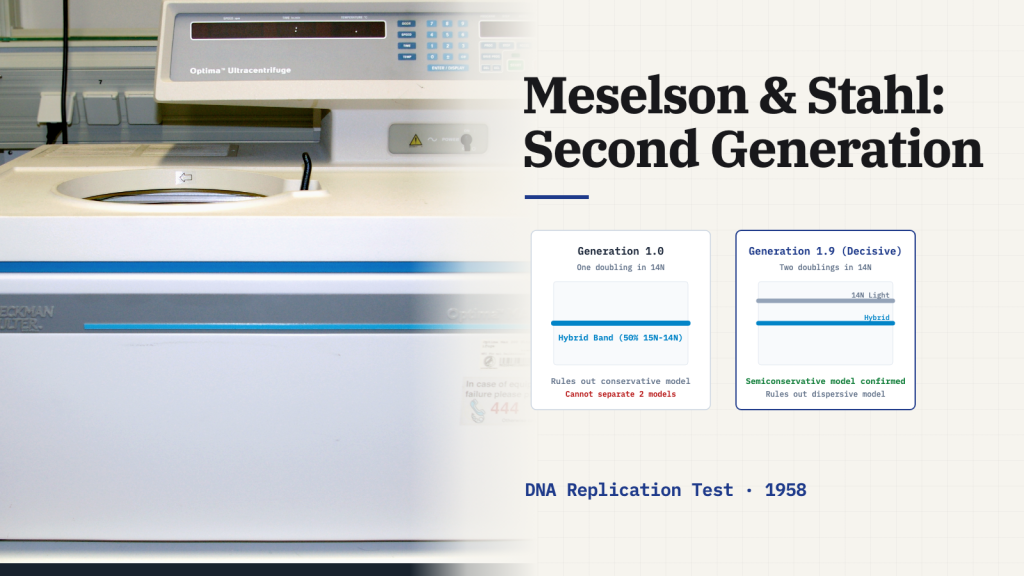
In 1957 at the California Institute of Technology, Matthew Meselson and Franklin Stahl spun bacterial deoxyribonucleic acid (DNA) in an analytical ultracentrifuge at more than forty thousand revolutions per minute, waiting for molecules to settle into clear ultraviolet bands. When the first generation of Escherichia coli grown in ordinary nitrogen finished dividing, a single clean band appeared halfway between heavy and light controls. That result ruled out conservative replication, but on its own it could not distinguish between the remaining two models.
Four years earlier, James Watson and Francis Crick had proposed the double-helix structure of DNA, famously noting that specific base pairing immediately suggested a copying mechanism. Under their semiconservative hypothesis, the two parental strands separate, each serving as a template to direct synthesis of a complementary partner. But two rival models explained the same biological inheritance. In conservative replication, the original parental molecule remains entirely intact while a completely new duplex forms. In dispersive replication, parental material breaks apart and disperses evenly across daughter strands.
The Trap of the First Generation
To test the models, Meselson and Stahl devised an isotope-labeling strategy. They grew E. coli cells for fourteen generations in a medium containing ammonium chloride enriched with nitrogen-15, a stable, heavy isotope of nitrogen. The heavy nitrogen incorporated uniformly into the purine and pyrimidine bases of the bacterial DNA, making it roughly one percent denser than normal DNA containing nitrogen-14.
Next, they abruptly shifted the exponentially growing culture to a medium containing a tenfold excess of ordinary nitrogen-14 ammonium chloride, along with unlabeled ribosides. Any newly synthesized DNA would incorporate the lighter isotope. In density-gradient centrifugation in concentrated cesium chloride (CsCl), centrifugal force drove the DNA toward the bottom of the centrifuge cell while diffusion pushed back, focusing DNA molecules into narrow equilibrium bands at the exact position where solution density matched their buoyant density.
When cells completed one generation in the light medium, the original heavy band vanished. In its place stood a single intermediate band centered at fifty percent between the nitrogen-15 and nitrogen-14 reference positions. This intermediate density immediately eliminated conservative replication, which required two distinct bands—one fully heavy parental duplex and one fully light daughter duplex. But it could not distinguish semiconservative replication from dispersive replication: both models predicted that after one round of copying, every DNA molecule would consist of half heavy nitrogen and half light nitrogen.
The Verdict in the Second Doubling
The decisive test lay in what happened next. Under the dispersive hypothesis, another round of replication in light medium would dilute parental atoms further, shifting the single hybrid band into an even lighter intermediate position. Under the semiconservative hypothesis, each hybrid duplex would separate into one heavy strand and one light strand. The heavy strand would direct synthesis of a light partner, creating a hybrid molecule; the light strand would direct synthesis of another light partner, yielding a purely light molecule. Semiconservative replication predicted two discrete populations: one intermediate hybrid band and one fully light band, appearing in equal proportions.
When Meselson and Stahl sampled bacterial lysates after roughly two generations—recorded at 1.9 generations in their primary experiment—the ultraviolet absorption photographs revealed exactly two sharp bands. One band remained at the hybrid density, and a second band aligned precisely with the nitrogen-14 standard. That was the semiconservative pattern, and it ruled out dispersive replication. By 4.1 generations, the hybrid band persisted with diminishing relative intensity while the light band grew dominant.
Evidence Over Assumption
Meselson and Stahl published their results in the Proceedings of the National Academy of Sciences in July 1958. Their experimental design offers a practical question for researchers and engineers: which observation causes competing explanations to diverge? In this experiment, another generation supplied the answer. The first generation yielded a single intermediate band; the second produced separate intermediate and light bands.
Related stories
Sources
- Matthew Meselson and Franklin W. Stahl, “The Replication of DNA in Escherichia coli,” Proceedings of the National Academy of Sciences, July 15, 1958, 44(7): 671–682
- OpenStax, Biology 2e, Section 14.3: “Basics of DNA Replication,” Rice University, 2018
- Cold Spring Harbor Laboratory DNA Learning Center, “DNA replication,” Animation and Experiment Narrative
- National Human Genome Research Institute (NHGRI), “1958: Semiconservative Replication of DNA,” Online Education Kit, April 2013
- Cold Spring Harbor Laboratory DNA Learning Center, “Matthew Stanley Meselson,” Biography and Historical Context
- Featured image: Matylda Sęk (Cygaretka); Wikimedia Commons; CC BY-SA 3.0 (adapted from the original)
 SIGNAL TITANS

Leave a Reply