
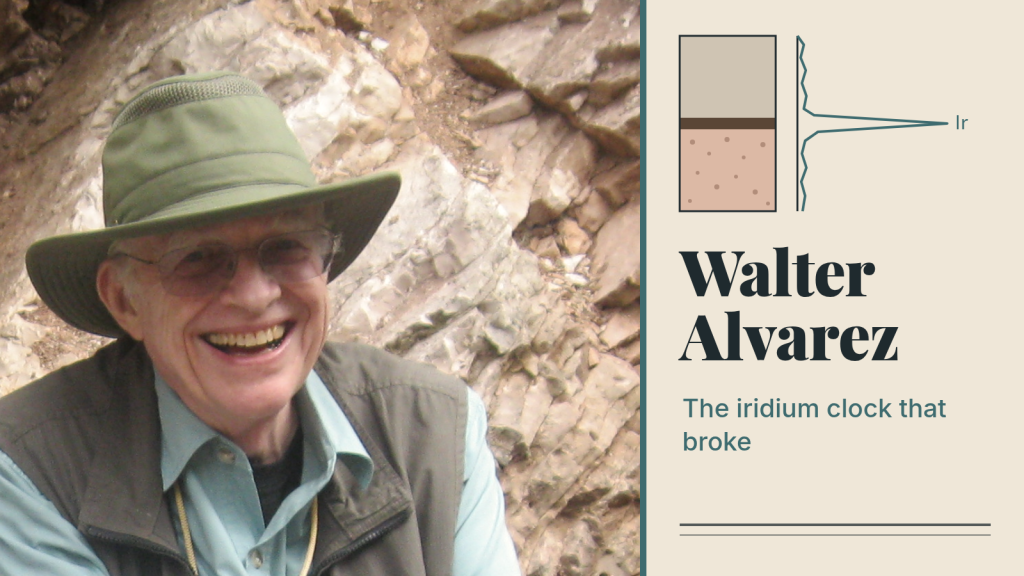
In the late 1970s, geologist Walter Alvarez and his father, physicist Luis Alvarez, tried to use the metal iridium as a clock to time a band of clay in an Italian gorge, and the clock pointed them to an asteroid impact instead.
They were not hunting for whatever killed the dinosaurs. They wanted a number of years.
The clay lies in the Bottaccione Gorge near Gubbio, between two layers of limestone laid down on an ancient sea floor. The limestone below it is crowded with fossils of one kind of foraminifera, tiny single-celled sea organisms. In the clay, Berkeley’s lab magazine reported in 1979, “they are entirely absent.”
The clay band marks the boundary between the Cretaceous and Tertiary periods. The question was how long that clay took to form, and so how long the extinction it records had lasted.
Luis Alvarez, who had won the 1968 Nobel Prize in Physics for work on subatomic particles, proposed the clock. Iridium is rare in Earth’s crust, because most of it is bound up with iron in the planet’s core, but a steady fall of dust from space keeps adding it to the surface.
“Because we know the rate at which extraterrestrial matter rains down on the earth each year,” Luis Alvarez said, measuring iridium in the clay might show “how long a period of time was represented by that clay layer.”
The logic was simple. A layer that formed quickly would collect little space dust; one that formed slowly would collect more. Frank Asaro and Helen Michel, nuclear chemists at Lawrence Berkeley Laboratory, measured iridium and about 30 other elements with neutron activation analysis, a method for detecting very small amounts of an element.
The clock that broke
The answer did not fit the question. The clay held far more iridium than the rock around it. In their 1980 paper, the team reported iridium about 30 times above the background level at Gubbio, about 160 times at a boundary site in Denmark and about 20 times in New Zealand.
Read as a clock, that much iridium said something absurd. If it had all come from the usual rain of space dust, the sea floor would have had to stop collecting sediment for several million years. Walter’s magnetic dating of similar rock samples from Gubbio said otherwise: it “does not show any significant decrease in the sedimentation rate during that period,” Michel told the lab magazine.
So the clock had not measured time. It had recorded an event: a sudden, large delivery of iridium from somewhere beyond Earth.
The first suspect was an exploding star
One early candidate was a nearby supernova. If an exploding star was the source, the clay should also contain plutonium-244, so Asaro and Michel irradiated a sample and looked for it. They got “no signal,” with a method that could have detected one tenth of the expected amount.
The 1980 paper put the conclusion plainly: the iridium was “of extraterrestrial origin, but did not come from a nearby supernova.”
On 6 June 1980, the physicist, the geologist and the two nuclear chemists published “Extraterrestrial Cause for the Cretaceous-Tertiary Extinction” in the journal Science. Their proposal: an asteroid about 10 kilometres across hit Earth, and the debris it threw up shrouded the planet in darkness. Geologists now call that boundary the Cretaceous-Paleogene, or K-Pg, boundary.
Where is the crater?
Many geoscientists and paleontologists resisted the idea. JSTOR Daily, the online magazine of the digital library JSTOR, later described “massive pushback” from paleontologists. One objection, Physics World wrote, kept coming back: where is the crater?
A candidate had in fact been spotted already. In 1978, two years before the paper, geophysicist Glen Penfield was working on an airborne magnetic survey off the Yucatán Peninsula for Pemex, Mexico’s state oil company. He noticed unusual magnetic readings. When he matched them with older gravity maps, they formed what he later called “a shallow, 180-kilometer diameter gravity-magnetic bullseye.”
In 1981, Penfield and Antonio Camargo, his Pemex project supervisor, who was later credited as a co-discoverer, presented their findings at the Society of Exploration Geophysicists meeting in Los Angeles, with the word “crater” left out of the title. By then, Penfield recalled, the iridium work “had the world looking for 200-kilometer-wide craters.”
It took most of another decade to connect Penfield’s bullseye to the iridium layer. In 1990, Alan Hildebrand of the University of Arizona called Penfield. In 1991, Hildebrand, Penfield, Camargo and colleagues proposed in the journal Geology that “a buried 180km-diameter circular structure” on the Yucatán Peninsula was an impact crater, possibly the one from the end of the Cretaceous. It is now known as Chicxulub.
What the record says, and what is still argued
The Alvarezes did not find the crater. Penfield and Camargo found it while working for Pemex, and Hildebrand’s team proposed the link to the boundary in 1991.
Popular accounts can also shrink the credit to one famous name. JSTOR Daily’s 2016 account says the story “starts with physicist Luis Alvarez” and does not name his son, Asaro or Michel. The 1980 paper had four authors, and the iridium measurements behind it were made by Asaro and Michel.
The central claim has held up, though not every part of the story is closed. In 2010, a review by 41 researchers in Science concluded that the Chicxulub impact triggered the mass extinction, while noting that it fell within a long period of volcanic eruptions in India’s Deccan Traps. Two studies published in 2019 still disagreed about when most of that lava erupted relative to the impact, a question that bears on how much the eruptions contributed to the extinction.
The lesson in a broken clock
The iridium measurement failed at the job it was designed for. It could not say how long the clay took to form, because its central assumption, a steady rain of space dust, did not hold for that one layer.
That failure was the discovery. The team did not throw away a reading that made their model say something impossible. They checked it against an independent clock, Walter’s magnetic dating. They found the same anomaly in Denmark and New Zealand, so it was not a quirk of one gorge. And they tested their first suspect, a supernova, with a prediction that could fail, then dropped it when no plutonium-244 showed up.
A number that breaks your model is not always noise; sometimes it is the most important number you have. So before you discard a strange reading in a benchmark, a log or a dashboard, ask which of your assumptions turned it into nonsense.
Related stories
Sources
- “Researchers Uncover First Evidence That Dinosaur Extinction Caused By Asteroid Impact,” LBL News Magazine, Fall 1979 (Berkeley Lab reprint)
- L. W. Alvarez, W. Alvarez, F. Asaro and H. V. Michel, “Extraterrestrial Cause for the Cretaceous-Tertiary Extinction,” Science 208 (6 June 1980), NASA Technical Reports Server record
- Encyclopédie de l’environnement, “The Cretaceous-Paleogene crisis: why looking for iridium?”
- Glen Penfield, “Unlikely Impact,” AAPG Explorer (1 December 2019)
- A. R. Hildebrand et al., “Chicxulub Crater: A possible Cretaceous/Tertiary boundary impact crater on the Yucatán Peninsula, Mexico,” Geology 19(9), 1991
- P. Schulte et al., “The Chicxulub Asteroid Impact and Mass Extinction at the Cretaceous-Paleogene Boundary,” Science 327 (2010)
- Sergio de Régules, “Chicxulub: scientists revisit the crater of doom,” Physics World (19 September 2015)
- James MacDonald, “How We Know What Killed the Dinosaurs,” JSTOR Daily (9 December 2016)
- Carolyn Gramling, “Dueling dates for a huge eruption reignite the debate over dinosaurs’ death,” Science News (21 February 2019)
- NobelPrize.org, “The Nobel Prize in Physics 1968”
- Featured image: Walter Alvarez at the K-Pg boundary in the Bottaccione Gorge near Gubbio, Italy, in 2010, cropped. Photograph by Orangeboxes2, via Wikimedia Commons, CC BY-SA 4.0
 SIGNAL TITANS
_Boundary_at_Bottaccione_Gorge_near_Gubbio_Italy.jpg)
Leave a Reply