
In 1997, the official FAQ (frequently asked questions) page of the Apache HTTP Server explained the project’s name in three short sentences: “A cute name which stuck. Apache is ‘A PAtCHy server’. It was based on some existing code and a series of ‘patch files’.” A year earlier, Apache had become the most used web server in Netcraft’s survey.
The FAQ did not keep that answer. A later version called the pun “more popularly (though incorrectly) accepted.” Today the Apache Software Foundation (ASF), which grew out of the project, says that co-founder Brian Behlendorf first used the name and that the “patchy server” story was a rumor: “rumor became lore, and lore became legend.” Behlendorf traces the name to a documentary about Geronimo, and decades later that account was at the center of objections to the name.
Eight webmasters and a stalled server
In February 1995, the most popular server software on the web was the HTTP daemon that Rob McCool had written at the National Center for Supercomputing Applications (NCSA) at the University of Illinois. Its development “had stalled after Rob left NCSA in mid-1994,” as the Apache project’s history puts it. Webmasters who ran it had written their own extensions and bug fixes, and a small group of them began coordinating those changes, in the form of patches, over email.
Behlendorf and Cliff Skolnick set up a mailing list and logins on a machine in the California Bay Area, with bandwidth donated by HotWired. By the end of February, eight core contributors had formed the Apache Group: Behlendorf, Roy T. Fielding, Rob Hartill, David Robinson, Skolnick, Randy Terbush, Robert S. Thau and Andrew Wilson. Their first public release, version 0.6.2, came out in April 1995: NCSA httpd 1.3 plus the published bug fixes and enhancements they considered worthwhile.
The patchwork phase was short. In mid-1995 the group switched to Thau’s new server base, code-named Shambhala, which had a modular structure, an application programming interface (API) for extensions, pool-based memory allocation and an adaptive pre-forking process model. Pre-forking means starting worker processes before requests arrive, so the server does not have to create a new process for each request. Apache 1.0 was released on December 1, 1995. In Netcraft’s survey of April 1996, which found more than 150,000 servers, Apache and its derivatives held 29%, ahead of NCSA’s 26%.
A pun that fit the first months
The pun worked because it was half true. The early releases really were NCSA’s server plus a stack of patches, and the ASF’s own timeline page still ties the name to those patches: “Hence, initially, the name Apache, as it was ‘a patchy server’. At least, so the legend goes.”
But the same 1997 FAQ that gave the joke as the answer also said, “We now, however, have our own server, and our project is mostly our own.” By then the pun described the project’s first months better than the server it was naming.
How the official answer changed
The FAQ changed in steps. On the last day of 1999, a developer committed an edit with the message “Try and address concerns about the use of the name.” It added a second meaning: for many developers, the name also carried a reverent association with the Apache tribe, described as “well-known for their superior skills in warfare strategy and inexhaustible endurance.”
A later version reversed the order. It opened with the tribe, saying the name “was chosen from respect for the Native American Indian tribe of Apache,” and only then turned to the pun: “Secondarily, and more popularly (though incorrectly) accepted, it’s a considered cute name which stuck.”
The ASF’s history page now credits Behlendorf with first using the name. It says a pun on the name spread as the server grew from patches applied to the NCSA server, “with the rumor being that ‘Apache’ actually stood for ‘a patchy server’.”
Behlendorf’s version
Behlendorf told his story in “Trillions and Trillions Served,” a 2020 documentary about the ASF. As the open source news site FOSS Force transcribed it, he said: “I had just seen a documentary about Geronimo and the last days of a Native American tribe called the Apaches, right, who succumbed to the invasion from the West, from the United States, and they were the last tribe to give up their territory and for me that almost romantically represented what I felt we were doing with this web-server project.” According to The Register, he wanted a name more romantic than a technical term like “spider.”
It is a recollection given about 25 years after the fact. The foundation’s current account gives the same order: the name came first, and the pun followed.
When the tribute became the problem
In January 2023, three members of Natives in Tech, a U.S. nonprofit, asked the ASF to change its name. Citing Behlendorf’s account in the documentary, Adam Recvlohe, Holly Grimm and Desiree Kane called it a “frankly outdated spaghetti-Western ‘romantic’ presentation of a living and vibrant community as dead and gone,” and pointed to the ASF’s own code of conduct, which asks members to be careful in the words they choose. An ASF spokesperson told The Register: “We hear the concerns from the Native American people and are listening.”
On July 18, 2024, the ASF board announced that it would retire the feather logo. The foundation wrote that “it is inappropriate for the Foundation to use Indigenous themes or language,” but that it was “not changing the organization’s name at this time.” A name change, it said, would have “a hefty price tag” and would have to be led almost entirely by volunteers. On September 11, 2025, the ASF introduced its new logo, an oak leaf.
The 2025 announcement also gave a reason specific to software. The ASF wrote that “the implications on the security of the global software supply chain” of moving away from the apache.org domain “are such that a change is not practical to do.” Its projects, it added, would keep their established names “for security concerns and continuity of the software ecosystem.”
What a name costs to change
Netcraft’s July 2026 survey still counted the Apache HTTP Server on 12.10% of active websites. Over three decades, the explanation of its name has been rewritten at least three times, in the project’s own documents, where anyone can read the old versions. The name itself has stayed, partly because it is no longer just a word: it is part of a domain the software supply chain depends on.
A project can rewrite the story behind a name in a single commit. Changing the name, once other people’s systems depend on it, becomes a question of cost and security. Which names in your own systems could you still change, and which already belong to everyone who depends on them?
Related stories
Sources
- The Apache Software Foundation, “About the Apache HTTP Server Project”
- Apache HTTP Server FAQ, revision of 4 May 1997 (ASF’s httpd repository on GitHub)
- Apache HTTP Server FAQ commit, 31 December 1999: “Try and address concerns about the use of the name”
- Apache HTTP Server 1.3 FAQ, later revision (ASF’s httpd repository on GitHub)
- The Apache Software Foundation, “History”
- The Apache Software Foundation, “History Project Timeline”
- The Apache Group, press release on the April 1996 Netcraft survey, 3 April 1996
- “Apache Innovation,” a segment of the documentary “Trillions and Trillions Served” (YouTube)
- Christine Hall, “ASF Retires Indigenous Imagery but Keeps Apache Name, for Now,” FOSS Force, September 2025
- Thomas Claburn, The Register, 11 January 2023, on the Natives in Tech request and the ASF’s response
- The Apache Software Foundation, “Evolving the ASF Brand,” 18 July 2024
- The Apache Software Foundation, “Introducing the ASF’s New Logo,” 11 September 2025
- Netcraft, “July 2026 Web Server Survey,” 27 July 2026
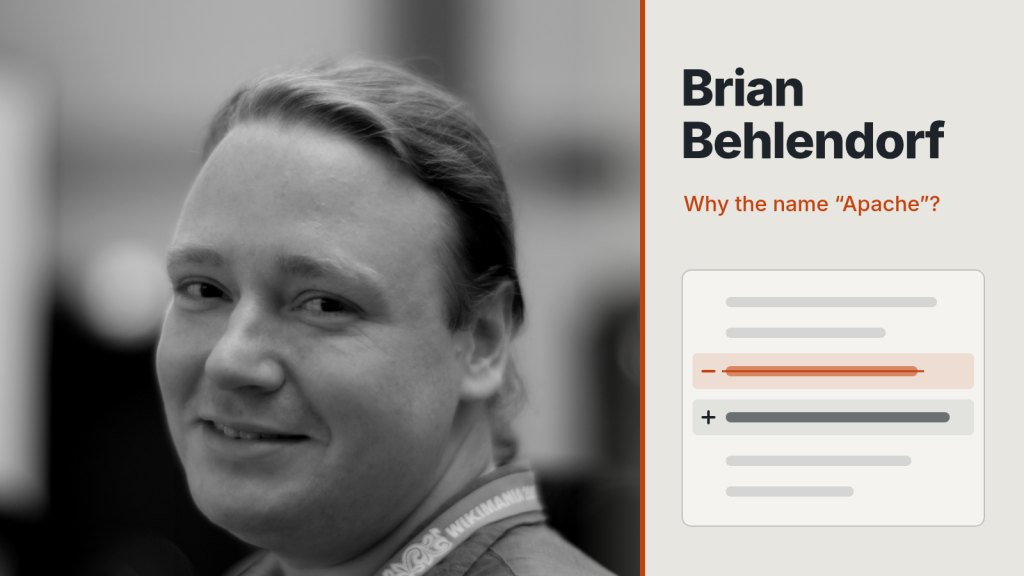
- Featured image: Brian Behlendorf in 2007. Photograph by Joi Ito, via Wikimedia Commons, CC BY 2.0
 SIGNAL TITANS
.jpg)
Leave a Reply