
At the end of 1968, the Defense Department’s Advanced Research Projects Agency selected Bolt Beranek and Newman—a Cambridge firm originally established as an acoustics laboratory—to build the first specialized hardware nodes for the ARPANET. Program manager Larry Roberts had issued a request for proposals in July 1968 to construct Interface Message Processors, which would function as the world's first computer routers. Winning out over larger defense contractors, BBN proposed adapting existing commercial hardware rather than building a dedicated machine from scratch.
Adapting the Minicomputer Frame
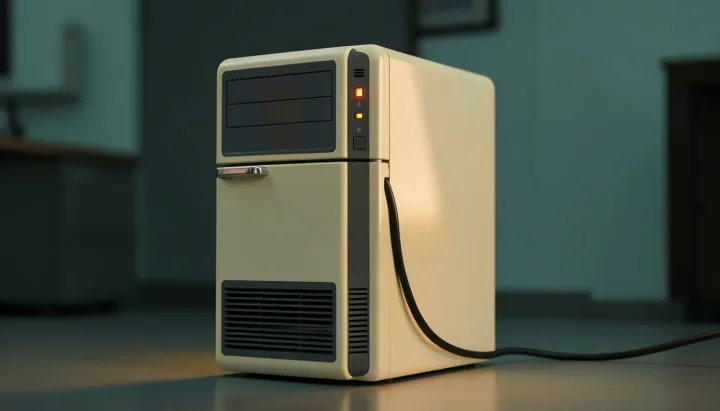
BBN selected the Honeywell 516, a minicomputer roughly the size of a household refrigerator, as the hardware foundation for routing data between disparate host mainframes. Operating on ordinary wall current, the Honeywell machine provided a relatively affordable and reliable platform for packet switching, allowing BBN to focus its design effort on specialized interfaces and custom control software.
Stress-Testing Honeywell's Hardware
Project manager Frank Heart led the engineering effort at BBN, relying on Severo Ornstein as principal hardware architect and Will Crowther to direct software development. Their task was to modify the Honeywell 516 so it could manage high-speed packet routing across an initial four-node network linking UCLA, Stanford Research Institute, UC Santa Barbara, and the University of Utah. Though Honeywell's minicomputer was already established on the market, BBN pushed its internal components to performance levels that exposed previously unknown hardware flaws. The engineering team resolved these subtle flaws under tight deadline pressure, preparing the first completed unit for delivery to California in late summer 1969.
The Loopback Demonstration and the First Crash
The first public demonstration took place in late August 1969 at UCLA. A Scientific Data Systems Sigma 7 mainframe sent a data packet to its freshly delivered IMP, which successfully routed the packet straight back to the host display screen in a loopback test. Two months later, on October 29, 1969, the network attempted its first host-to-host transmission between UCLA and SRI. UCLA programmer Charley Kline sat at a terminal connected to the Sigma 7 and began typing the command 'LOGIN' over a phone link to SRI's SDS 940 computer. Kline successfully sent the letters 'L' and 'O', but the receiving system crashed when he entered the 'G', leaving 'LO' as the network's first recorded inter-host transmission.
From Arbitrary Bits to Universal Addressing
By the early 1970s, the network expanded across the United States, yet traffic remained light because connected systems lacked standard protocols for interpreting data. BBN and academic researchers addressed this by developing higher-level standards like Telnet and File Transfer Protocol. In early 1972, BBN programmer Ray Tomlinson introduced cross-host email, establishing an addressing format that separated a local username from a specific host computer name using the '@' symbol. This single innovation allowed independent computers across the network to identify message recipients without maintaining a single centralized directory.
BBN’s adaptation of standard minicomputers into dedicated network nodes proved that incompatible computer systems could reliably exchange packet-switched data over long distances. By isolating routing tasks inside specialized gateway hardware, the team established the fundamental architectural pattern that continues to direct traffic across modern internet infrastructure.
AI-generated editorial illustration; not a documentary photograph.
Source: A Web Around the World, Part 9: A Network of Networks
 SIGNAL TITANS
Leave a Reply