
The first wave of laptops powered by NVIDIA's new RTX Spark platform has officially begun shipping, introducing a fresh class of high-end Windows devices designed to challenge Apple’s dominance in the creator market. Major manufacturers including ASUS, Dell, HP, Lenovo, Microsoft, and MSI have rolled out new hardware featuring the NVIDIA N1X superchip. Early reviews highlight these machines as genuine MacBook Pro competitors, offering specialized local AI processing and creator-focused performance previously unseen in traditional Windows laptops.
Hardware Specifications and OEM Lineups
The flagship launch of this ecosystem is Microsoft's Surface Laptop Ultra, which starts at $2,599.99 and features a 15-inch Mini-LED display alongside options for up to 128GB of unified memory. According to evaluations from outlets like Windows Central and WIRED, the device adopts a System on a Chip architecture similar to Apple Silicon, bundling the N1X CPU, RTX GPU, and memory together to enable high-speed local AI execution. The N1X is available in an 18-core configuration with 5,120 GPU cores and a 20-core version featuring 6,144 GPU cores, allowing power users to scale memory and graphical throughput depending on their workflow demands. Alongside Microsoft, ASUS has launched the ProArt P14 and P16 duos starting at $2,599.99 and $2,799.99 respectively, while Dell introduced its XPS 16 with RTX Spark starting at $3,799.99. Additional systems include HP's OmniBook series, Lenovo’s Yoga 9n, and MSI’s Prestige N16 Flip AI+, expanding choices across diverse convertible and clamshell form factors.
Analysis: Redefining Windows Performance and Market Strategy
The arrival of the RTX Spark platform marks a pivotal tactical shift in the PC market, directly targeting the long-standing performance-per-watt advantage held by Apple Silicon. For years, Windows manufacturers struggled to scale creator-focused laptops without relying on power-hungry discrete components or sacrificing portability. By integrating a unified memory architecture and robust local AI capabilities into an 80-watt envelope, NVIDIA is attempting to redefine what high-end Windows portables can achieve. Reviewers note that machines like the Surface Laptop Ultra successfully bridge gaps in build quality, display engineering, and local processing speed that previously kept professional creators tethered to macOS. However, this transition also exposes deep structural challenges. Because these platforms rely on Arm-based processing and strict thermal caps, they must navigate software emulation hurdles and battery constraints that do not trouble rival architectures. For enterprise developers, high-end content creators, and local AI experimenters, these laptops represent a compelling step forward, yet they also signal that the ecosystem is still maturing through a transitional phase where software optimization must catch up with pioneering silicon capabilities.
Real-World Limitations and Target Audience
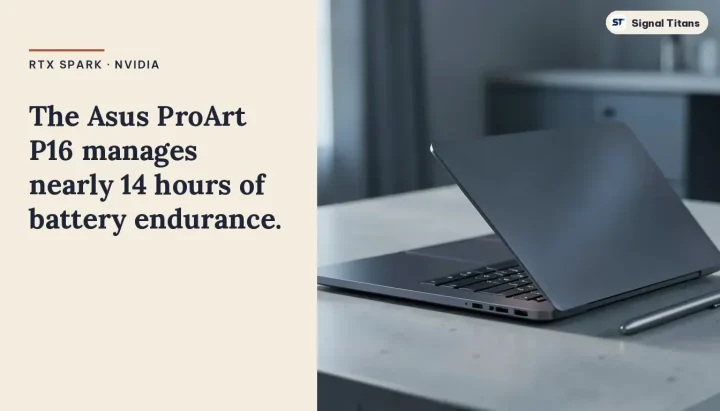
Despite high praise for their raw processing power and stunning displays—such as the Surface Laptop Ultra reaching record-breaking brightness levels with 1,344 dimming zones—reviewers emphasize several material limitations. Battery life remains a primary point of contention; while devices like the Asus ProArt P16 manage nearly 14 hours of endurance, models like Microsoft's flagship struggle to match the longevity of an M-series MacBook Pro during heavy workloads. Furthermore, gaming performance is constrained by the N1X's 80-watt power limit and the reliance on Arm-based app emulation, which results in lower frame rates and compatibility gaps with popular titles. Reviewers also note practical drawbacks such as highly reflective screen coatings and high entry price points across the board, reminding potential buyers that these specialized machines are engineered primarily for developers and professional creators rather than general consumers or casual gamers.
Cover: AI-generated illustration with headline text; not a documentary photograph.
Source: Reviewers say RTX Spark laptops deliver the AI power creators want · Microsoft Surface Laptop Ultra Review: The First Real AI PC | WIRED
 SIGNAL TITANS
Leave a Reply