
Meta has introduced Muse Spark Open, a massive open model featuring 816 billion total parameters, 42 billion active parameters, and an industry-standard one-million-token context window. According to reports, the company positions this release as its leading open-weight offering to date, designed specifically for complex software engineering, coding tasks, and multi-step reasoning workflows.
Model Architecture and Deployment Access
Developers can access the model through multiple major API providers, including Baseten, Fireworks AI, Groq, Modal, Nebius, OpenRouter, and Together AI. Furthermore, because it utilizes open weights, practitioners can download the model files directly from platforms such as Amazon SageMaker AI, Google Cloud Model Garden, Hugging Face, and Microsoft’s Foundry Model Catalog.
Licensing Terms and Commercial Constraints
Despite the availability of open weights, the governing Muse Model License imposes distinct conditions on commercial users. While internal usage, standard product integration, and research remain free, enterprises exceeding $20 million in gross revenue over any consecutive twelve-month period face strict requirements. Specifically, such organizations must notify Meta and secure a separate written agreement prior to offering the model or any derivative works as part of a Model as a Service business. Additionally, developers must prominently display specific attribution text within the user interface of any application utilizing the software, and the usage policy explicitly prohibits military deployments and critical infrastructure applications.
Performance and Benchmark Comparisons
In internal evaluations, Meta reports that Muse Spark Open outperforms competing United States models such as Thinking Machines' Inkling and Nvidia's Nemotron 3 Ultra by significant margins across various test suites. When compared against established Chinese open models like Kimi K3, GLM 5.3, and Qwen3.8, Spark Open takes the lead on agentic and tool-use evaluations, including JobBench and MCP-Atlas, while roughly matching performance on SciCode. However, independent and reported coding benchmarks indicate that it trails behind some competitors in raw programming tasks, scoring lower on Terminal-Bench 2.1 and DeepSWE 1.1 evaluations.
Hardware Demands and Practical Realities
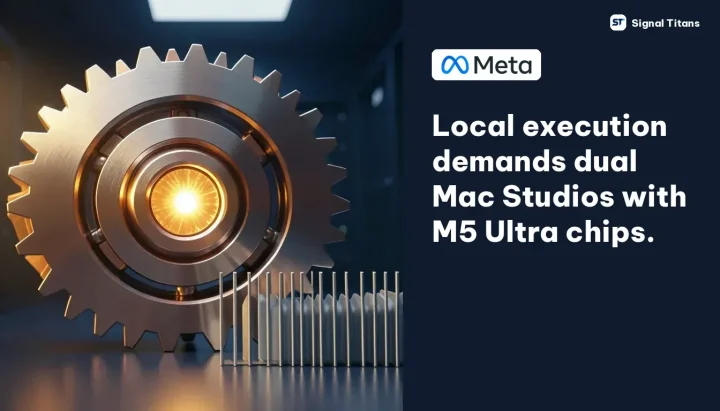
Running an 816-billion parameter model locally presents extreme infrastructure hurdles for typical developer setups. Meta notes that deploying the system locally requires specialized hardware configurations, such as linking dual high-end Mac Studio systems equipped with M5 Ultra chips and 512 GB of unified memory utilizing MLX frameworks. Such hardware requirements place local execution out of reach for standard consumer workstations, restricting extensive on-premise execution primarily to heavily provisioned enterprise environments.
Analysis: Navigating the Competitive Open-Weight Landscape
The launch of Muse Spark Open highlights an evolving strategic shift among major technology laboratories attempting to balance open-source community engagement with protective commercial guardrails. By introducing models of massive scale with semi-open licenses, companies like Meta aim to capture developer mindshare and compete directly with rapidly advancing international alternatives, particularly from Chinese research labs. At the same time, the inclusion of revenue thresholds and prohibitions on specific deployment sectors illustrates a deliberate effort to retain monetization control over large-scale API and service offerings. For enterprise architects and developers, evaluating such models involves weighing raw performance metrics against compliance overhead, user interface attribution mandates, and the substantial compute resources required for inference. While the availability of the model across multiple cloud platforms broadens accessibility, the licensing complexity underscores that open weights no longer guarantee unhindered commercial freedom, forcing organizations to carefully audit their revenue structures and operational use cases before integrating frontier-class architectures into production pipelines.
Cover: AI-generated illustration with headline text; not a documentary photograph. Logo: Meta, via Wikimedia Commons (Public domain).
Source: Meta ships Muse Spark Open, its answer to China’s open-weight models · meta-models/Muse-Spark-Open-816B-A42B · Hugging Face
 SIGNAL TITANS
Leave a Reply