
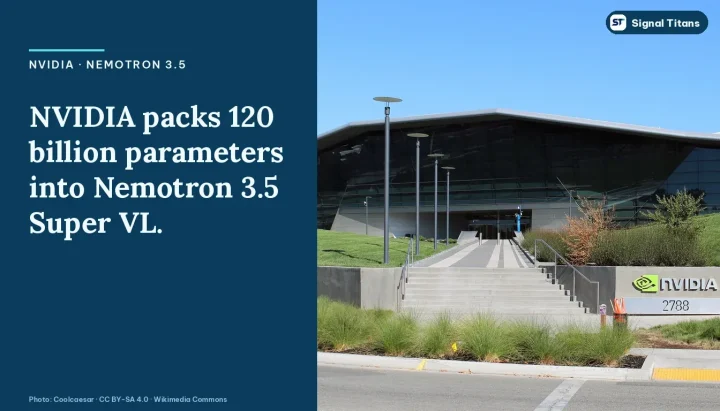
NVIDIA has broadened its open artificial intelligence model portfolio with the introduction of the Nemotron 3.5 Super VL and two specialized edge variants, the Bolt 74B-A9B and Bolt E4B. According to the company announcements, these releases are designed to bridge the gap between heavy enterprise server requirements and local desktop hardware execution. By offering open weights, open datasets, and comprehensive training recipes, the hardware giant aims to provide organizations across various industries with flexible infrastructure for always-on automated agents.
Scaling Multimodal Intelligence for Enterprise Workflows
At the core of the new lineup is Nemotron 3.5 Super VL, a 120-billion-parameter multimodal model built in cooperation with the Nemotron Coalition. The model targets advanced agentic tasks such as complex instruction execution, visual document understanding, and multi-step business workflows. NVIDIA reports that the architecture matches the accuracy of much larger reasoning models while operating at a fraction of the parameter size, enabling faster task completion for high-volume corporate operations. Numerous technology firms, financial institutions, and security companies have already begun post-training the system using proprietary data and custom pipelines. These customized deployments span financial document intelligence, automated code debugging, and cyber defense analysis, utilizing accessible frameworks for fine-tuning.
Bringing Local Agentic Power to Edge Devices
Complementing the larger server-grade model, the new Bolt series scales down intelligence for local hardware environments. The Nemotron 3.5 Bolt 74B-A9B utilizes quantization techniques designed to fit within localized memory constraints on workstation setups. Independent benchmark aggregations corroborate NVIDIA’s framing of its competitive edge; data from PinchBench highlights specific open-weights variants of the model family as achieving top-tier average success rates across standardized coding agent tests in their parameter class, though implementation precisions can vary between benchmark listings and consumer releases. Meanwhile, the smaller Bolt E4B variant targets voice assistants and interactive characters on resource-constrained embedded systems and personal computers.
Analysis: Shifting Control Toward Local and On-Premises Infrastructure
The expansion of the Nemotron ecosystem underscores a broader strategic pivot within the enterprise artificial intelligence landscape: moving away from mandatory cloud centralization toward localized, highly governable execution. For many commercial and public-sector entities, sending sensitive financial documents, proprietary source code, or medical records to external cloud APIs introduces acute data-residency and security vulnerabilities. By delivering models that span from massive data server configurations down to localized desktop hardware, NVIDIA is addressing the pressing demand for enterprise data privacy without forcing a compromise on agentic capability. Organizations can tailor these open-weight frameworks to specific internal policies, creating closed-loop validation systems that continuously scan for fraud, parse credit agreements, or verify semiconductor designs entirely behind corporate firewalls. This shift alters the economics of agentic deployment, allowing institutions to invest heavily in specialized fine-tuning knowing that their operational intellectual property remains under strict local custody. At the same time, the reliance on community-driven tools and standard inference runtimes lowers the barrier to entry, empowering developers to integrate sophisticated multi-turn workflows directly into everyday desktop applications without incurring recurring cloud API overhead.
Cover: Coolcaesar · CC BY-SA 4.0 · Wikimedia Commons. Layout and headline text by Signal Titans.
Source: Open From Data Center to Desktop: NVIDIA Expands Nemotron Family With Highest Efficiency Super VL and Bolt Models · Best Models by Success Rate | PinchBench – OpenClaw Benchmark
 SIGNAL TITANS
Leave a Reply