
Emerging consumer hardware, particularly camera-equipped smartglasses and early humanoid robotics, faces intense public scrutiny and regulatory pushback as critics highlight how these devices are routinely exploited for public harassment and privacy violations, according to recent reports from the Guardian and Tom's Guide.
Meta Connect 2026 and the Missing Apology
During the Meta Connect 2026 keynote, CEO Mark Zuckerberg announced a fresh lineup of hardware, including virtual reality glasses, audio-only smart eyewear, and a pendant housing the new Muse AI system, according to Tom's Guide. However, coverage from both the Guardian and Tom's Guide notes a glaring omission: Zuckerberg did not offer an apology for the widespread harassment linked to camera-equipped smartglasses, which critics have increasingly labeled 'pervert glasses' due to their misuse in public spaces. Tom's Guide points out that this lack of contrition contrasts sharply with other tech industry leaders who have publicly addressed product-related controversies in the past.
Surging Sales Amid Escalating Public Bans
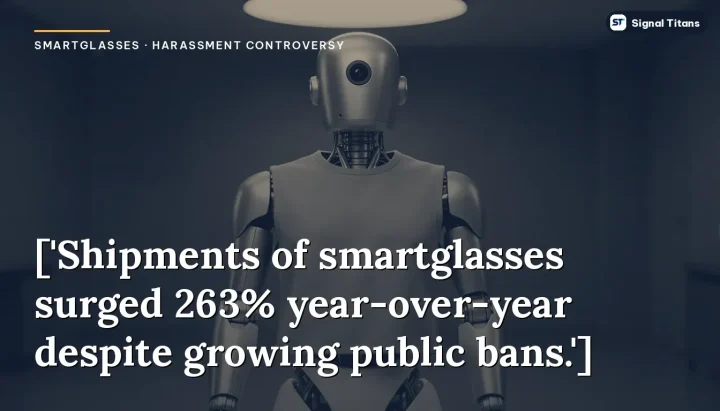
Despite the growing controversy, market data indicates that smartglasses sales are expanding rapidly. Industry reports cited by Tom's Guide show that shipments surged 263% year-over-year in early tracking, with Meta capturing the vast majority of the market and EssilorLuxottica scaling production significantly. Concurrently, public backlash has intensified. Several local governments in Australia have voted to ban smartglasses from public areas, while various restaurants, pubs, and theaters in London consider similar restrictions. Furthermore, Immigration and Customs Enforcement (ICE) has banned its officers from wearing them, and a University of Sydney research paper highlighted how social media influencers frequently use the devices to harass individuals in public settings.
Firmware Fixes and Tampering Rates
In response to privacy concerns, Meta updated its smartglasses firmware to block video recording if the physical LED indicator light is intentionally tampered with or obscured, a measure highlighted by both publications. During an interview, Zuckerberg told journalist Joanna Stern that the proportion of devices bricked due to recording light tampering amounted to less than one-tenth of a percent, translating to several thousand units overall. Earlier in the year, a cottage industry had emerged offering modifications to disable these recording indicators before platform restrictions and firmware countermeasures were deployed.
Emerging Threats in Humanoid Robotics
Beyond wearable cameras, physical robotics is encountering similar ethical and legal challenges. The Guardian reports that police in Cologne, Germany, opened an investigation after two teenage males used a remotely controlled humanoid robot to touch a 16-year-old girl's buttocks and make sexually suggestive gestures, livestreaming the incident online. Local law enforcement officials described the event as entirely unprecedented 'new territory'. While acquiring such technology remains expensive, long-term industry projections from financial institutions anticipate widespread commercial adoption of humanoid robots across industrial and service sectors in the coming decades.
The Governance Gap in Ambient Computing
The rapid commercial expansion of ambient recording devices and autonomous humanoid robotics exposes a critical structural failure in proactive product safety and governance. As major technology firms race to scale consumer adoption—evidenced by soaring hardware shipments and aggressive long-term deployment forecasts—the social costs are disproportionately absorbed by vulnerable members of the public, particularly women targeted in public spaces. When safety protocols rely primarily on reactive firmware patches, consumer-side workarounds, or defensive venue bans rather than robust architectural safeguards, digital harassment easily spills over into physical boundary violations. The widening chasm between corporate growth metrics and local legislative bans signals an urgent need for comprehensive regulatory frameworks. Without genuine manufacturer accountability and forward-looking safety design, emerging consumer technologies risk normalizing digital intrusion and physical harassment as an unavoidable side effect of modern innovation, leaving individuals with few effective avenues for protection or recourse.
Cover: AI-generated illustration with headline text; not a documentary photograph.
Source: Move over, pervert glasses – the latest toxic trend is robogroping · What was missing from Meta Connect 2026? An apology | Tom's Guide
 SIGNAL TITANS
Leave a Reply