
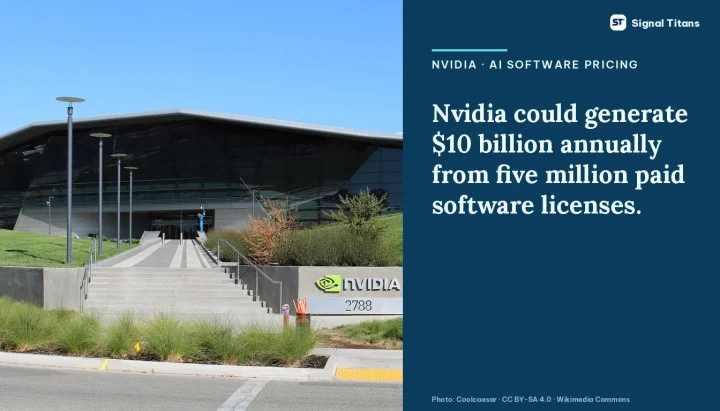
Nvidia is reportedly exploring a new recurring software pricing model that could charge enterprises $2,000 per GPU annually for managing and running autonomous artificial intelligence agents. According to reports from Notebookcheck and Tom's Hardware, Nvidia CEO Jensen Huang outlined the potential fee during an appearance at GTC Berlin on October 22. While the company has not yet confirmed a final pricing structure, specific launch dates, or which exact products the fee would cover, the proposal underscores Nvidia's deepening strategic pivot toward recurring software revenue as enterprise deployments of AI agents scale up.
Potential Pricing Projections and Existing Software Suites
The financial implications of a $2,000 annual per-GPU software fee are substantial, though publications have emphasized that the figures remain illustrative rather than official forecasts. According to calculations highlighted by both sources from FourWeekMBA, securing five million paid licenses at that rate would yield $10 billion annually, totaling $50 billion over a five-year renewal cycle. However, Nvidia has not disclosed how many GPUs might ultimately be eligible for the proposed tier, leaving total potential revenue uncertain.
Furthermore, questions remain regarding how this potential fee would integrate with Nvidia's current commercial offerings. The company already markets its AI Enterprise software platform at a significantly higher rate of $4,500 per GPU for an annual subscription. Both Tom's Hardware and Notebookcheck note that it remains unclear whether the newly discussed $2,000 fee covers overlapping capabilities or an entirely different category of agent-management tools, and neither source treats the lower figure as an official price cut for existing enterprise suites.
OpenShell Reference Architecture and Ecosystem Security
The discussion surrounding agent software pricing arrives closely on the heels of hardware and security framework announcements aimed at enterprise environments. On October 21, Nvidia announced the OpenShell Reference Architecture, a runtime environment engineered to establish strict operational boundaries for autonomous AI agents. The architecture integrates Nvidia’s Vera Rubin computing infrastructure, Vera CPUs, and BlueField-4 data processing units operating alongside Nvidia Sentry. This independent monitoring system can actively quarantine agents that attempt to violate pre-established security parameters.
Ecosystem adoption of these security controls is already taking shape. Tom's Hardware reports that partners are incorporating OpenShell into their respective workflows. Anthropic is integrating the architecture and BlueField hardware with Claude Managed Agents to enhance sandboxed execution safety, while Salesforce has developed a Slack Admin Bridge enabling administrators to monitor agent requests, review permissions, and approve actions directly within Slack.
Strategic Implications of Nvidia's Software Push
The exploration of a per-GPU annual software fee highlights a profound transition in Nvidia’s corporate identity and business model. For years, the market has categorized Nvidia primarily as a hardware titan, supplying the essential high-performance GPUs that fuel the global generative AI boom. However, as enterprises shift from simple chat-based models to complex, autonomous AI agents capable of utilizing tools, accessing sensitive databases, and executing multi-step workflows without human intervention, the demand for sophisticated orchestration and runtime security has surged. By tying software licensing directly to its hardware infrastructure, Nvidia is laying the groundwork for a predictable, high-margin recurring revenue stream that mirrors software-as-a-service models in traditional enterprise technology. This strategy seeks to capture value not only from the initial silicon purchase, but from the entire lifecycle of enterprise AI factories. Jensen Huang himself has signaled this broader evolution, noting in recent podcast remarks cited by Tom's Hardware that people might soon stop categorizing Nvidia strictly as a chip company. As automotive, healthcare, telecommunications, and life sciences sectors increasingly rely on Nvidia's comprehensive technology stacks rather than standalone processors, software licensing will inevitably form the backbone of the company's next growth phase. Nevertheless, until Nvidia clarifies its product packaging and specific licensing terms, enterprises will need to evaluate how these emerging agent frameworks fit into their existing infrastructure budgets.
Cover: Coolcaesar · CC BY-SA 4.0 · Wikimedia Commons. Layout and headline text by Signal Titans.
Source: Nvidia discusses $2,000-per-GPU annual fee for running AI agents · Nvidia discusses $2,000-per-GPU annual fee for software that 'runs agents on AI factories' — details unclear about potential overlaps, firm already charges more than twice that amount for its AI Enter
 SIGNAL TITANS
Leave a Reply