
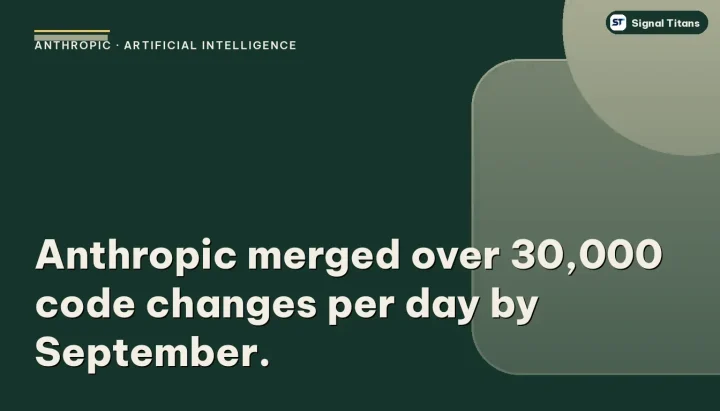
The transition from human-paced deployment schedules to autonomous agentic systems is fundamentally altering software engineering. According to reports covered by The New Stack, engineering velocity has scaled exponentially, with companies like Anthropic jumping from roughly 2,500 merged code changes per day in May to over 30,000 by September. As coding ceases to be the primary constraint, industry attention is shifting rapidly toward the delivery pipeline's capacity to handle thousands of concurrent automated changes.
The Control Loop and the Verification Gap
Engineering leaders analyzing these workflows often view the software factory through a control-engineering lens: intent serves as the setpoint, AI agents act as the controller, and verification functions as the sensor. According to a Q2 2026 report from Faros AI cited in industry analyses, organizations adopting high-gain AI strategies experienced a 66.2% increase in completed epics alongside a 242.7% surge in incidents per pull request, while weekly deployments declined. Without a matching upgrade to the verification sensor, high-speed automated generation risks destabilizing the entire delivery pipeline by shipping unverified or flawed code faster than traditional testing can catch it.
Levels of Autonomy and Dark Factories
To conceptualize this shift, Dan Shapiro’s five-level framework maps AI coding maturity from basic autocomplete up to Level 5—the "dark factory," where specifications go in and fully tested software emerges without human intervention. While most developers currently operate around Level 3 by reviewing daily diffs, advanced organizations are experimenting with radical operational models. For instance, StrongDM gained attention for running engineering teams under rules prohibiting humans from writing or reviewing code, relying instead on a "Digital Twin Universe" of behavioral dependency clones to validate agent output automatically.
Core Properties of an Effective Sensor
Experts emphasize that scaling automation safely requires optimizing three fundamental sensor properties: latency (how quickly the system reports results), fidelity (how closely test readings match real-world dependencies), and bandwidth (the capacity to run concurrent verifications for multiple agents). Cloud-native and distributed microservice architectures complicate this further, as bugs often hide in the interactions between separate services. Building environments that provide high fidelity and sufficient bandwidth without introducing prohibitive latency remains a primary technical hurdle for teams attempting to scale their software factories.
What This Means for the Future of Engineering Teams
The rapid mainstreaming of agentic software factories signals a profound structural transformation for software organizations. As generative AI models make code production virtually instantaneous, the strategic value within engineering departments shifts entirely away from raw line-by-line output and toward harness engineering, architecture, and verification infrastructure. Companies can no longer rely on legacy human-scale CI/CD pipelines or slow staging environments to catch regressions when dozens of AI agents are committing changes simultaneously. This shift directly impacts development teams by redefining developer roles from active coders and diff-reviewers into specification writers and system architects. Furthermore, infrastructure teams face mounting pressure to build advanced testing environments—such as behavioral digital twins or specialized ephemeral clusters—that can match agent velocity without compromising system fidelity. Ultimately, these developments suggest that an organization's ultimate delivery speed will no longer be determined by how fast its AI models can generate code, but by how reliably and quickly its automated sensors can verify it.
Editorial graphic and headline text by Signal Titans.
Source: Building an agentic software factory? Start with the sensor. · What Is a Software Factory? AI and Dark Factories Explained
 SIGNAL TITANS
Leave a Reply