
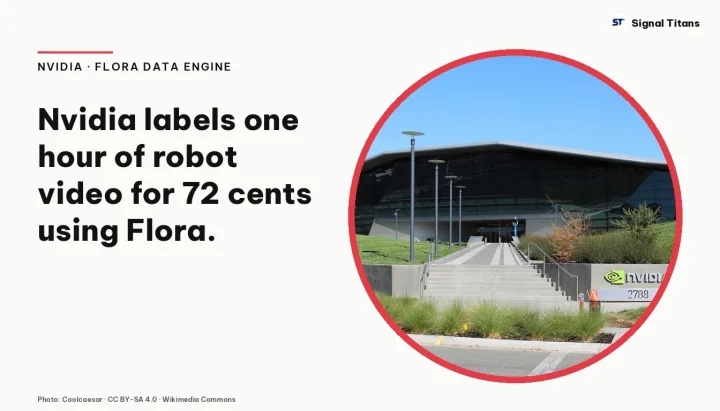
Nvidia's GEAR research lab has officially released Flora, an industrial-strength open data engine designed to streamline and democratize the annotation of robotics training videos. Available now on Hugging Face, the model suite addresses a major bottleneck in the robotics industry: the high cost and labor intensity of generating comprehensive training labels. According to Nvidia and technical documentation from the research team, Flora is already deployed in production environments to train GR00T models, handling massive annotation workloads at scale.
Underlying Architecture and Tri-Layer Annotations
Training large robotics foundation models requires three distinct types of data annotations: action descriptions for pretraining data selection, step-by-step progress ratings for reinforcement learning, and outcome judgments for deployment monitoring. Most existing pipelines address only a single category, while general-purpose frontier models remain prohibitively expensive for large volumes. Flora resolves this by utilizing a suite of three fine-tuned Qwen3.5 models. A 9B parameter model segments videos into distinct action timestamps, while a 27B model generates detailed descriptions incorporating temporal context. A secondary 27B model, designated Flora-Rewarder, dynamically shifts roles based on prompts to evaluate episode success on a one-to-five scale, classify half-second execution steps, and score performance against custom rubrics.
Benchmark Performance and Comparative Trade-Offs
Independent evaluations and Nvidia's internal benchmarks highlight mixed strengths when comparing Flora against proprietary alternatives like GPT-6 Astra and Gemini 3.8 Flash. On public benchmarks such as WGO-Bench, Flora excels primarily in temporal localization and detecting action boundaries, achieving state-of-the-art scores in specific captioning metrics. Furthermore, on RoboRewardBench, Flora demonstrates a significantly lower error rate than Astra in identifying mid-episode failures, successfully catching partial task completions that competing models often miss. However, testing also reveals methodological nuances and trade-offs; while Flora excels at boundary detection and error catch rates, competing commercial systems occasionally deliver more precise qualitative descriptions or higher trajectory-ranking scores.
Production Scale and Projected Cost Reductions
A cornerstone of Nvidia's announcement is the dramatic reduction in annotation expenses. Nvidia projects that labeling one hour of robot video costs approximately 72 cents using Flora, compared to an estimated $88.50 with GPT-6 Astra and around $42 with Claude Opus 5. Nevertheless, the company acknowledges that these specific cost figures represent financial projections derived from an assumed rental rate of $10 per GPU per hour, rather than direct production measurements. At an operational level, the data engine has proven its industrial robustness, reportedly annotating up to 200,000 hours of video daily across a cluster of 512 GB300 GPUs during active GR00T model training cycles.
Strategic Implications for the Robotics Ecosystem
The introduction and open-source release of Flora mark a significant strategic maneuver by Nvidia to solidify its dominance across the entire robotics value chain. By addressing the severe shortage of structured robotics training data—a persistent hurdle that has historically slowed physical AI development—Nvidia provides academic researchers and commercial developers with an industrial-grade tool to scale custom datasets. This release directly challenges proprietary commercial data services, such as Scale AI's Physical AI Data Engine, and positions Nvidia's ecosystem as a comprehensive solution spanning hardware accelerators, simulation pipelines, data engines, and foundation models like GR00T. As competitors like Google introduce similar automated video-parsing workflows, the availability of open data engines lowers the financial barrier to entry for robotics research. Ultimately, by open-sourcing infrastructure that cuts annotation costs by orders of magnitude, Nvidia aims to accelerate the deployment of physical AI systems while simultaneously driving long-term enterprise demand for its high-performance hardware architecture.
Cover: Coolcaesar · CC BY-SA 4.0 · Wikimedia Commons. Layout and headline text by Signal Titans.
Source: Nvidia open-sources Flora to make robot video labeling 125x cheaper than GPT-6 Astra · Flora: An Open Model Suite for Scaling Robotics Data Engines
 SIGNAL TITANS
Leave a Reply