

During his 22-orbit flight aboard the Faith 7 capsule in May 1963, L. Gordon Cooper Jr. reported looking out his window from 100 miles above Earth and spotting individual vehicles on dirt roads, smoke-belching trains, and house roofs below. Vision experts doubted his claims, calculating that human eyes could not discern objects smaller than 150 feet across from orbital altitude. Some psychiatrists even speculated that microgravity was causing astronauts to suffer from visual hallucinations.
The Orbital Hallucination Hypothesis
During his Mercury-Atlas 9 flight in May 1963, Cooper captured 29 color photographs using a 70mm camera while observing Earth. According to NASA historical records, his reports of spotting a white automobile kicking up dust near the U.S.-Mexico border met widespread skepticism. Optical experts assumed that individuals with standard 20/20 vision could not distinguish ground features below the 150-foot threshold from 100 miles up, even though Cooper reportedly possessed 20/12 vision. As noted in Air Force and Space Digest, this skepticism led some psychiatrists to speculate that weightlessness was impairing cognitive function and inducing sensory hallucinations in early Mercury spacefarers.
Constructing Terrestrial Eye Charts in Texas and Australia
To evaluate astronaut vision scientifically, NASA developed visual acuity experiments deployed on the Gemini V and Gemini VII missions in 1965. The plan relied on dual testing: an onboard optical device and massive terrestrial eye charts. NASA engaged the Dow Chemical Corporation to manufacture large white rectangular panels measuring between 150 and 600 feet in length. Technicians arranged these stark white targets against dark tilled soil at two ground stations: one in Laredo, Texas, and another near Carnarvon, Australia. In orbit, astronauts evaluated their vision using a binocular-like instrument called the In-Flight Vision Tester, identifying the directional orientation of small rectangular patterns presented at varying contrast levels.
Testing Vision from Orbit
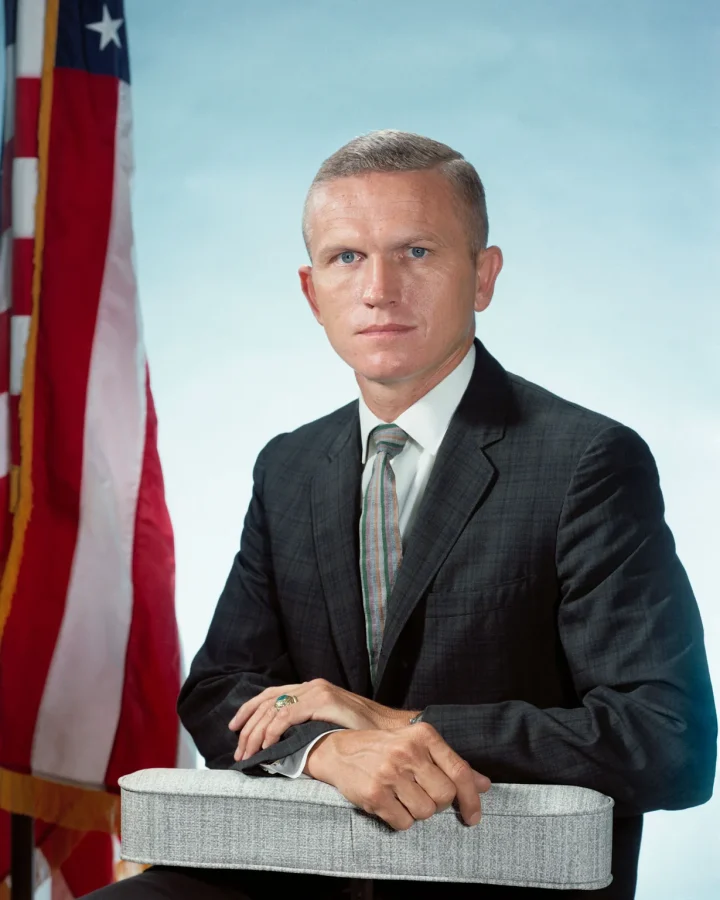
During the Gemini V flight in August 1965, Cooper and pilot Charles "Pete" Conrad Jr. conducted vision tests while tracking ground targets. In December 1965, Gemini VII command pilot Frank Borman continued the testing across a two-week spaceflight. Although scattered sunlight on spacecraft windows, heavy cloud cover, and unfavorable pass angles frequently obscured ground views, astronauts on both missions repeatedly identified the orientation of the Laredo rectangles from orbit. The combined measurements proved that visual acuity did not degrade during two-week missions and confirmed that astronauts could indeed resolve fine surface details like roads, buildings, and ship wakes.
From Visual Proof to Earth Observation Satellites
Proving that the human eye could reliably perceive fine surface details from space transformed orbital observations into a catalyst for planetary remote sensing. Validating astronaut vision motivated NASA, the U.S. Geological Survey, the Office of Naval Research, and the U.S. Department of Agriculture to advocate for spaceborne instruments capable of inventorying crops, mapping geological features, and monitoring oceans. These findings directly accelerated the development of the Earth Resources Technology Satellite, launched by NASA in 1972 and later renamed Landsat 1, initiating the modern era of satellite Earth monitoring.
Cover: AI-generated editorial illustration; not a documentary photograph.
Source: The View from Above: The Gemini Visual Acuity Experiments
 SIGNAL TITANS
Leave a Reply