

In April 1930, twelve science-fiction writers and enthusiasts gathered in a basement Manhattan speakeasy over Italian food and Prohibition wine to debate how human beings might reach the moon. Among them was G. Edward Pendray, the science editor for the New York Herald Tribune who also authored science fiction under the pen name Gawain Edwards. By the end of their evening, the group resolved to organize their informal network into the American Interplanetary Society.
A Basement Speakeasy and Kitchen Engineering
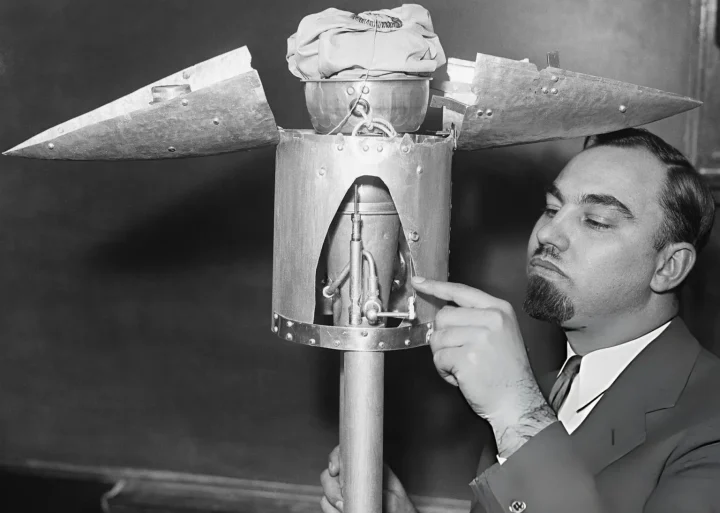
Pendray and his wife, Lee, turned their domestic spaces into early experimental hubs. Lacking corporate funding or academic research facilities, the society’s members assembled their first liquid-fuel vehicles from accessible consumer hardware. Working alongside fellow rocketeer Hugh Franklin Pierce in a residential kitchen and a basement machine shop, the team built custom rocket assemblies from modified utensils. Pierce machined a metal cocktail shaker to serve as the liquid-cooling jacket surrounding the rocket motor, while a small stainless-steel saucepan was repurposed as a nose cone, designed to split apart at peak altitude and deploy a recovery parachute sewn by Lee Pendray.
Lessons from Germany and Staten Island Flight
Seeking technical guidance after facing skepticism from American institutions, the Pendrays traveled to Europe in the spring of 1931. In Germany, they met key figures of the German Rocket Society, including cofounder Willy Ley and a nineteen-year-old Wernher von Braun. Observing working liquid-fuel engine tests provided Pendray with technical insights that directly informed the American Interplanetary Society's initial flight attempts.
Returning to New York, the team constructed the AIS 1. In November 1931, they conducted a ground test on a farm in Lambertville, New Jersey. Mountings held the vehicle while its motor generated 60 pounds of thrust, though the rocket dropped before a free flight could take place. The group incorporated lessons from the test into their next iteration, the seven-foot AIS 2. On May 14, 1933, the craft was launched from Great Kills on Staten Island. Filmed by newsreel cameras, the rocket reached an altitude of 76 meters in two seconds before its oxygen tank burst, dropping the hull into New York Bay, where spectators in a rowboat recovered the fragments.
From Interplanetary Dreams to Industrial Public Relations
By 1934, as member interest shifted away from purely lunar goals toward military and industrial applications, the group renamed itself the American Rocket Society. Pendray’s career adapted alongside the field; in 1936, he established the public relations department at the Westinghouse Electric & Manufacturing Company.
During a summer vacation in 1938, Pendray devised a major corporate initiative for the upcoming 1939 New York World’s Fair. To capture public interest and position Westinghouse against industrial competitors, he proposed burying a sealed, rocket-shaped vessel containing representative artifacts of contemporary society for observers thousands of years in the future.
A Five-Thousand-Year Payload in Cupaloy
On September 23, 1938, the Westinghouse Time Capsule was lowered into a shaft 50 feet deep beneath the fairgrounds in Queens, New York, designated for unsealing in the year 6939. The seven-foot housing was manufactured from Cupaloy, a specialized alloy of copper, chromium, and silver engineered in Westinghouse laboratories to match the mechanical strength of steel while resisting corrosion. Engineers evacuated moisture, filled the interior cylinder with inert nitrogen gas, and sealed the envelope.
The payload comprised a broad cross-section of 1930s technology and culture: seeds, newsreel clips, a microscope, a plastic Mickey Mouse cup, a message written by Albert Einstein, and microfilmed records encompassing ten million words across one thousand pictures and books.
The twin projects of Pendray's early career—amateur liquid-fuel rocketry and the 5,000-year Westinghouse Time Capsule—established a blueprint for translating speculative aerospace concepts into organized research and enduring public messaging. By connecting raw amateur experimentation with corporate communications, Pendray helped steer early rocketry out of basement speakeasies and into the modern industrial era.
Cover: AI-generated editorial illustration; not a documentary photograph.
Source: Distillations magazine
Ed Pendray and the Science of Tomorrow
 SIGNAL TITANS
_by_ACME.jpg)
Leave a Reply