
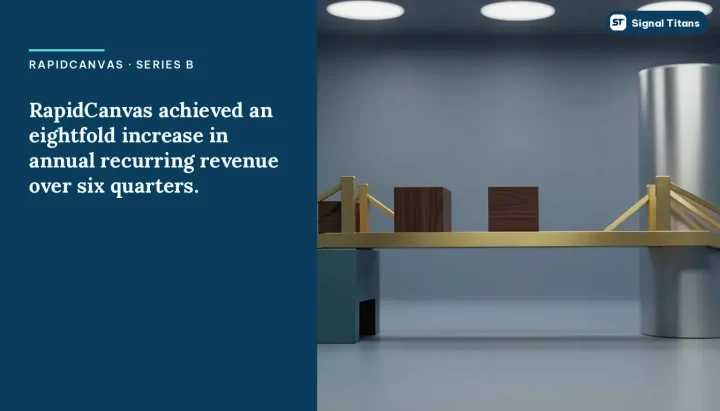
Enterprise AI startup RapidCanvas has closed a $29 million Series B funding round to expand its operations and scale its managed deployment platform. According to reports from TechStartups, RapidCanvas, and Unite.AI, the financing brings the Austin, Texas-based company's total funding to $52.5 million. The investment round was led by Vertex Ventures Southeast Asia & India alongside Hitachi Ventures, with continued participation from existing backers including Accel, Peak XV Partners, Valley Capital Partners, and Titanium Ventures.
Targeting the Mid-Market AI Bottleneck
RapidCanvas focuses on businesses generating between $100 million and $10 billion in annual revenue, a segment that often struggles to transition from experimental AI pilots to production environments. According to the company's announcements cited across the sources, these mid-market enterprises typically possess dedicated AI budgets and executive mandates but lack both the massive capital required for traditional consulting firms and the specialized internal engineering teams needed for custom development. To address this friction, RapidCanvas employs what it terms a Hybrid Approach, combining subscription-based software tools with dedicated field AI engineers who work alongside client teams to build and maintain operational workflows.
Platform Architecture and Technical Infrastructure
The underlying technology stack integrates three core components designed to manage institutional data and application lifecycles. The Enterprise Context Engine gathers and structures business processes, decision histories, metric definitions, and validation patterns unique to each organization. Meanwhile, the Visual Development Canvas enables engineers to construct custom applications using pre-built components. RapidCanvas claims that its proprietary skills library provides new projects with a 60-percent head start based on benchmarked code, though this metric originates from internal company figures rather than independent testing. Finally, the Operational Harness provides governance, role-based access controls, audit logs, and performance monitoring for applications deployed in production environments.
Rapid Growth and International Expansion
The fresh capital infusion arrives on the heels of significant commercial momentum. The company reported an eightfold increase in annual recurring revenue over the preceding six quarters, with more than 40 percent of its customer base operating multiple AI applications in production. Data provided for 2026 indicates that over 75 enterprises across sectors such as manufacturing, financial services, retail, and infrastructure have utilized RapidCanvas applications to execute 1.4 million AI-driven decisions. Leadership intends to deploy the Series B funds toward expanding its go-to-market teams, strengthening partnerships with private equity and advisory networks, and growing its field engineering footprint across the United States, Brazil, and India.
Navigating the Shift from Pilots to Production
The commercial trajectory of RapidCanvas highlights a broader transition occurring across the enterprise technology landscape, where businesses face mounting pressure to demonstrate tangible financial returns on AI investments within short timeframes. While widespread interest in generative tools and automated workflows has lowered the barrier to experimentation, translating proofs-of-concept into reliable, secure production systems remains a persistent operational hurdle. By blending software automation with high-touch human engineering, RapidCanvas attempts to bridge the gap between expensive bespoke consulting and rigid do-it-yourself platforms. However, this hybrid model introduces a fundamental economic question regarding scalability. Traditional services-heavy delivery models often struggle to maintain high profit margins as customer volume increases, whereas pure software businesses benefit from zero marginal costs. For mid-market enterprises evaluating this approach, the core consideration will be whether the platform's reusable components can sufficiently compound over time to reduce delivery friction, or if human-led implementation will remain a structural bottleneck. As investors like Hitachi Ventures note, the ultimate success of enterprise AI will depend on the economics of delivering measurable outcomes at scale, making RapidCanvas's ability to automate its deployment playbook a critical test for the managed execution sector.
Cover: AI-generated illustration with headline text; not a documentary photograph.
Source: RapidCanvas raises $29M Series B to bring Fortune 100-grade AI to every enterprise · RapidCanvas Raises $29M Series B to Bring Fortune 100-Grade AI to Every Enterprise | RapidCanvas · RapidCanvas Raises $29M Series B to Scale Enterprise AI Delivery
 SIGNAL TITANS
Leave a Reply