
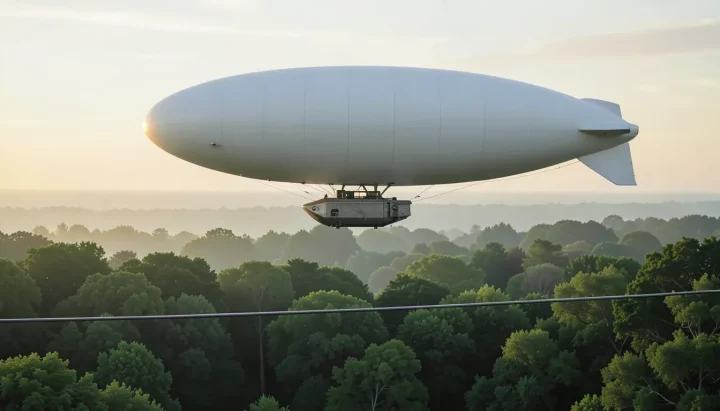
French startup HyLight has successfully secured €13 million in a new funding round to scale its autonomous, hydrogen-powered airship fleet designed for inspecting critical infrastructure. According to reporting from EU-Startups and official company materials, the round was led by Rubio Impact Ventures, DRW, and Teampact Ventures, with continued participation from existing backers Y Combinator and Ring Capital. Founded in 2022 by Martin Bocken, Josef Rokusek, and Thomas Laporte, the young enterprise aims to replace carbon-heavy helicopter missions with a zero-emission alternative for monitoring power lines, gas pipelines, and railways across Europe.
Fleet Technology and Multi-Sensor Software Integration
The core innovation centers on a 12-meter-long hydrogen airship capable of flying for up to ten hours with a targeted range of 350 kilometers. According to EU-Startups, the aircraft operates with zero direct emissions and low noise levels, carrying up to 10 kilograms of advanced payload instruments. These include LiDAR systems, optical cameras, and methane detectors. Official company documentation on HyLight's platform details that the onboard hardware is paired with a specialized dashboard that transforms raw aerial captures into real-time data processing, AI-assisted anomaly detection, and 3D reconstructions.
Furthermore, both sources highlight the vehicle's regulatory clearance and connectivity features. While EU-Startups notes authorization from the French civil aviation authority (DGAC) and the European Union Aviation Safety Agency (EASA) for beyond visual line of sight (BVLOS) operations, company disclosures emphasize that these flights are supported by robust remote control links combining radio frequency, LTE, and satellite connectivity. This technological stack allows the airships to navigate sensitive rural, suburban, and urban environments reliably, including flights over the Palace of Versailles.
Scaling Operations and Expanding Across Europe
With the newly acquired capital, HyLight plans to scale its industrial footprint rapidly. The company is currently transitioning from operating four aircraft to targeting a simultaneous active fleet of 15 airships by 2027. This industrialization includes bringing a new production facility online and internalizing the manufacturing of strategic components. To support this growth, the startup intends to recruit 50 new employees spanning engineering, artificial intelligence, data science, regulatory affairs, and business development.
Geographically, HyLight is setting its sights on broader European expansion, identifying Germany and the Netherlands as immediate priority markets. The startup has already established a foothold by conducting operational missions for major European infrastructure operators such as Enedis, NaTran, Téréga, VINCI, and SNCF Réseau. These missions focus on monitoring network integrity, detecting structural defects, and identifying vegetation risks or methane leaks before they escalate into major outages.
Why Autonomous Hydrogen Airships Represent a Shift for Critical Infrastructure
The €13 million investment into HyLight highlights a growing industry pressure to modernize how society maintains aging power grids, pipelines, and transport corridors. For decades, infrastructure inspection has relied heavily on manned helicopters—a method that remains expensive, noisy, and environmentally taxing, emitting up to one metric ton of CO₂e per flight hour. As climate change pressures, stricter environmental regulations, and an aging workforce converge globally, traditional inspection methods are increasingly falling short of demand. While fixed-wing drones often lack the necessary flight endurance and satellites lack microscopic precision, hydrogen airships occupy a unique middle ground combining long-range endurance with millimeter-level data collection.
For network operators and utility companies, this shift promises significant cost reductions, enhanced safety in densely populated regions, and proactive maintenance that catches faults before they turn into costly leaks or catastrophic failures. By combining aeronautical engineering with automated AI data pipelines, HyLight is not just building aircraft; it is creating a continuously updated digital twin of Europe's physical backbone. This creates downstream implications for sectors far beyond energy, including insurance, agriculture, and public land management, signaling a broader transition toward clean, data-driven industrial monitoring.
AI-generated editorial illustration; not a documentary photograph.
Source: HyLight raises €13 million for its autonomous airships inspecting Europe’s critical infrastructure · HyLight | Zero-Emission Aerial Inspection
 SIGNAL TITANS
Leave a Reply