
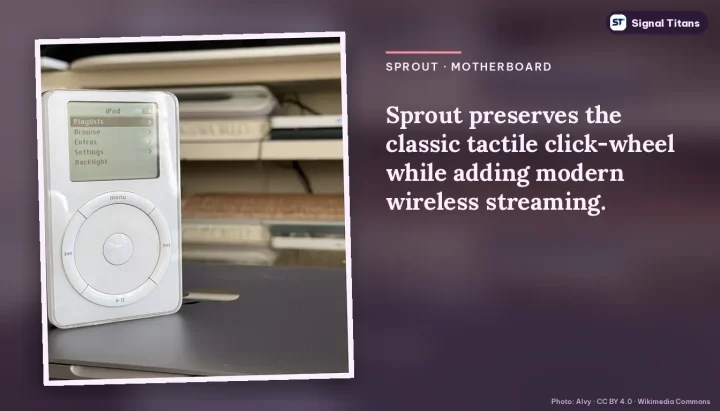
A retro tech project is developing a replacement motherboard designed to bring vintage click-wheel digital audio players into the modern era without altering their classic aesthetic. According to reports from Cult of Mac and the Crowd Supply campaign page, the initiative—named Sprout—replaces the original logic board of select legacy devices to introduce contemporary hardware capabilities such as Bluetooth, Wi-Fi, and USB-C connectivity.
Preserving Iconic Hardware While Upgrading Core Components
Unlike traditional retro modifications that typically swap out aging mechanical hard drives for flash storage or install larger batteries, Sprout takes a much more comprehensive approach. According to both sources, the replacement circuit board drops directly into third-generation, fourth-generation, and iPod mini models. Because the logic board is the only major internal component swapped out, the original outer case, screen, and mechanical click-wheel remain completely intact, allowing the device to maintain its classic look and tactile feel.
Beneath the familiar exterior, the Sprout mainboard introduces significant hardware enhancements. The system integrates a high-fidelity digital-to-analog converter to improve audio quality for wired headphones, alongside Bluetooth connectivity for wireless accessories like AirPods. Furthermore, a modern USB-C port handles device charging and drag-and-drop file transfers for local music libraries. Users can also expand their storage capacity significantly, with support for microSD cards up to 2TB, replacing the original internal storage limitations entirely.
Two Distinct Versions Powered by Custom Software
The project is offered in two distinct configurations tailored to different user preferences, both built around the Raspberry Pi RP2350 microcontroller chip. The base model, known as Sprout Pico, is engineered for instant power-on performance, focusing exclusively on playing locally stored music collections and downloaded podcasts. Meanwhile, the step-up Sprout Pi model incorporates an additional Raspberry Pi Compute Module Zero. This extra processing hardware enables advanced capabilities, including streaming audio from services like Spotify and Apple Music, running third-party apps, and syncing podcasts directly over a wireless network.
To manage this upgraded hardware, the development studio designed entirely new software and firmware from scratch. According to project documentation, the custom runtime is engineered to replicate the look and feel of the original device interface, including navigation features like Cover Flow, integrated search functions, and podcast menus. However, developers note that streaming proofs of concept rely on platform APIs that frequently change, meaning specific streaming integrations are still under active development and could evolve prior to the official commercial release.
Open-Source Commitment, Pricing, and Availability
Transparency is a major focus for the development team, with plans to make Sprout a fully open-source hardware and software project. According to Crowd Supply and developer disclosures, schematics, board layouts, and bills of materials will be published on GitHub under the CERN-OHL-S v2 license before the campaign concludes. Firmware and runtime components will use the MPL-2.0 license, while documentation and reverse-engineering notes are set for a Creative Commons CC BY 4.0 release. At present, an official launch date and retail price remain unannounced, though prospective buyers can sign up on Crowd Supply for campaign alerts.
Bridging Nostalgia and Modern Convenience
The emergence of projects like Sprout highlights a growing counter-trend against smartphone saturation, where consumers increasingly seek out single-purpose electronic devices free from notifications, social media distractions, and constant connectivity. By targeting older legacy models—specifically the third-generation, fourth-generation, and mini variants that traditionally receive less attention from hardware modders—the creators have identified an underserved market segment. These specific legacy units are often more affordable to purchase secondhand, presenting a viable economic pathway for retro enthusiasts looking for a daily-use media player.
Developer and commentator Parker Ortolani noted that such an ambitious overhaul could be an obvious choice for retro fans, provided it delivers on its technical promises. Achieving these targets involves overcoming notable engineering hurdles, particularly regarding battery efficiency and dynamic streaming APIs. The studio's prototype testing targets up to 40 hours of continuous Bluetooth playback on the larger legacy models using a 2,500mAh cell, and roughly 20 hours on the mini. If successful, this open-source motherboard could redefine how vintage consumer electronics are restored, successfully merging mid-2000s hardware nostalgia with modern wireless expectations without forcing users to abandon their preferred headphones or streaming ecosystems.
Cover: Alvy · CC BY 4.0 · Wikimedia Commons. Layout and headline text by Signal Titans.
Source: Sprout iPod motherboard brings Bluetooth and Wi-Fi to old models · Sprout Pi Mainboard | Crowd Supply
 SIGNAL TITANS
Leave a Reply