
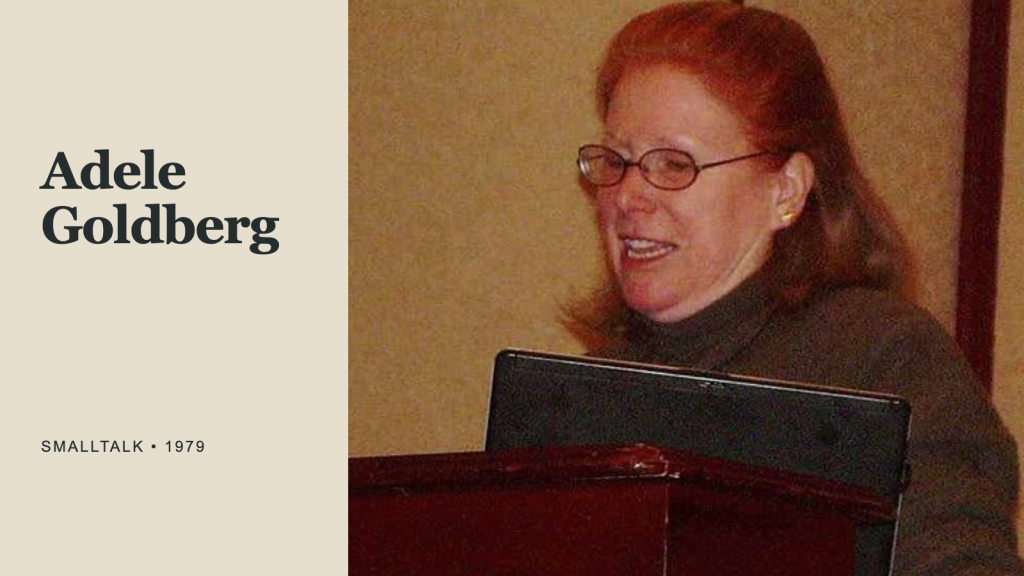
In 1979, Apple engineers were invited to see work at Xerox’s Palo Alto Research Center. One of the people responsible for that work did not want to give the demonstration. Her objection was overruled.
Adele Goldberg helped develop Smalltalk, a programming language and interactive computing environment that made software feel radically different from the command-driven systems familiar to many users. According to historical accounts, Goldberg resisted showing it to visitors from Apple, but Xerox management decided otherwise. The episode is often retold as the moment Xerox gave away the future of personal computing. That version is memorable, but it hides a much richer story.
The visit mattered. So did the years of engineering that preceded it, the decisions made by Apple’s own teams afterward, and the Smalltalk ideas that traveled well beyond any one product.
What the visitors were actually seeing
Smalltalk was not simply another programming language with a different set of commands. At PARC, its developers explored a computing environment built around interacting objects, visible graphical elements, and the ability to change a program while using it. The machine was not merely following instructions on a remote batch-processing schedule. It was becoming a medium in which a person could experiment and immediately see results.
The project emerged from Alan Kay’s vision of personal, approachable computing and was realized through contributions from Dan Ingalls, Adele Goldberg, and many other colleagues. Goldberg played important roles in the system’s development, its documentation and explanation, and making its concepts accessible to others. Calling Smalltalk the invention of one person would erase the collective nature of the research.
In a period when computers were expensive and interfaces often demanded specialized knowledge, a responsive graphical environment suggested a broader audience. Researchers could create windows, manipulate visual elements, and build applications with tools that were themselves part of the environment. The significance was not one attractive screen. It was an entire approach to making software.
Why Goldberg objected
The 1979 demonstration took place within a business relationship involving Xerox and Apple. Accounts of the visit describe Goldberg as reluctant to share Smalltalk with Apple’s representatives; executives at Xerox instructed her to proceed. Steve Jobs was among the Apple visitors who became interested in PARC’s graphical work.
Goldberg’s concern makes sense when considered from a researcher’s perspective. A working demonstration condenses years of experiments into a brief, persuasive encounter. Viewers may not receive the source code or the design notes, yet they can absorb the organizing ideas and take them into a new project. That can be precisely what a commercial laboratory needs to think about before opening its doors.
From management’s perspective, however, showing advanced research might strengthen a strategic relationship. The same demonstration could be valued as proprietary know-how by its makers and as a business opportunity by its owners. These motivations are not interchangeable, and the people who built a system do not always control the decisions about who sees it.
Influence is not the same as copying
It is misleading to imagine that Apple engineers simply carried a finished Xerox computer back to their office and renamed it. Apple’s Lisa and Macintosh involved extensive work by Apple teams, different engineering constraints, other influences, and decisions of their own. Seeing a convincing prototype can redirect a design effort without making the resulting product a literal copy of the prototype.
The famous PARC story also blends several lines of research: graphical user interfaces, pointing devices, networking, document creation, and programming environments. Smalltalk was connected to that ecosystem, but it was not identical to every technology the visitors saw. Separating these strands makes the history more accurate and gives credit to the people who worked on each of them.
Even the familiar question of why Xerox did not become the dominant personal-computer company has no single technical answer. Research strength, product strategy, manufacturing, distribution, timing, and organizational priorities are different capabilities. A laboratory can establish that a new way of computing is possible without being positioned to sell millions of machines based on it.
The work that outlived the visit
Smalltalk’s influence spread through object-oriented programming, live development environments, and teaching. Its model encouraged programmers to think about software as communicating objects within systems that could be inspected and altered. Subsequent languages and tools borrowed ideas in different ways, sometimes explicitly and sometimes through several generations of influence.
Goldberg’s contribution cannot be reduced to a moment of resistance. She helped shape and communicate a sophisticated technical environment. Documentation and education are particularly important in experimental computing: a system that only its creators can understand is less likely to change how other people work.
The project also reveals the difference between showing and transferring knowledge. A demonstration may make an idea seem obvious, yet turning it into reliable software remains difficult. Apple still had to build products. Smalltalk’s own community still had to develop languages, implementations, and techniques. The decisions of one afternoon did not complete either task.
A useful question for today’s builders
Research teams still face a version of Goldberg’s dilemma. A prototype can attract investment, customers, collaborators, and talented new colleagues. The same prototype can reveal the concept that gives a team its advantage. Legal agreements may govern access to source material or confidential details, but the broad insight delivered by a compelling demonstration is harder to contain.
Keeping every idea secret is not a universal solution: ideas improve when others test them, challenge them, and find unexpected applications. Showing everything without discussion is not a universal solution either. A responsible decision depends on what is disclosed, who may use it, and what the team hopes to gain.
The lasting question in Goldberg’s story is not simply who saw Smalltalk first. It is who gets to decide when painstaking research becomes an idea available for someone else to build upon. The answer has consequences for scientists, engineers, managers, and anyone whose work can be understood in a single unforgettable demonstration.
Sources
- Computer History Museum — Adele Goldberg
- Computer History Museum — Personal computing history
- Computer History Museum — Smalltalk history
- Computer History Museum — Smalltalk at 50
- Computer History Museum — Making Smalltalk
- Photograph: Terry Hancock, CC BY-SA 2.5
 SIGNAL TITANS
.jpg)
Leave a Reply