
According to data published by the European Commission, a significant share of European small and mid-sized enterprises (SMEs) and mid-caps are transitioning from initial experimentation to practical workplace integration of artificial intelligence and algorithmic management systems. The findings derive from Flash Eurobarometer 3696, which gathered first-party evidence from 12,826 business leaders across all 27 EU member states during fieldwork conducted in March and April 2026, targeting privately owned companies employing between one and 749 staff members.
Current Adoption Patterns and Human Oversight
The survey reports that 42 percent of surveyed European businesses already utilize artificial intelligence or automated management tools, while an additional 21 percent intend to adopt them in the near future. However, the European Commission notes that these deployments are frequently limited and experimental rather than deeply embedded across entire corporate structures. The primary reported application is customer service and customer relations at 47 percent, followed by performance and productivity monitoring at 36 percent, and logistics, planning, or staff scheduling at 30 percent.
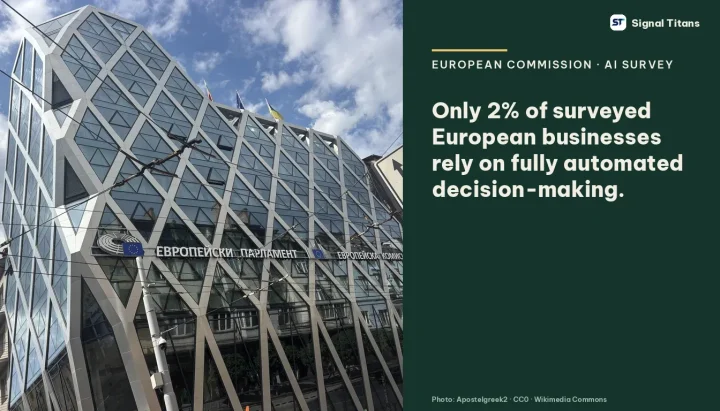
Crucially, the data challenges the assumption that workplace automation removes human judgment entirely. While 61 percent of respondents indicate that AI assists their company in decision-making processes, 90 percent emphasize that human staff retain ultimate authority over final choices. Fully automated decision-making accounts for only 2 percent of reported cases.
Major Barriers Slowing Workplace Implementation
Despite rising adoption figures, widespread implementation continues to face distinct obstacles. The Eurobarometer identifies four closely grouped barriers that temper corporate enthusiasm. High investment costs are cited by 50 percent of respondents, while legal uncertainty and a lack of trust in artificial intelligence for staff-related decisions each affect 49 percent of businesses. Furthermore, 48 percent point to an internal lack of specialized expertise as a limiting factor.
These challenges illustrate why initial interest does not automatically translate into comprehensive organizational rollouts. Companies must weigh these friction points against anticipated workplace benefits, such as the 75 percent of surveyed employers who express a positive expectation that algorithmic tools will improve overall job quality—comprising 16 percent with a very positive outlook and 59 percent with a rather positive view.
Context, Implications, and Strategic Implementation
The findings of Flash Eurobarometer 3696 carry broad implications for business leaders, policymakers, and software developers operating within the European Union. By capturing empirical data across thousands of enterprises, the survey moves past speculative industry estimates to reveal a nuanced corporate reality. Organizations are not pursuing abstract technological overhauls; instead, they are selectively deploying algorithmic management tools to resolve specific operational bottlenecks, such as handling customer inquiries or managing complex staff schedules.
For enterprise leadership and IT strategists, the low rate of fully automated decision-making underscores that accountability remains firmly human. This dynamic intersects directly with active regulatory frameworks, including the European Union's AI Act and the proposed Quality Jobs Act, signaling that compliance and transparency are inseparable from successful deployment. For SMEs constrained by high costs and a lack of in-house expertise, the path forward relies on narrow pilot scopes, rigorous baseline tracking, and clearly defined human review points rather than sweeping organizational transformations. Ultimately, bridging the gap between current experimentation and sustained operational value requires aligning tool selection with measurable friction points while actively managing legal and trust uncertainties before deployment.
Cover: Apostelgreek2 · CC0 · Wikimedia Commons. Layout and headline text by Signal Titans.
Source: EU Survey Finds 42% of SMEs Use AI, but Trust and Cost Still Shape Adoption · EU Survey: 42% of SMEs Use AI and Algorithmic Management
 SIGNAL TITANS
Leave a Reply