
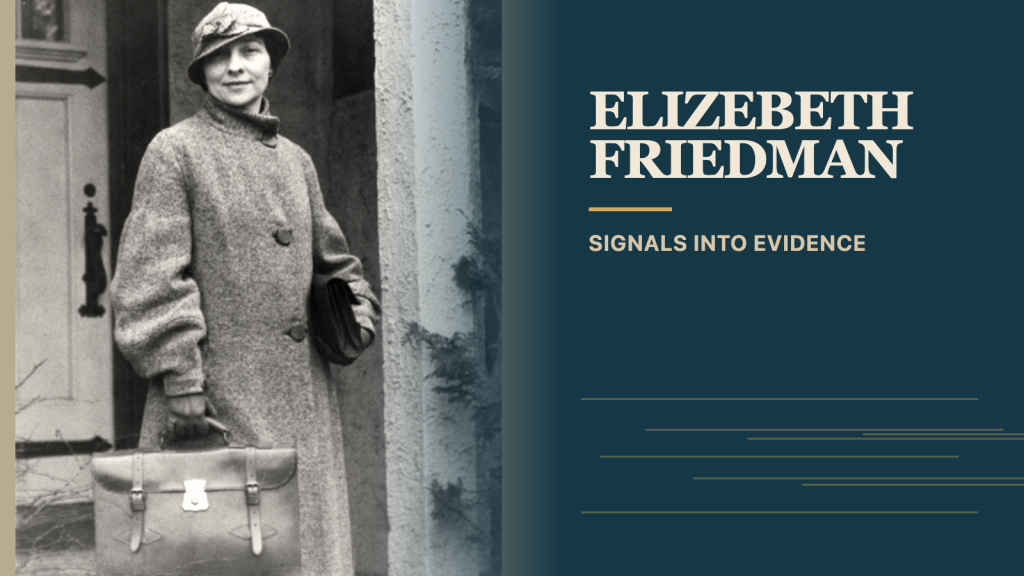
During Prohibition, smugglers had a technology problem that looked like an advantage.
Radio let rum-running ships and shore stations coordinate across long distances. Codes and ciphers were supposed to make those messages useless to anyone listening. But the U.S. government had Elizebeth Smith Friedman, a cryptanalyst who could turn intercepted strings of letters into operational information — and, just as importantly, into evidence that could survive a courtroom challenge.
Her work is often summarized with one dramatic number: during the Prohibition era, Friedman and the small cryptanalytic effort around her solved about 12,000 coded messages. The more interesting story is how that capability was built. She did not merely crack puzzles. She helped create a repeatable process for collecting communications, analyzing them, connecting them to real-world movements and teaching others to do the same.
Her route into cryptanalysis began with Shakespeare
Friedman did not set out to become a federal codebreaker. In 1916 she joined Riverbank Laboratories in Illinois, where one of the institution’s unusual research projects involved claims that secret ciphers in Shakespeare’s works could prove Francis Bacon was the real author. Riverbank also became an early American center for serious study of codes and ciphers.
There she met William Friedman, whom she later married. Both developed deep expertise in cryptanalysis, but Elizebeth’s career was not simply an appendix to her husband’s. The National Security Agency’s historical profile notes that she introduced him to the field and built a substantial record of her own.
In the 1920s she moved into government work involving the encrypted radio traffic of smugglers. Prohibition had created a large illegal market for alcohol, and ships offshore used radio to arrange cargo transfers, fuel, rendezvous points and movements toward the coast. Interception alone was not enough. A message that looked like random groups of letters had to be reconstructed into language, connected to a sender and then fitted into a larger pattern of activity.
Breaking the message was only half the job
Cryptanalysis can sound like a contest between a clever code maker and a clever codebreaker. Friedman’s work shows why real intelligence work is less romantic and more demanding.
The Coast Guard and Treasury needed analysis that could guide enforcement. A decrypted message might identify a ship, a location, a delivery schedule or a relationship among operators. But enforcement agencies also had to show how they knew what the message meant. Friedman became an expert witness, explaining methods in court while defense lawyers challenged the government’s interpretations.
A Smithsonian account of one major prosecution describes the problem clearly: the government had to connect defendants to hundreds or thousands of encrypted messages moving among ships, shore stations and headquarters. The value of the codebreaking was not that it produced an elegant plaintext sentence. The value was that it helped turn scattered radio traffic into a chain of evidence.
NSA and Coast Guard histories credit Friedman and her colleagues with solving roughly 12,000 rum-runner messages and supporting hundreds of prosecutions. Those numbers matter, but they also reveal a scaling problem. No single analyst could remain the only person capable of doing the work.
She built a capability, not just a collection of clever solutions
As the volume and difficulty of traffic increased, Friedman pushed for a dedicated cryptanalytic unit and trained additional analysts. NSA’s historical account says that by 1931 she had helped convince Congress of the need for a headquarters section with seven people. Teaching others the fundamentals let routine cases move through the system while she focused on unfamiliar or more resistant ciphers.
That choice is easy to underestimate. A specialist who keeps every difficult task personally can look indispensable while quietly becoming a bottleneck. Friedman did the opposite. She converted individual expertise into organizational capacity.
The tools were basic by modern standards. Her teams did not have searchable databases, automated pattern detection or modern computers. They worked from intercepted radio traffic, paper records, frequency counts, repeated patterns, operator habits and accumulated knowledge of the networks they were studying. The advantage came from disciplined method and context as much as from mathematical ingenuity.
Codebreaking changed operations because it connected signals to action
The Prohibition campaign also shows how intelligence becomes useful only when several systems connect. Radio operators had to intercept traffic. Analysts had to identify the cipher system. Investigators had to compare decoded details with ships, people and movements. Prosecutors then had to explain the chain convincingly enough for a court.
Friedman stood unusually close to all of those layers. She analyzed messages, organized a team, supported enforcement and testified about the work. Later she also handled other federal cryptanalytic assignments, including work against international smuggling and wartime targets. Her career eventually became important enough that the NSA inducted her into its Cryptologic Hall of Honor.
Yet for many years her public reputation lagged behind the significance of the work. Classification, institutional habits and the greater fame of William Friedman’s military cryptologic career all helped obscure her role. Declassified histories have made the operational record easier to see.
The lasting lesson is about turning expertise into a system
Friedman’s story is not only about being unusually good at solving ciphers. It is about what she did after she became good at it.
She connected analysis to evidence. She documented methods well enough to defend them. She trained other people. She helped create a dedicated unit instead of allowing critical knowledge to remain concentrated in one person’s head.
That pattern applies far beyond cryptography. A breakthrough by one expert is fragile. A process that can collect inputs, test interpretations, train successors and produce results that outsiders can verify is infrastructure.
Rum runners tried to gain an advantage by making their radio traffic unreadable. Friedman’s answer was not one brilliant solution. It was a working system for making the unreadable usable.
Sources
- National Security Agency — Elizebeth S. Friedman
- National Security Agency — Pioneering Codebreaker Elizebeth Friedman Honored by U.S. Coast Guard
- U.S. Coast Guard Historian’s Office — Mrs. Friedman, the Coast Guard’s Cryptologist-in-Charge
- Smithsonian Magazine — The Coast Guard’s Most Potent Weapon During Prohibition?
- National Security Agency — Listening to the Rumrunners
- Featured portrait — Elizebeth Smith Friedman via Wikimedia Commons; U.S. Government public domain.
 SIGNAL TITANS
Leave a Reply