
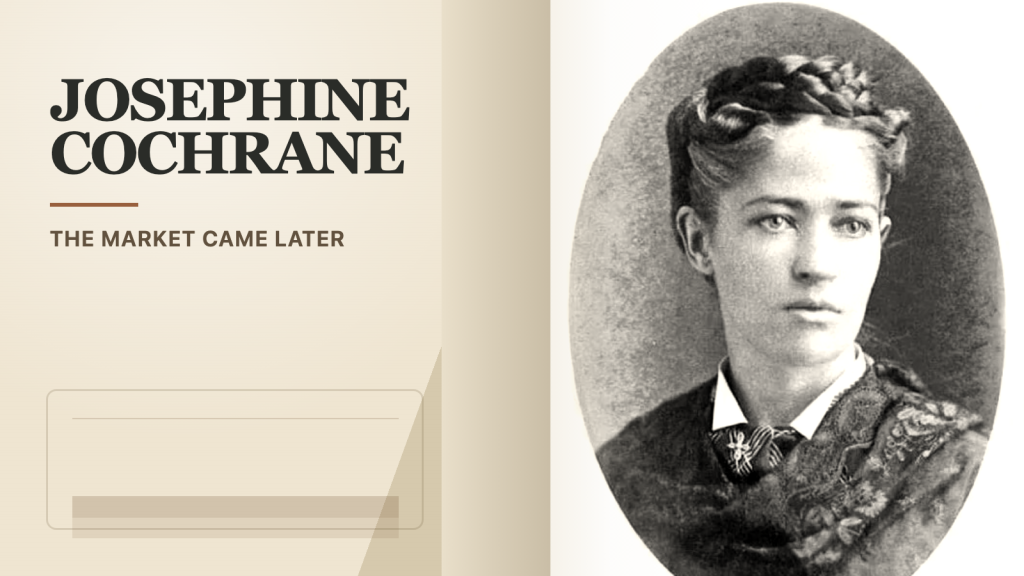
Josephine Cochran had a machine that worked decades before most homes were ready to buy it.
In 1886, she received a U.S. patent for a dish-washing machine that held plates and cups in fitted wire racks while water pressure did the cleaning. Earlier inventors had tried mechanical dishwashers, but Cochran’s design was practical enough to become a business. The surprise came after the engineering problem was solved: the best early customers were not ordinary households.
Hotels, restaurants, hospitals and other institutions made more sense. They washed large quantities of dishes, breakage cost money, and they were more likely to have the hot-water capacity and staff needed to run an expensive machine. Cochran had not merely invented an appliance. She had run into a second problem: a product can work before the surrounding system is ready for it.
The machine solved a real mechanical problem
Accounts of Cochran’s life often begin with chipped china. She entertained frequently in Shelbyville, Illinois, and later descriptions say she became frustrated when dishes were damaged during washing. Whatever weight one gives that origin story, the technical problem was concrete. Dishes had to be held securely while being cleaned without hand scrubbing.
Cochran measured plates, cups and saucers and designed wire compartments to hold them in place. Those compartments sat inside a wheel within a boiler. A motor turned the mechanism while hot soapy water was pumped over the dishes. The important design shift was not simply “washing by machine.” Her system used racks to control the position of fragile objects and water pressure to clean them, rather than relying on scrubbers rubbing directly against the china.
She worked with a mechanic, George Butters, while developing the prototype. She filed her first patent as “J. G. Cochran” in 1885, and U.S. Patent No. 355,139 was granted on December 28, 1886. By then she also had a business reason to make the idea succeed. Her husband had died in 1883, leaving debts, and an invention that could be sold was more than a household convenience.
A working invention met an unready home
The easy version of an invention story ends when the prototype works. Cochran’s story becomes more useful at exactly that point.
A dishwasher in the late nineteenth century depended on more than the dishwasher itself. It needed a supply of hot water, space, plumbing, money for a costly machine and a reason to replace familiar labor. Many homes did not have the infrastructure or budget to make that trade attractive. National Inventors Hall of Fame accounts note that early domestic machines could cost hundreds of dollars, while household hot-water systems often could not supply what the machines required.
That did not mean the invention had failed. It meant the first viable market was elsewhere. In 1887, according to the U.S. Patent and Trademark Office’s history of Cochran, she sold a machine to Chicago’s Palmer House hotel. Hotels and restaurants had a much clearer economic case: high dish volume, repeated labor, expensive breakage and centralized kitchens. Hospitals and colleges also became customers.
At the 1893 World’s Columbian Exposition in Chicago, Cochran’s machine won recognition for its mechanical construction, durability and suitability for the work. Publicity helped, but it still did not turn the dishwasher into an immediate mass-market household product.
She changed the customer before the technology around her changed
Cochran did not wait for every home to become ready. She built a company around customers who already had the conditions her machine needed.
That is an important distinction. When a product fails to spread, the defect may be inside the product — but it may also be in the environment around it. Electricity, plumbing, roads, batteries, broadband, payment rails and regulations have all played the same role for later technologies. An invention can be technically sound and still arrive before its supporting system.
Cochran kept improving the machine, selling it and supervising installations. Her company eventually became associated with the business that would become part of KitchenAid. Household adoption came much later. By the 1950s, more homes had adequate hot water, better detergents were available and domestic expectations had changed. Only then did the dishwasher become a normal home appliance rather than mainly a commercial tool.
The useful lesson is to diagnose the missing layer
When something good does not sell, the first conclusion is often that the idea was wrong. Cochran’s experience suggests a more precise question: what has to be true around the product for the product to be useful?
For her dishwasher, the missing layers included hot-water capacity, affordability and household infrastructure. Instead of pretending those constraints did not exist, she found buyers for whom they were less restrictive.
That is a practical product lesson more than an inspirational one. Separate the invention from its ecosystem. If users are not ready, ask whether the product is wrong, the timing is wrong, or the first customer segment is wrong. Sometimes the best evidence that an idea works is not mass adoption. It is a smaller group of customers for whom the surrounding conditions already make the value obvious.
Sources
- U.S. Patent and Trademark Office — “I’ll do it myself”
- National Inventors Hall of Fame — Josephine Garis Cochran
- Lemelson-MIT — Josephine Cochrane
- Smithsonian Magazine — This Time-Saving Patent Paved the Way for the Modern Dishwasher
- Wisconsin Historical Society — Early Electric Dishwasher
- Featured portrait — Josephine Garis Cochrane via Wikimedia Commons; public domain.
 SIGNAL TITANS
Leave a Reply