
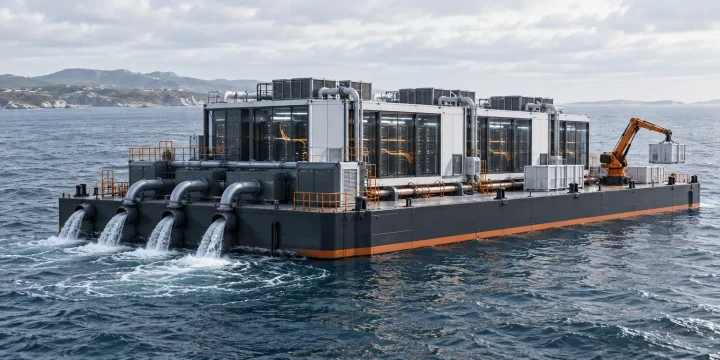
AI-generated editorial illustration; not a documentary photograph.
Y Combinator’s latest Demo Day cohort leaned heavily toward deep tech, with investors highlighting startups working on data-center infrastructure, specialized AI chips, robotics, defense systems and biological computing. TechCrunch’s September 13 report identified nine companies mentioned by at least two early-stage venture capital investors.
Infrastructure Moves Offshore and Into Light
Atomarine plans to place data centers on barges, using seawater for cooling before eventually shifting from a gas-powered pilot targeted for 2028 to floating nuclear power ships in 2032. The company says letters of intent represent more than $4 billion in customer interest, which is potential demand rather than booked revenue.
Dipole Labs is developing optical networking hardware intended to keep data traveling as light instead of repeatedly converting it to electricity. The company says its switch could reduce the power use, heat and delays associated with moving data between chips in GPU clusters.
New Approaches to AI Compute
Lamb Labs proposes embedding model weights directly into custom silicon called Model Processing Units, aiming to remove memory-bandwidth bottlenecks during inference. Parasma is pursuing a more experimental route: training human brain cells as a potential energy-efficient computing medium for AI workloads.
Robotics Spans Homes and Industry
Nori, launched six weeks before the report, says it has generated almost half a million in sales for a roughly $1,600 humanoid robot designed for household tasks and laptop-based remote operation. Another company in the cohort says its heavy-lifting robots are already installing solar panels and are tied to $25 million in contracts through 2027.
Waddle Labs is building an API layer that uses LLM agents to generate executable robot-control code from natural-language instructions. Separately, another highlighted startup collects videos of people working to create robotics training data and says it has recorded activity across more than 150 environments.
Defense Revenue, Investor Attention
Isengard is developing jet-powered strike and counter-drone systems for local production in allied countries. TechCrunch reported that the company is generating $10 million in revenue, while two investors described it as carrying one of the cohort’s highest valuations. The report did not disclose specific valuation figures, and investor interest does not establish commercial or technical performance.
Source: The 9 buzziest startups from Y Combinator’s latest Demo Day, according to VCs
 SIGNAL TITANS
Leave a Reply