
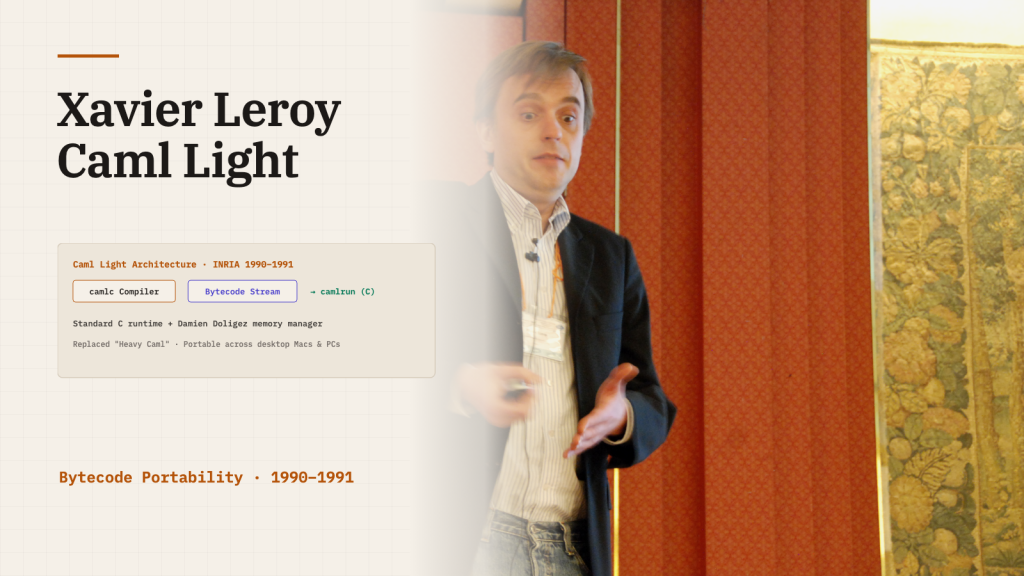
Between 1990 and 1991, computer scientist Xavier Leroy designed Caml Light, a new implementation of the Caml programming language, to run on ordinary desktop computers. Its predecessor, nicknamed “Heavy Caml,” used a Lisp environment and had high memory and processing requirements that limited its accessibility.
Leroy built Caml Light around a compact interpreter written in the C programming language. The interpreter executed bytecode—instructions for an abstract machine—instead of relying on an existing Lisp environment or requiring a separate machine-code generator for each processor architecture. Together with an efficient memory management system contributed by Damien Doligez, the new design turned Caml into a portable system that ran comfortably on desktop Macs and PCs.
The Weight of Heavy Caml
Caml originated from work on the ML (Meta Language) family of programming languages. In the early 1980s, the Formel team at the French research institute Inria, led by Gérard Huet and Guy Cousineau, began implementing ML to support proof assistants. Between 1984 and 1987, Pierre-Louis Curien, Ascánder Suárez, and Guy Cousineau developed Caml V3.1. The system compiled Caml to bytecode that was interpreted by the Categorical Abstract Machine (CAM), an execution model based on categorical combinatory logic. Ascánder Suárez built the implementation using LeLisp, and Inria released it to the public in 1987.
Despite gaining significant interest in academic circles, Caml V3.1 struggled with practical adoption. Running on top of a full Lisp system imposed heavy processor overhead and steep memory requirements. The original implementation also lacked built-in support for separate compilation, although Pierre Weis and Michel Mauny added it after Suárez left in 1988. In his 1990 implementation report, Leroy noted that the absence of an ML implementation for microcomputers was a primary barrier to wider educational use.
Choosing Bytecode and C
When Xavier Leroy began designing a replacement in 1990, he faced a fundamental architectural choice. Generating native assembly language produces high performance, but writing a native-code compiler backend for every processor architecture of the early 1990s would require immense effort. Bytecode interpretation offered portability at the cost of execution overhead.
Leroy resolved the tension by splitting execution into two well-defined stages. The Caml Light compiler translated source code into bytecode instructions. To execute those instructions on target computers, Leroy wrote a bytecode interpreter in standard C. Using standard C made the runtime easy to port across many architectures without writing a new native-code generator for each processor.
Memory Management and the Runtime Engine
A functional programming language generates large numbers of short-lived data structures, making automated memory management critical to performance. In Caml Light, Damien Doligez contributed an efficient garbage collection and memory allocation system. The memory manager operated directly within the C runtime, keeping the memory footprint low and avoiding the heavy overhead of the earlier Lisp-based system.
The resulting runtime command, named camlrun, formed the backbone of the platform. It packaged three primary components: the bytecode interpreter that executed compiled instructions, the memory allocator and garbage collector, and a set of primitive C functions for low-level system operations such as input and output. Bytecode executables produced by the compiler could launch camlrun automatically, so developers could run them like ordinary programs.
Caml Light maintained near-complete backwards compatibility with earlier Caml while operating with a fraction of the computational resources. By reducing hardware barriers, the new implementation enabled Caml to run directly on desktop computers, including the Macintosh and PC systems of that era.
From Classrooms to Modern Systems
The lightweight architecture helped make Caml a widely used educational tool. Caml Light remained in classroom use for years, particularly in France’s scientific preparatory classes (classes préparatoires scientifiques).
The system continued to evolve throughout the 1990s. In 1995, Leroy unveiled Caml Special Light, which combined the language’s clean semantics with an optimizing native-code compiler. In 1996, the integration of an object-oriented type system created Objective Caml, which was officially renamed OCaml in 2011. OCaml eventually superseded Caml Light and offers both portable bytecode and native-code compilation.
The Architectural Lesson
Caml Light suggests a practical question for any portable runtime: which parts must understand the target processor, and which can stay the same across machines?
Leroy put bytecode execution in a C interpreter, and Doligez supplied the memory manager. A C compiler on the target machine could then build the runtime. By pairing bytecode with a compact C runtime, they made Caml accessible on smaller desktop computers and helped broaden its educational and research use.
Related stories
Sources
- A History of OCaml
- Caml Light, INRIA
- Xavier Leroy Software Portfolio
- The Runtime System (camlrun), Caml Light Manual
- Xavier Leroy Selected Publications
- Featured image: David Van Horn; Wikimedia Commons; CC BY 2.0 (adapted from the original)
 SIGNAL TITANS

Leave a Reply