
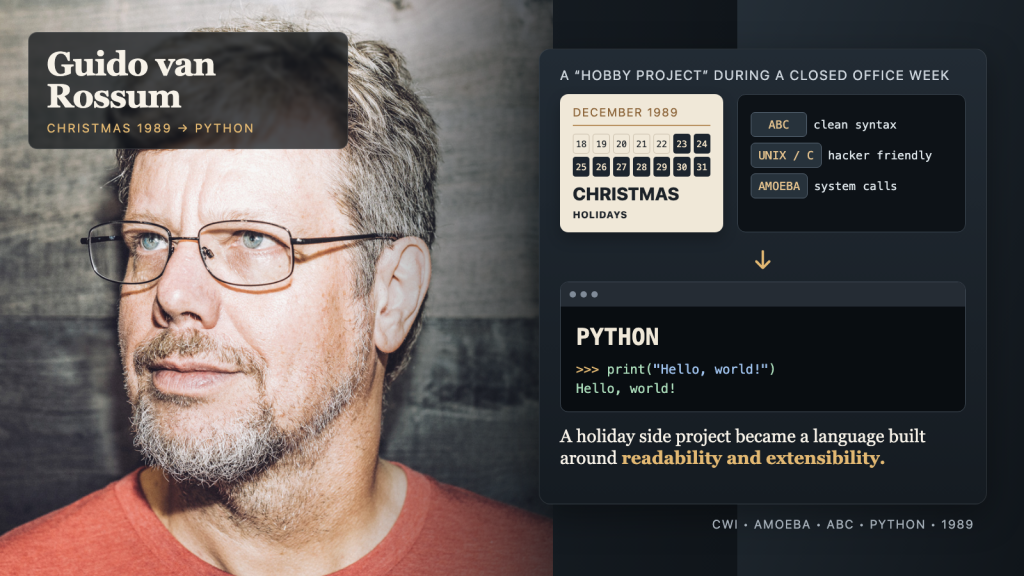
Python began because Guido van Rossum needed something to do during the Christmas holidays of 1989.
His office at CWI in Amsterdam would be closed.
He had a home computer.
He had time.
And he had been thinking about a programming language that did not yet exist.
So he started writing an interpreter as a “hobby” project.
The side project became Python.
The idea had been building long before Christmas
Van Rossum had already worked on a language called ABC at CWI.
ABC was designed to make programming accessible to people who were not professional programmers.
It emphasized clear syntax and simplicity.
But ABC struggled to find the audience its designers wanted.
It was too heavy for many small computers of the time.
Unix programmers already had their own tools.
Van Rossum liked parts of ABC, but he had also learned what he wanted to change.
Then the Amoeba project created a practical problem
Van Rossum later worked on Amoeba, a distributed operating system developed in Amsterdam.
The team needed a better way to write system administration tools.
C was powerful but expensive in programmer time.
Bourne shell was convenient, but Amoeba had its own system-call interface that the shell could not easily reach.
Van Rossum saw an opening.
What if there were a scripting language with some of ABC’s clean syntax, but with access to system calls and the extensibility expected by Unix and C programmers?
He decided it should not be an Amoeba-only language.
It should be general enough to grow.
Christmas 1989 gave him the uninterrupted time
In his own account, van Rossum says he was looking for a hobby programming project to keep him occupied during the week around Christmas.
The office would be closed.
He began writing the interpreter for the language he had been thinking about.
The first working draft took longer than the holiday itself.
During 1990, Python was increasingly used inside the Amoeba project.
Colleagues tried it.
Their feedback changed the language.
The hobby project became a real tool because it immediately had real users nearby.
The name had nothing to do with snakes
Van Rossum needed a working title.
He was a fan of the British comedy series Monty Python’s Flying Circus.
He chose “Python” because it was short, unusual and slightly irreverent.
The name was memorable enough to survive.
Only later did snake imagery become attached to the language.
The original reference was comedy.
Python was designed between two worlds
One side came from ABC.
Readable syntax.
A language that did not force users to fight punctuation constantly.
An emphasis on expressing the program clearly.
The other side came from Unix and C.
Real operating-system access.
Extensibility.
The ability to integrate with existing systems instead of living in a protected educational environment.
Python’s identity emerged from the attempt to keep the best of both worlds.
It was public before it was polished
Van Rossum continued working on Python mostly in his own time.
In February 1991, after a little more than a year of development, he posted the language to USENET.
That distribution channel mattered.
ABC had been developed before widespread Internet distribution made sharing source code easy.
Python arrived at a better moment.
People could download it, try it, send feedback and contribute from other countries without waiting for magnetic tapes or formal releases.
The network became part of the language’s growth.
The “holiday project” story can be misleading
Python did not come from one week of random inspiration.
The coding started during a holiday.
The design was built from years of accumulated experience.
Van Rossum had worked on ABC.
He had worked on Amoeba.
He understood C and Unix culture.
He had seen the cost of writing too much low-level code.
He had seen the limitations of a language that was elegant but difficult to integrate with the systems people already used.
The holiday created time.
The insight had been accumulating for years.
This is how many good side projects actually begin
A side project is often described as something disconnected from “real work.”
But the strongest ones are frequently compressed versions of problems the creator has been carrying for a long time.
A programmer keeps rewriting the same utility.
A designer keeps fighting the same workflow.
An operations team keeps gluing the same systems together.
Then a quiet week appears.
The accumulated frustration finally gets turned into a tool.
The timing looks accidental.
The preparation was not.
Python grew because the language could keep absorbing new use cases
Van Rossum deliberately avoided making Python specific to Amoeba.
That decision mattered.
A narrow internal scripting language might have solved one project.
A general extensible language could move into system administration, web development, scientific computing, education, automation, data analysis and later machine learning.
The language did not need those future markets to be predicted in 1989.
It only needed enough generality to avoid closing the door.
The better question is not “what can I build in a week?”
Python’s origin is often inspiring because it feels small.
One programmer.
One holiday.
One interpreter.
But the more useful question is different:
What problem have you already spent years understanding deeply enough that one uninterrupted week could finally turn your knowledge into a working prototype?
Van Rossum’s Christmas holiday did not magically create expertise.
It created space for expertise to become software.
If you had one uninterrupted week with no meetings, what recurring problem would you finally turn into a tool?
Sources
- Python Documentation — General Python FAQ: Why was Python created?
- Python.org — Guido van Rossum, Foreword for Programming Python
- CWI — Interview with Guido van Rossum: “I’d rather write code than papers”
- CWI — History highlights: Python begins during Christmas 1989
- CWI — 25 Years of Python at CWI
- Python.org — Python software history and ABC lineage
- Featured-image portrait — Guido van Rossum at Dropbox in 2014, photo by Daniel Stroud, CC BY-SA 4.0 via Wikimedia Commons. Editorial derivative remains under the same license.
 SIGNAL TITANS
Leave a Reply