
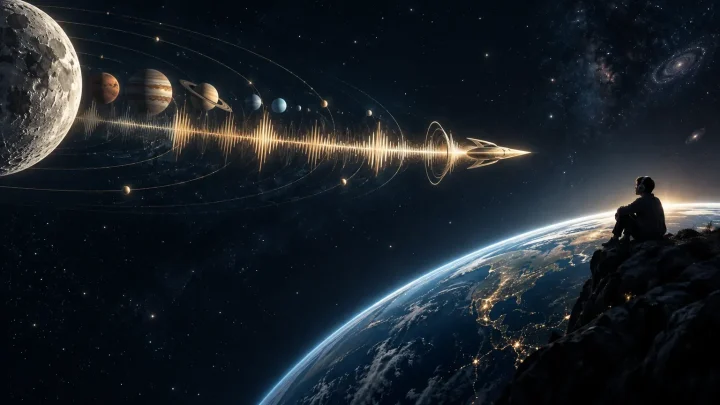
Space exploration is often presented as a visual experience: a rocket rising through fire, a rover crossing a dusty landscape, or a telescope revealing distant light. NASA’s audio collection offers another way into that story. Through podcasts, mission recordings, planetary sounds, and data sonifications, the agency invites audiences to encounter exploration through listening. The result is not merely a soundtrack for science. It is an archive of how discovery has been communicated, remembered, and made emotionally immediate for people on Earth.
A universe carried by sound
NASA’s audio offerings span several forms. Podcasts explore questions such as what it takes to launch a rocket and what scientists learn when they search for life beyond Earth. The featured series NASA’s Curious Universe brings listeners closer to the people and places connected to the agency’s space exploration, presenting stories about discoveries that continue to shape knowledge of the universe.
Other collections make the archive more tangible. Artemis audio is available for creative projects, while historical recordings preserve sounds from earlier spaceflight missions. NASA also shares sounds associated with planets such as Mars and Jupiter, giving listeners an audio interpretation of worlds that are otherwise separated from everyday human experience by immense distances.
Listening to data and memory
Data sonifications add another dimension. Telescope imagery can be translated into sound, allowing scientific information to be experienced through an additional sensory channel. The image remains an image, but sound can reveal patterns and movement in a way that changes how an audience approaches it. This does not replace visual astronomy; it expands the ways people can engage with it.
The archive also preserves the human texture of exploration. A launch, a mission recording, or a remembered transmission carries more than technical information: it records the presence of people working across time, distance, and uncertainty. NASA’s SoundCloud collection brings together sounds from historic spaceflight and current missions, linking the past of exploration with its continuing present.
Why listening changes the story
The editorial lesson is simple but useful: science communication does not have to rely on explanation alone. A sound can create attention before a listener knows every technical detail. It can make a remote mission feel present, give historical events a recognizable texture, and help audiences approach scientific data with curiosity. NASA’s audio archive shows how listening can turn space exploration from something viewed at a distance into a story encountered more directly, one signal at a time.
AI-generated editorial illustration; not a documentary photograph.
Source: Podcasts and Audio
 SIGNAL TITANS
Leave a Reply