
The United Kingdom government has officially announced the establishment of the AI Biosecurity Lab (AIBL), a dedicated organisation positioned as a world-first initiative designed to tackle emerging biological risks through frontier artificial intelligence. According to reports from official government publications and technology news desks, the initiative is backed by a substantial funding and commitment package totaling up to £300 million, comprising direct state allocations alongside major corporate contributions.
Mission and Scope of the Initiative
The primary mission of the AI Biosecurity Lab centers on strengthening national and global resilience against a diverse range of biological threats, including those potentially enabled or accelerated by rapid advancements in artificial intelligence systems. While acknowledging that frontier AI models unlock unprecedented opportunities for scientific discovery and disease understanding, authorities emphasize that increasingly capable technologies can simultaneously lower barriers to harmful activities. To counter this, AIBL will concentrate its initial delivery phase on enhancing the early detection of emerging biological threats and accelerating the research, development, and testing processes for vaccines, medical treatments, and other essential countermeasures.
Operating as an independent, non-profit entity, the lab is structured to attract top-tier technical talent from both industry and academia. This governance model is designed to allow the organisation to operate with the operational speed and focus characteristic of private sector frontier AI enterprises while maintaining close alignment with public security objectives.
Industry Commitments and Technical Partnerships
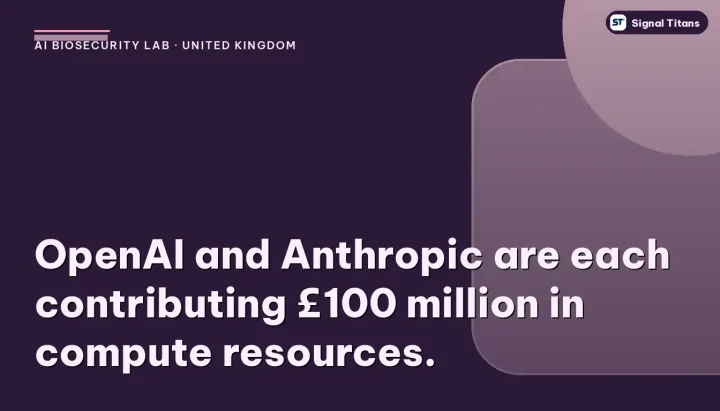
The setup relies heavily on deep public-private collaboration, with major AI firms contributing extensive computational resources and specialised expertise. OpenAI is slated to provide £100 million worth of compute resources and model credits, while also extending trusted access to its most capable relevant models via its Rosalind Biodefense programme. Concurrently, Anthropic has committed up to £100 million in model credits, alongside trusted model access and dedicated technical support to aid the lab's mission.
Beyond these primary commitments, AIBL is forging strategic research collaborations with other prominent entities in the technology and life sciences sectors. Google DeepMind will contribute scientific expertise and explore providing trusted access to its frontier Gemini and specialised science models. Additionally, Basecamp Research, a prominent UK-based AI life sciences firm, will supply access to its proprietary AI-biology models and specialised technical capabilities to help address high-priority biosecurity challenges.
Integration Within the National Framework
AIBL's operational architecture is embedded within a broader National AI Biosecurity Initiative, linking the lab with established public sector bodies such as the UK Health Security Agency, the Animal and Plant Health Agency, and the Defence Science and Technology Laboratory. The organisation will also work closely with the Medicines and Healthcare products Regulatory Agency to prepare for potential public health emergencies and provide foundational insights for the regulation of AI-designed medicines.
To guide its research agenda, the lab will establish a dedicated scientific advisory committee drawing on multidisciplinary expertise from academic institutions, industry stakeholders, and the third sector. Furthermore, the government intends to sustain the initiative over the long term by blending public allocations with philanthropic funding streams, ensuring that continuous investment flows into advanced biosecurity infrastructure.
Setting a Precedent for Public-Private Biosecurity Governance
The launch of the AI Biosecurity Lab represents a critical milestone in the evolving governance of frontier artificial intelligence, shifting the paradigm from theoretical risk assessments to operational defense mechanisms. As artificial intelligence increasingly permeates fields like synthetic biology and pharmacology, governments face the dual challenge of harnessing life-saving scientific innovations while mitigating dual-use security threats. By pooling substantial financial capital, cloud compute credits, and proprietary model access into an independent non-profit structure, the UK is attempting to bridge the traditional agility gap between fast-moving tech corporations and bureaucratic state agencies.
This model addresses long-standing concerns that public regulators lack direct access to frontier models during active evaluation cycles. However, the long-term effectiveness of AIBL will depend heavily on the depth of its institutional independence and its ability to maintain transparent, objective safety standards while relying heavily on commercial partners who hold a vested interest in the underlying technologies. The success or failure of this initiative could ultimately serve as a blueprint for how allied nations manage the security implications of advanced AI capabilities in the coming decade.
Editorial graphic and headline text by Signal Titans.
Source: UK Establishes AI Biosecurity Lab Backed by OpenAI and Anthropic · Introducing the AI Biosecurity Lab – GOV.UK
 SIGNAL TITANS
Leave a Reply