
Recent evaluations of artificial intelligence systems using the cooperative multiplayer game Overcooked have highlighted deep-seated limitations in multi-agent coordination, real-time planning, and visual processing. According to reports from Notebookcheck, researchers converted the chaotic kitchen game into a specialized testing environment known as DuoCook to assess how effectively vision-language models can manage complex, multi-step tasks.
Translating a Chaotic Kitchen into an AI Benchmark
In the standard version of the game, human participants form teams of two to four to operate a virtual restaurant under tight time constraints, dividing responsibilities such as chopping ingredients, cooking meals, washing dishes, and delivering final orders. Success relies heavily on efficient labor division and real-time adaptation. The DuoCook environment adapts this dynamic for artificial intelligence by tasking a single vision-language model—a system capable of interpreting both visual inputs and textual commands—with simultaneously controlling two distinct characters in the kitchen.
Dismal Performance Metrics Across Top Models
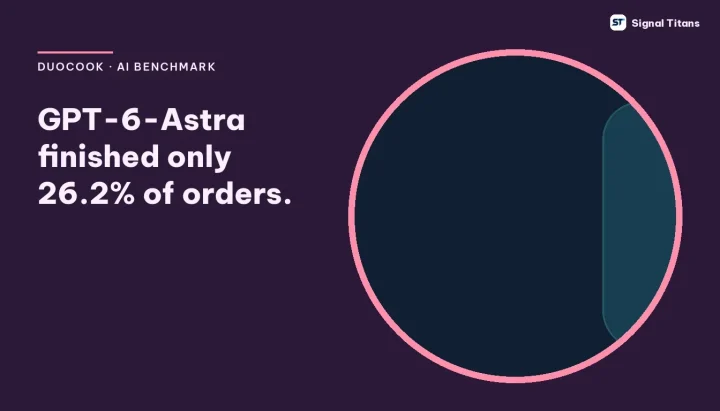
When put through the DuoCook trials, the tested models demonstrated severe operational bottlenecks. The top-performing system in the evaluation, identified as GPT-6-Astra, successfully completed an average of just 26.2 percent of customer orders. Other tested models fared significantly worse, managing between 8.8 and 11.2 percent completion rates. Maps featuring dynamic obstacles, shared equipment, and zones requiring ingredient handoffs posed the steepest hurdles. To address memory limitations, the team introduced a shared notebook where agents could record observations; while Claude showed performance improvements in this setup, GPT and Gemini actually declined in score, and API costs increased uniformly across all models.
Why Multi-Agent Coordination Remains a Bottleneck
The struggle of advanced AI systems to master a straightforward cooperative game carries profound implications for the broader landscape of artificial intelligence development. While the DuoCook environment relies on a constrained virtual kitchen, the fundamental bottlenecks it exposes—such as task division, resource allocation, and tracking shifting intermediate goals—are identical to the obstacles facing autonomous AI agents deployed in complex real-world workflows. Today, developers increasingly look toward multi-agent systems to handle workflows ranging from software engineering to enterprise logistics. However, if state-of-the-art vision-language models struggle to coordinate simple actions like chopping and plating under pressure, deploying autonomous agents into unpredictable environments remains a distant prospect. Furthermore, the findings demonstrate that simply scaling memory features or adding shared scratchpads does not provide a universal fix, often introducing efficiency penalties and higher API costs without guaranteeing better collaboration. This underscores a critical gap in current AI architectures: knowing how to process individual commands does not translate into knowing how to synchronize actions dynamically with other entities. Consequently, the research serves as a sobering reality check for industry expectations surrounding autonomous multi-agent orchestration, suggesting that foundational improvements in reasoning and cooperative dynamics are required before AI can reliably manage intricate, multi-step cooperative tasks outside of controlled benchmarks.
Experimental Limitations and Pre-print Status
Despite the compelling insights generated by the DuoCook evaluation, the study's scope remains bounded by its specific design. The environment incorporates several structural aids—such as position-tracking grids, equipment legends, structured status logs, and explicit lists of permitted actions—yet coordination remains exceptionally difficult. Additionally, the findings stem from a pre-print study, meaning the work has not yet undergone formal peer review by an academic journal or conference, prompting the researchers to advise caution when interpreting the metric outcomes.
Editorial graphic and headline text by Signal Titans.
Source: AI struggles with Overcooked: Even the best model manages just 26 percent · KI scheitert an Overcooked: Selbst das beste Modell schafft nur 26 Prozent – Notebookcheck News
 SIGNAL TITANS
Leave a Reply