
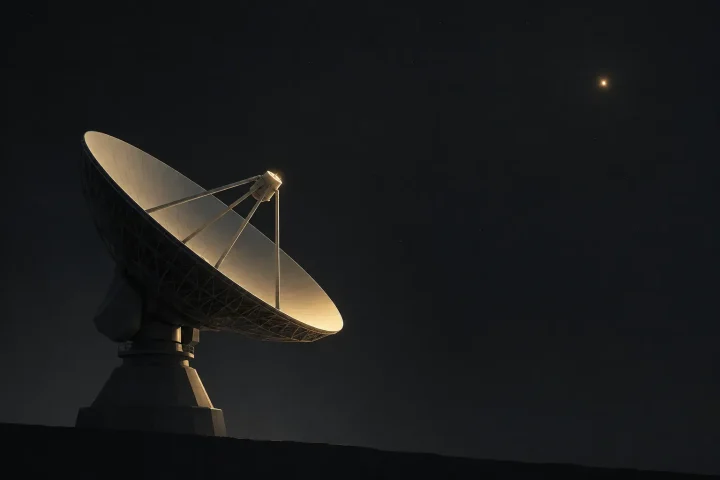
A spacecraft can travel farther than any human has ever gone, collect images no one has seen and measure environments that remain unreachable to people. Yet none of that becomes knowledge until the information finds its way home. According to NASA’s SCaN program, the communications and navigation systems supporting its missions are as critical as the spacecraft themselves.
The mission behind the mission
NASA’s Space Communications and Navigation program manages the networks that send commands outward and bring data back to Earth. These exchanges happen every day across a broad range of missions: astronauts aboard the International Space Station, spacecraft studying Earth, probes exploring the Moon and vehicles traveling far beyond it.
The Near Space Network supports missions within roughly one million miles of Earth. It combines government and commercial assets to provide communications and navigation services, helping return terabytes of important data. That arrangement makes the network less like a single cable and more like a coordinated service that must support many kinds of missions at once.
Listening across the solar system
For the most distant missions, NASA relies on the Deep Space Network, an international array of giant radio antennas at Goldstone in California, Madrid in Spain and Canberra in Australia. The network’s 34- and 70-meter dishes support spacecraft communication and navigation at the Moon, Mars and beyond. Their work also contributes to planetary radar and radio astronomy.
The locations matter because Earth is always turning. A global arrangement allows one station to hand responsibility to another as a spacecraft’s signal moves across the sky. The result is easy to overlook: a distant machine remains reachable because an Earth-based system has been designed around motion, distance and delay.
Building the next connection
SCaN is also preparing communications for a new era of lunar exploration. Its work includes support for Artemis, plans for internet-like capabilities around the Moon and search-and-rescue services for astronauts. NASA is combining public infrastructure with commercial partnerships, while developing technologies such as laser communications and delay- and disruption-tolerant networking.
The broader lesson is an editorial one, not a universal formula: exploration is often remembered through its dramatic images and bold destinations, while dependable connections receive less attention. But the connection is part of the achievement. A discovery becomes useful when a system can carry it across darkness, distance and interruption, and deliver it to people waiting on Earth.
AI-generated editorial illustration; not a documentary photograph.
Source: SCaN. Space Communications: 7 Things You Need to Know
 SIGNAL TITANS
Leave a Reply