
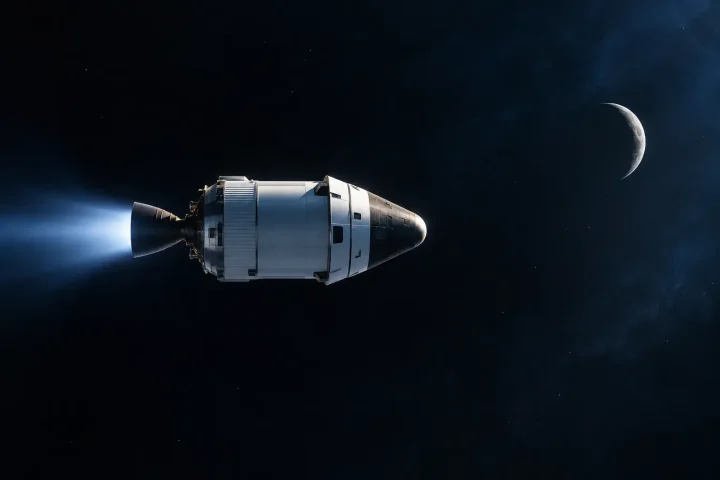
A journey beyond Earth is not carried by one machine doing everything. It is a carefully timed handoff. According to NASA, a rocket carries a spacecraft from Earth’s surface to space, usually reaching low Earth orbit or sending the vehicle onward. After separation, the spacecraft assumes the next responsibilities: navigation, propulsion, carrying its payload, supporting its crew when needed, and reaching its destination or returning safely. The drama of exploration depends on this division of labor.
One mission, many responsibilities
NASA describes rockets as complex systems with millions of pieces and interdependent systems that must be calculated and constructed to work together. Their design follows the mission. A spacecraft traveling farther from Earth generally requires a larger and more powerful launch vehicle, because the journey demands more energy and capability at the start.
But the rocket is only the opening act. A spacecraft is the vehicle that flies in space, carrying astronauts, cargo, or instruments, and sometimes serving as the destination itself. The International Space Station is one example: it is both a place where people live and work and a spacecraft in its own right. Smaller vehicles deliver crew and cargo to it, then separate and continue their own part of the mission.
A fleet built around the next step
NASA’s vehicles show how specialization extends across an entire exploration architecture. The Space Launch System is designed to send Orion, astronauts, and cargo directly toward the Moon in a single launch. Orion then provides the exploration vehicle for Artemis missions, including crew transport, emergency abort capability, support during space travel, and safe re-entry from deep space return velocities.
Other systems serve different stages and destinations. Commercial crew spacecraft transport astronauts to and from the International Space Station, while commercial cargo spacecraft carry supplies and scientific investigations. Farther away, NASA’s planned Gateway will need logistics deliveries, and commercial human landing systems are being developed to carry Artemis astronauts between lunar orbit and the Moon’s surface.
The lesson in the handoff
The broader lesson is an editorial reflection, not a formula: difficult projects become more understandable when responsibility is divided into clear stages. One system lifts the mission away from Earth. Another navigates the space between worlds. Others support people, deliver supplies, conduct research, or complete the return journey. NASA’s fleet makes exploration look less like a single leap and more like a sequence of trusted handoffs, each one carrying the mission only as far as its particular strengths allow.
AI-generated editorial illustration; not a documentary photograph.
Source: Spaceships and Rockets
 SIGNAL TITANS
Leave a Reply