
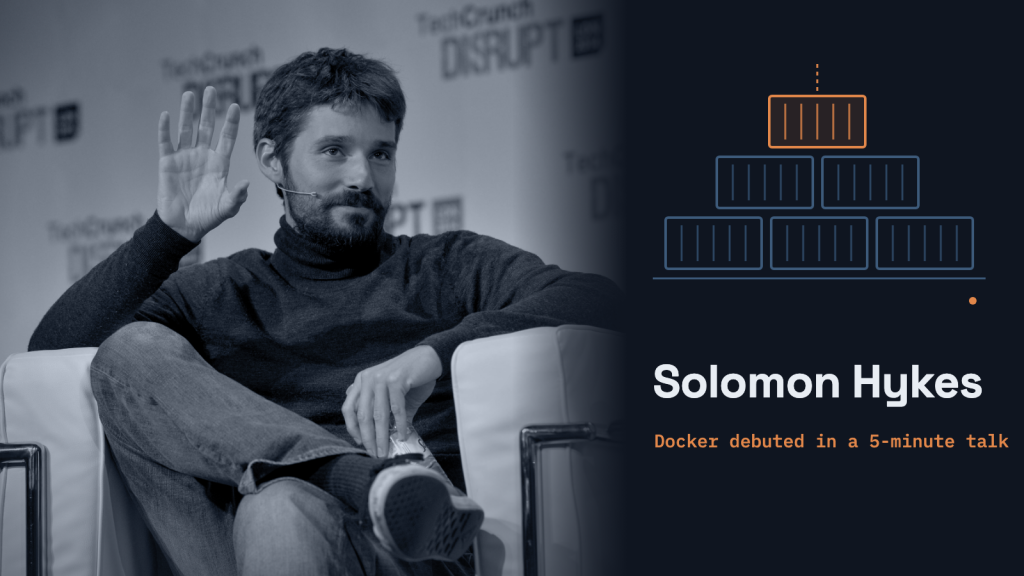
On 15 March 2013, at PyCon US in Santa Clara, Solomon Hykes gave a lightning talk called “The future of Linux Containers.” Lightning talks at PyCon last five minutes. The conference listing summed up the pitch: dotCloud had been running containers internally, the technology was complicated, so they had not talked about it. “Until now: Docker.”
A week later, on 23 March, Docker 0.1.0 appeared in the project’s changelog; its first entry reads “First release.” The talk was short. The decision behind it was not. Hykes had decided to stake his company on a free tool and stop splitting its attention with the business that was paying the bills.
The fork in the road
dotCloud was a platform-as-a-service company: developers pushed code, and dotCloud ran it. It had come through Y Combinator in 2010, and it had real customers. In a 2016 interview with Y Combinator, Hykes described the problem without drama: “dotCloud was by no means a failure, but it wasn’t succeeding fast enough, basically.”
The team had already been looking for something bigger. “Docker was maybe the sixth attempt at doing something to solve that problem,” Hykes said. “And the previous five obviously failed.” Around the end of 2012, he said, “I kind of made a call with myself.” The moment of action, in his telling, was “the beginning of 2013, basically.”
The options on the table
The sources describe three realistic paths, not a list of secret strategy memos:
- Keep going with the PaaS. It had paying users, but by Hykes’s own account it was not growing fast enough.
- Run both. Keep the PaaS at full speed and build the new thing on the side. This is what dotCloud had done with its five earlier attempts.
- Go all in on Docker, as open source. Release the container tool publicly and let the old business take second place.
The second option looks like the prudent one. Hykes’s diagnosis of the earlier failures was blunt: “I think the reason they failed, really, is because we weren’t all in. We tried to do both.”
The choice, and what Docker actually was
Hykes picked the third path. It was not an easy sell. SD Times reported that investor Dan Scholnick remembered a board meeting in the first quarter of 2013 “where Hykes asked the board if he could open-source Docker.io,” and that “the board—Scholnick included—was hesitant.” The sources do not record the board’s specific objections, so it would be invention to supply them here. What is documented is the outcome: Docker was released as open source that March.
There is a common myth worth correcting here: Docker did not invent containers. FreeBSD jails were described in 2000. Linux 2.6.24 added control groups and PID namespaces in January 2008. Early Docker ran on LXC, existing Linux container tooling; its own homepage said “Docker complements LXC with a high-level API which operates at the process level.” Docker’s contribution was packaging and developer experience: layered images, a registry to push and pull them, and a simple command line. Even the “pivot” label is only half true. Hykes told SD Times that “before we built the PaaS, we spent two years building a first version of Docker.” In 2013, the company went back to its foundation.
The bill
Going all in had a direct cost. “In our case, we had to lay off people because we couldn’t afford to do something new and keep doing the existing thing at full speed,” Hykes said. The company changed shape quickly. Ben Golub became CEO in July 2013, and Hykes moved into the CTO role. On 29 October 2013, dotCloud renamed itself Docker. In SD Times’s phrase, “the DotCloud moniker and PaaS gameplan were thrown in the trash by October.”
In August 2014 Docker sold the dotCloud platform, with about 500 customers, to the Berlin company cloudControl. TechCrunch reported that four of Docker’s roughly 50 employees were still dedicated to it and that Golub would not disclose the price. His explanation was focus: “It’s gotten to the point, where we need to focus all our energy and resources on it.”
How it aged
As a technology bet, it paid off fast. When Docker 1.0 shipped in June 2014, the company cited more than 2.75 million downloads, and Data Center Knowledge reported that 95 percent of contributions came from outside the company. Docker 0.9 had already replaced LXC as the default with libcontainer, its own Go library for talking to the kernel directly, though LXC remained available as an option.
As a business, the trade-off came back later. Kubernetes, which Google open-sourced in 2014, became the standard for running containers in production, ahead of Docker’s own orchestration. Hykes stepped back from day-to-day operations in March 2018. In November 2019, Docker sold its enterprise business to Mirantis, with “hundreds of enterprise customers,” and refocused on developers under a new CEO, Scott Johnston. A 2021 retrospective in Increment put the problem in one line: “Docker largely solved users’ problems so well—and for free—that there wasn’t much left to sell.”
That is not proof the 2013 decision was wrong. Kelsey Hightower, quoted in the same piece, said: “I think they did the right thing; they made this hard pivot.” The cautious path had already failed five times. The bold one created a standard that an entire industry adopted, even if the company that released it captured only part of the value.
The decision rule
Hykes’s lesson about focus holds up: half-committed experiments tend to die quietly. The Docker story adds a second question that open-source founders still face. Before you go all in on giving something away, ask: if this succeeds beyond every forecast, what will people still need to pay us for?
Sources
- “Lightning Talk – The future of Linux Containers,” Solomon Hykes, PyCon US 2013 (PyVideo)
- Y Combinator, interview with Solomon Hykes on Docker and dotCloud, 2016
- Alex Handy, “Docker grows to harbor innovation,” SD Times, February 2014
- Docker CHANGELOG (0.1.0, 23 March 2013), moby/moby mirror
- The Changelog, on dotCloud’s release of Docker, April 2013
- TechCrunch, “Docker sells dotCloud to cloudControl to focus on core container business,” August 2014
- Data Center Knowledge, on the Docker 1.0 release, June 2014
- Docker blog, “Docker 0.9: introducing execution drivers and libcontainer,” March 2014
- Poul-Henning Kamp and Robert N. M. Watson, “Jails: Confining the omnipotent root,” 2000
- Kernelnewbies, Linux 2.6.24 release notes (control groups, PID namespaces), 2008
- Solomon Hykes, “Au revoir,” Docker blog, March 2018
- Mirantis, “Mirantis acquires Docker Enterprise,” November 2019
- Docker press release on its new direction and CEO Scott Johnston, November 2019
- Lucy Wyman, Increment, on Docker CE and EE, 2021
- Featured image: Solomon Hykes at TechCrunch Disrupt Europe, London, October 2014 (not the 2013 PyCon talk). TechCrunch, via Wikimedia Commons, CC BY 2.0
 SIGNAL TITANS
Leave a Reply