
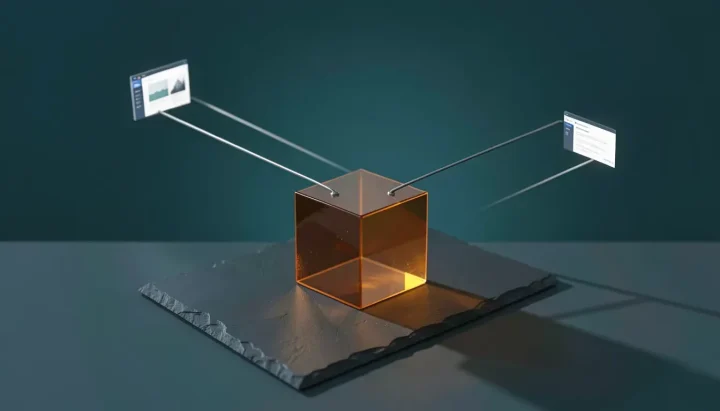
OpenCode has officially released version 2.0 following a public beta period, delivering a substantial architectural overhaul designed to unify its terminal, desktop, and web interfaces. According to creator Anomaly and reports from The New Stack, the update transitions the open-source coding agent onto a shared background service while introducing a rebuilt API, an embeddable SDK, and expanded support for background execution.
A Single Background Service for Multiple Interfaces
The cornerstone of version 2.0 is an automated background service that runs locally on a developer’s machine. As detailed by Anomaly and industry reports, OpenCode's terminal user interface, web app, and desktop client now communicate directly with this single central process. This setup ensures that developers can seamlessly transition a coding session across different interfaces without losing context. Furthermore, programmatic clients utilizing the @opencode/client package can automatically discover the local service, simplifying scheduled tasks and allowing developers to expose the service to external hosts or pair it with other applications.
Rebuilt APIs, SDKs, and Code Mode Integration
Version 2.0 completely replaces the project's original API, which developers noted grew haphazardly during the early days of agent development. The newly structured API grants agents enhanced control over their operating environment, including creating Git worktrees or interrupting stuck sessions. Alongside this, Anomaly introduced @opencode/sdk, an embeddable software development kit allowing engineers to embed OpenCode directly into custom environments like Cloudflare Durable Objects. Another major addition is Code Mode, which leverages a lightweight JavaScript interpreter via the @opencode/codemode package. By converting Model Context Protocol servers and OpenAPI endpoints into native scriptable functions, Code Mode enables agents to chain multiple tool calls in a single execution round-trip while avoiding excessive context bloat.
Background Subagents and Upgrade Implications
To help developers maximize model orchestration capabilities, OpenCode 2.0 introduces native support for background subagents and asynchronous shell commands. Primary agents can delegate tasks like code reviews or long-running test suites to secondary subagents or terminal processes, notifying the user upon completion. Users can also manually shift running foreground tasks into the background using a designated hotkey. However, these sweeping architectural upgrades come with notable breaking changes. Plugins built for version 1.0 are incompatible with the 2.x series, the server API has been completely overhauled, and configuration files have shifted. Upgrading requires manual intervention through command-line flags or downloading updated desktop binaries, as automatic updates have been disabled.
Why OpenCode 2.0 Marks a Turning Point for AI Tooling
The rollout of OpenCode 2.0 represents a critical maturation phase for open-source AI coding assistants, reflecting a broader industry shift toward flexible, multi-model architectures. Since gaining massive traction—surpassing 212,000 GitHub stars—driven partly by developer demand for model independence following restrictions on proprietary credentials like Anthropic's Claude, OpenCode has positioned itself as a core infrastructure layer. By consolidating multiple client interfaces under a unified background daemon and introducing sophisticated execution environments like Code Mode, Anomaly is addressing the architectural limitations that previously hindered complex agent workflows. For developers managing extensive toolchains and multiple specialized AI models, these upgrades reduce friction, eliminate unnecessary context round-trips, and provide the programmatic flexibility needed to scale agent utility beyond simple chat interfaces. While breaking changes and manual migration requirements may cause short-term friction for existing users, the long-term architectural stability ensures that OpenCode can effectively support deeply integrated, autonomous development workflows moving forward.
AI-generated editorial illustration; not a documentary photograph.
Source: “A major overhaul”: OpenCode 2.0 puts its terminal, desktop, and web apps on one shared service · OpenCode 2.0
 SIGNAL TITANS
Leave a Reply