
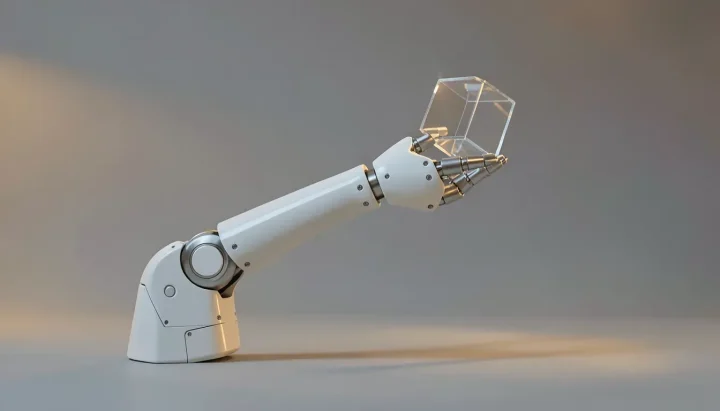
In an engineering walkthrough published on October 8, 2026, NVIDIA detailed a five-step workflow that uses frontier AI models to automate the conversion of raw CAD geometry into simulation-ready (SimReady) OpenUSD assets. Using an ABB Robotics YuMi dual-arm robot as a reference project alongside GPT-6 Astra as an example AI model, the guide explains how AI agents running in Codex CLI can write Python scripts to call NVIDIA Omniverse tools, configure physical properties, and test assets inside NVIDIA Isaac Sim 6.1.
Translating Geometry and Visual Appearance
Preparing raw CAD assets for physical simulation requires more than basic file translation. Raw STEP files must be converted into OpenUSD scenes with proper assembly structures, visual materials, and rigid-body physical properties. In the initial phases, an AI agent utilizes skills such as omniverse-cad-to-simready and omniverse-cad-to-usd to import the geometry into Isaac Sim 6.1. The agent then adjusts material roughness, color, and metallic parameters to match reference photos and videos without generating synthetic textures or altering underlying CAD mounting transforms.
Configuring Kinematics and Mass Distribution
Once visual attributes are set, the workflow configures joint limits, axes, collision geometry, and rigid body dynamics for both arms and grippers. When precise manufacturer spec sheets are incomplete, the AI agent can query public URDF descriptions to identify missing joint axes and zero-configuration poses. Component masses are calculated based on STEP geometry volumes and normalized to total specifications, such as 38 kg for the YuMi body and 0.28 kg for each gripper, assuming uniform material density across solid parts.
Validating SimReady Schemas and Execution
Before running task simulations, the asset undergoes automated validation against SimReady Foundation tier-core specifications. The validation engine checks unit consistency, texture dependencies, positive mass values, and admissible inertia tensors across all 21 rigid bodies. In NVIDIA's pickup-and-placement test, both arms completed four pick-and-place cycles over a 122.2-second physics simulation in Isaac Sim, transferring test cubes and an image-derived marker without relying on artificial kinematic holds or direct position overrides.
Implementation Limitations and Assumptions
NVIDIA emphasized that passing SimReady checks confirms simulation behavior strictly under tested conditions rather than real-world parity. Key friction parameters—set to 0.8 static and 0.6 dynamic friction—were estimates rather than physical contact measurements. Furthermore, internal components like gearboxes, motors, and wiring were not individually modeled, meaning simulation accuracy remains dependent on further physical calibration against real-world hardware.
AI-generated editorial illustration; not a documentary photograph.
Source: 5 Steps to Create SimReady Assets for Robotics with Frontier AI Models
 SIGNAL TITANS
Leave a Reply