
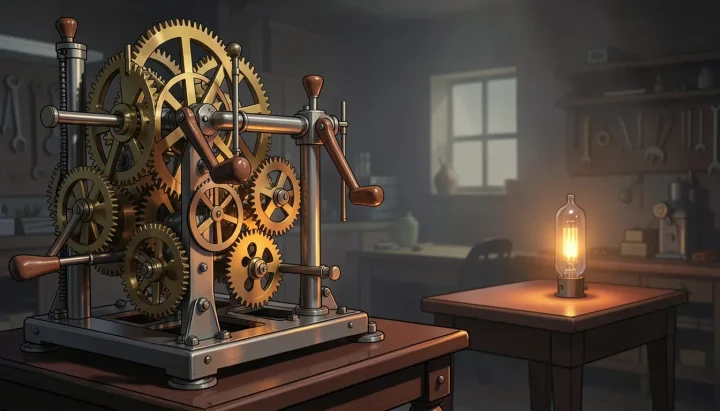
Before digital bits dictated calculation, computational power took physical form. Long before microprocessors arrived, engineer Vannevar Bush popularized a massive mechanical computing machine known as the differential analyzer. The apparatus occupied an oversized physical table equipped with interconnected steel shafts, gears, and mechanical levers. To perform a calculation, operators physically set the position of these mechanical components, using direct spatial measurements and rotational motion to compute complex numerical answers rather than manipulating electronic ones and zeros.
From Physical Gears to Digital Distinctions
Developed during the 1940s, analog computing technology preceded the widespread adoption of digital machines. Devices like the differential analyzer relied entirely on physical mechanisms and continuous physical properties to execute mathematical operations. However, during the 1960s, electronic digital computers superseded these mechanical systems by using discrete logic states and stored programs. According to historical accounts of computing, this transition prompted computer scientists and researchers to formalize their terminology, explicitly contrasting analog systems—defined by continuous physical values—with digital architecture built on discrete binary code.
Subverting Commercial Limits Through Net.art
As digital networks expanded in the late twentieth century, artists and writers recognized that digital systems were becoming increasingly standardized by commercial interests. Seeking a distinct online aesthetic, early creators formed a loose movement known as net.art. Working directly within network protocols, they crafted radical experiments including hypertext poetry, interactive browser disruptions, and structural web experiments that pushed against the medium's functional boundaries. Art historian Rachel Greene argued that net.art stood out precisely because its practitioners refused to let commercial interests dominate the network's creative and radical ideas, prioritizing unexpected artistic friction over corporate utility.
Bespoke Code and the Personal Web
This insistence on individual agency carried into early personal web publishing, where creators built bespoke digital spaces from raw code. In 2001, writer Rebecca Blood observed that early blogs functioned as intimate fragments, slowly pieced together over months to reflect a specific individual in a distinct place and time. Rather than relying on rigid social media templates, creators crafted custom web environments. The late designer Dean Allen famously described his personal website as an ambitious mix of PHP, MySQL, hypertext markup language, and cascading stylesheets—a hand-built digital room shaped by personal quirk and technical craftsmanship.
Building a Bulwark Against Homogeneity
Today, as machine-driven algorithms generate homogenized streams of optimized content, the hand-crafted personal site offers a distinct alternative. Hand-coded pages built out of personal curiosity continue to provide a space where human intent takes precedence over automated engagement metrics. The persistent effort of individual creators to craft personal, slow websites serves as a lasting bulwark against uniform, machine-optimized platforms, preserving room for individual expression on an increasingly automated web.
AI-generated editorial illustration; not a documentary photograph.
Source: The History of the Web A History of Analog The Web, By Humans The Analog Web
 SIGNAL TITANS
Leave a Reply