

On January 6, 1981, astronauts John Young and Bob Crippen climbed into the emergency slidewire escape system attached to Launch Pad 39A at Kennedy Space Center, testing the evacuation apparatus before the maiden flight of Space Shuttle Columbia. According to NASA history, this marked a fundamental shift in how the spaceport operated. During the 1960s and 1970s, Kennedy transitioned quickly between distinct human spaceflight programs. In the 1980s, the center was tasked with operating an ongoing processing engine. The workforce managed a continuous vehicle turnaround flow: post-landing safety checks, vehicle refurbishment inside the Orbiter Processing Facility, rollout, launch execution, and immediate preparation for the next mission.
Proving the Flying Machine
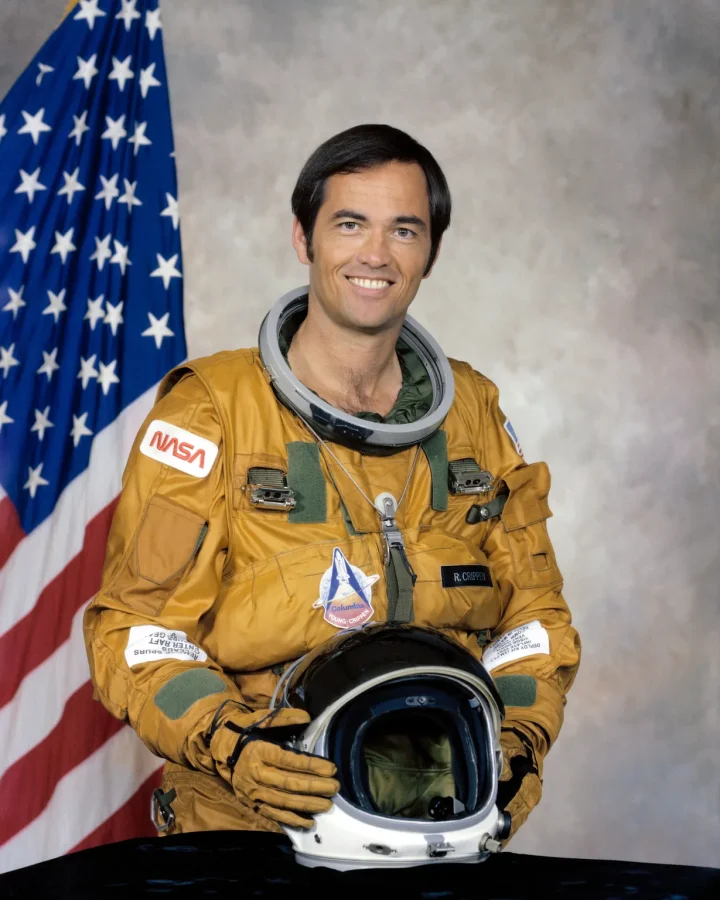
The operational pipeline faced its first complete trial on April 12, 1981, when Space Shuttle Columbia launched on mission STS-1 following a precise, on-schedule countdown. Command pilot John Young and pilot Bob Crippen spent two days in orbit verifying the spacecraft's flight systems. On April 14, 1981, Columbia completed its deorbit burn and landed on the dry lake bed at Edwards Air Force Base in California. The maiden voyage resonated throughout culture: Canadian rock band Rush wrote the song "Countdown" after observing the liftoff, and when MTV launched its initial television broadcast at 12:01 a.m. on August 1, 1981, the network used launch footage of Columbia as its opening visual segment.
Ramping Up Orbital Operations
Over the next four years, Kennedy Space Center accelerated its launch frequency from two flights in 1981 to nine flights in 1985. Operational milestones expanded the shuttle's versatility. Sally Ride became the first American woman in space aboard Challenger in 1983. On STS-8, Guion Bluford became the first African-American astronaut in space during a mission that achieved the program's first night launch and night landing. In 1984, Challenger accomplished the first landing directly at Kennedy’s Shuttle Landing Facility during STS-41B. On the following flight, STS-41C, astronauts captured, repaired, and redeployed the SolarMax satellite, proving the vehicle could function as an orbital repair facility.
Catastrophe and the Flight Safety Reset
The push toward higher flight rates came to a sudden halt on January 28, 1986. Seventy-three seconds into the STS-51L mission, Space Shuttle Challenger was lost when an O-ring in the right solid rocket booster failed, resulting in the loss of all seven crew members. The disaster forced a two-and-a-half-year pause in shuttle operations across the spaceport. Under new center director Forrest S. McCartney, Kennedy overhauled its workforce management and processing procedures. On September 29, 1988, Space Shuttle Discovery launched on mission STS-26, returning the space shuttle fleet to flight.
Resuming the Interplanetary Pipeline
By 1989, Kennedy Space Center launched five shuttle missions in a single year, supporting both orbital science and deep-space exploration. Payload bay configurations included reusable Spacelab modules for materials science and biological experiments. During two 1989 flights, Atlantis deployed the Magellan spacecraft to Venus and the Galileo probe to Jupiter. The 1980s transformed the spaceport from a launch facility focused on single missions into a continuous logistics engine capable of supporting complex planetary and orbital science.
Cover: AI-generated editorial illustration; not a documentary photograph.
Source: The 1980s: All Eyes Focus on Space Shuttle
 SIGNAL TITANS
Leave a Reply