
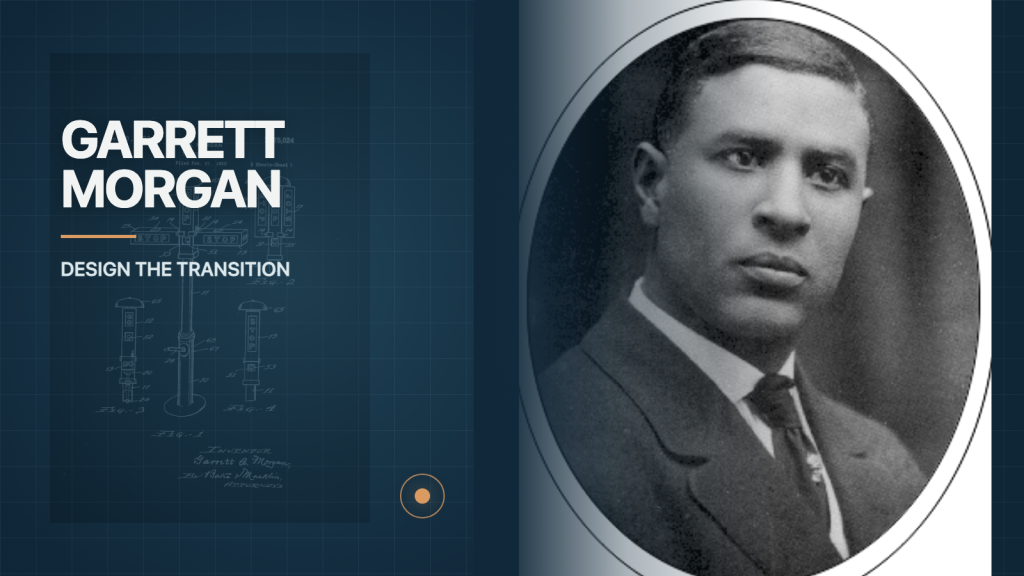
By 1923, traffic signals already existed. Garrett Morgan did not invent the idea of telling vehicles when to stop and go.
What he patented was narrower—and more interesting.
His design created a protected moment between competing traffic flows: a position in which traffic in every direction stopped before another direction received permission to move. Instead of treating an intersection as a simple flip from GO here to GO there, Morgan treated the transition itself as a safety problem.
That is the useful idea behind U.S. Patent 1,475,024.
The dangerous part was the switch
Early twentieth-century streets were becoming complicated systems. Cars mixed with horse-drawn vehicles, bicycles and pedestrians. Traffic control devices were appearing, but many signals were still simple stop-go systems, often operated manually by a police officer or attendant.
A direct change from one direction to another creates a predictable risk. A driver who has already entered the intersection may still be clearing it when cross traffic is released. The system can be correct in both states—STOP and GO—and still be dangerous during the transition.
Morgan’s patent, filed in February 1922 and granted on November 20, 1923, described a manually operated T-shaped signal with movable indicators. One of its stated objectives was to stop traffic in all directions before giving a proceed signal to any one direction. That all-stop interval gave vehicles already in the intersection time to clear and also created a safer opportunity for pedestrians.
It was not simply today’s yellow light
The story is often compressed into the claim that Morgan “invented the yellow light.” That is too neat.
His patent did include a third traffic condition, but the mechanism was not the same as the standardized electric red-amber-green signal familiar today. Smithsonian’s Lemelson Center notes that Morgan’s design used an all-direction stop position and that later standardized three-position signals with red, amber and green lenses superseded his particular mechanism.
The distinction matters. Morgan’s contribution was not a claim over every later traffic signal. It was a specific design response to a systems problem: two conflicting streams should not be switched instantly without a safety buffer.
That idea survives even when the hardware changes.
The patent shows exactly what problem he was solving
Historical retellings often say Morgan acted after seeing a collision on a Cleveland street. Several institutional biographies repeat that account. The patent itself is more useful for understanding the engineering logic because it states the goal directly.
Morgan wanted a visible indicator that could halt traffic in every direction before the next flow was released. He also described a signal that could be operated from a distance and returned to a neutral all-stop condition. The design therefore treated the intersection as a sequence of states rather than two opposing commands.
He later sold the patent rights to General Electric for $40,000, according to the Smithsonian, the Encyclopedia of Cleveland History and the National Inventors Hall of Fame. Morgan was already an entrepreneur and inventor; his earlier work included a breathing device used in rescue situations. Safety was a recurring theme in his inventions.
What Morgan actually changed
He did not solve traffic by adding more speed, more signs or a more powerful machine. He inserted a safe intermediate state.
That is a pattern engineers use everywhere. Electrical systems use interlocks so two dangerous conditions cannot occur at once. Databases use transaction states so information does not jump from one valid condition to another through an inconsistent middle. Industrial machines use neutral or locked states before direction changes. Computer deployments often use staged transitions rather than replacing one live system instantly with another.
The shared principle is simple: transitions deserve their own design.
A system can be safe in State A and safe in State B yet still fail while moving between them. Morgan’s traffic signal is a compact historical example of noticing that hidden third problem.
The better lesson is not “who invented the traffic light?”
Questions about invention often get flattened into a race for a single name. Traffic signaling did not emerge from one person or one device. Mechanical semaphores, electric lights, municipal experiments and later standards all contributed to the system used today.
Morgan’s patent belongs in that larger history because it captured one important insight: do not assume the handoff between two valid states is automatically safe.
When a process keeps failing at the moment of change, the right question may not be “How do we make either side stronger?”
It may be: “What safe state is missing in between?”
Sources
- U.S. Patent 1,475,024 — Traffic Signal
- Smithsonian Lemelson Center — Diverse Voices: Inventor Garrett Morgan
- U.S. National Park Service — Garrett Morgan: An Uncommon Inventor
- Encyclopedia of Cleveland History — Garrett A. Morgan
- Federal Highway Administration — Safer Stop and Go: Garrett Morgan’s Traffic Signal Legacy
- Featured portrait — Garrett Morgan via Wikimedia Commons; public domain.
 SIGNAL TITANS
Leave a Reply