
In 1935, civil engineering graduate Konrad Zuse sat at a drawing desk in the Henschel aircraft factory in Schönefeld, near Berlin, overwhelmed by the sheer monotony of performing endless structural calculations by hand. Determined to automate these tedious mathematical tasks, he resigned from his engineering job to build a mechanical device capable of executing calculations automatically. Moving back into his parents' apartment on Wrangelstraße 38 in Berlin, Zuse converted the living room into a workshop.
The Living Room Workshop
Zuse began constructing his first prototype, the Z1, using hand-cut sheet metal and glass plates. Finished in 1938, the Z1 contained approximately 30,000 metal parts and operated as a floating-point binary calculator. To feed instructions into the machine, Zuse punched code into discarded 35 mm photographic film. However, the thousands of intricate mechanical switches frequently jammed during operation, making the machine unreliable for complex calculations.
Recycled Relays and Isolation
To overcome the mechanical jams of the Z1, Zuse shifted to electromechanical components. He gathered discarded telephone relays from scrap piles to construct his next design, the Z2, which he presented to the German Research Institute for Aviation in September 1940. Building on that progress, Zuse completed the Z3 in his workshop at Methfesselstraße 7. On May 12, 1941, he presented the Z3 to the public. Powered by over 2,000 recycled telephone relays, the Z3 was a binary 22-bit floating-point calculator and became the world's first fully functional, programmable computer. Zuse accomplished this in near-total intellectual isolation between 1936 and 1945, working completely unaware of contemporary developments by pioneers like Alan Turing.
The Strategic Blindspot and Wartime Ruin
Despite the success of the Z3, official funding remained strictly limited. When Zuse's co-worker Helmut Schreyer requested government funding to build a faster successor using electronic vacuum tubes, officials denied the request, deeming vacuum-tube computer development strategically unimportant to the war effort. Physical destruction soon followed. An Allied air raid in late 1943 destroyed Zuse's workshop and the Z3. A subsequent raid on January 30, 1944, struck his parents' apartment, destroying both the Z1 and Z2 along with their original blueprints.
Rescuing the Z4 and Theoretical Vision
Refusing to stop, Zuse moved his work to new premises on Oranienstraße in Berlin. After heavy bombing devastated the surrounding Luisenstadt district in early February 1945, Zuse packed up his partially completed Z4 computer and evacuated it to Göttingen on February 14, 1945. Deprived of laboratory equipment in the war's final months, Zuse turned to theoretical computing. Between 1943 and 1945, he designed Plankalkül, the world's first high-level programming language, which included a complete program for a computer chess engine.
Operational Success in Post-War Europe
Despite wartime ruin, Zuse's salvaged Z4 survived the war intact. Delivered and installed at ETH Zurich in July 1950, the Z4 became the only working digital computer in Central Europe at the time. Zuse's path from a living room workshop in Berlin to academic deployment demonstrated that programmable computing could emerge from isolated individual initiative.
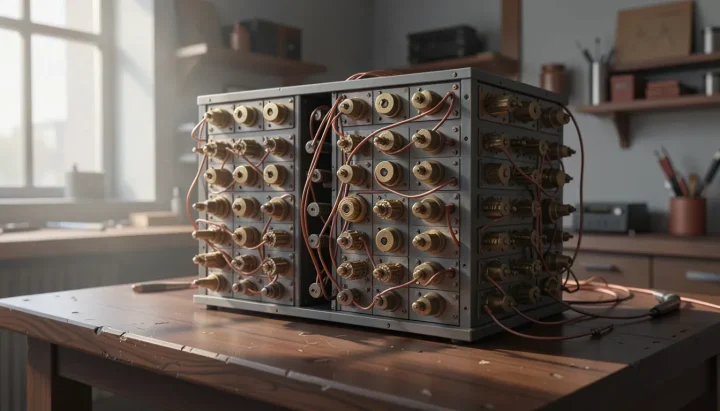
Cover: AI-generated editorial illustration; not a documentary photograph.
Source: Konrad Zuse
 SIGNAL TITANS
.jpg)
Leave a Reply