
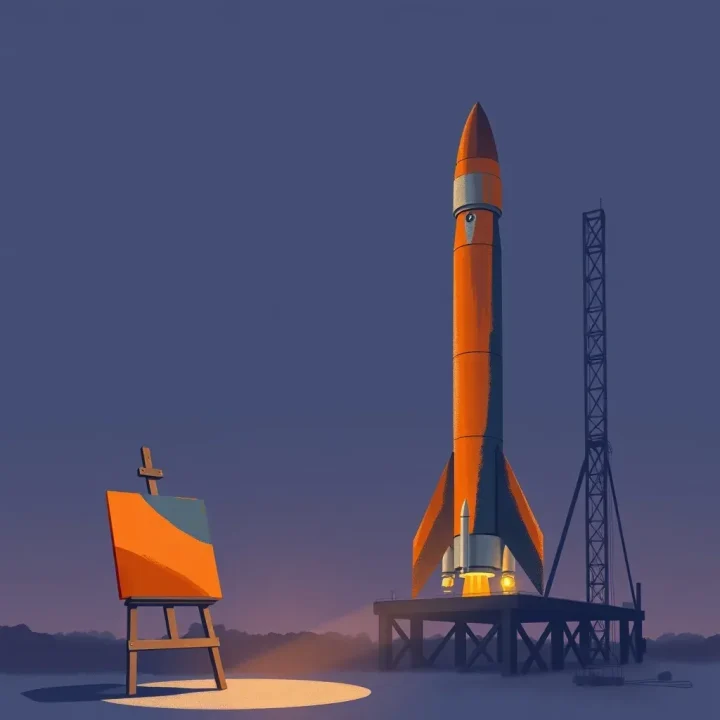
During rocket launches at Cape Canaveral, Florida, more than 200 cameras documented every split second of activity, recording every nut, bolt, and electronic device from every conceivable angle. Yet according to NASA history, agency leadership realized that comprehensive engineering photography captured mechanical components while missing the emotional impact and human dimension of spaceflight. In 1962, less than five years after NASA was founded, Administrator James Webb tasked staffer James Dean with creating an official arts initiative to document space exploration through creative eyes. To establish an operational framework, Dean partnered with Hereward Lester Cooke, a curator at the National Gallery of Art.
Access Over Remuneration
Cooke invited artists to join the project by offering behind-the-scenes access rather than financial gain. NASA paid a modest commission of just $800 per project, but creators were drawn by the opportunity to witness history unfolding firsthand. The agency welcomed a wide spectrum of visual styles, ranging from the abstract compositions of Robert Rauschenberg to the detailed figurative work of illustrator Norman Rockwell. Participating artists were permitted to roam launch facilities, observe astronaut suit-ups, and attend technical briefings. Artist Peter Hurd recorded spending five days exploring Cape Canaveral alongside seven fellow painters, filling notebooks with sketches and preliminary studies across the launch complex.
Exhibiting the Human Record
The visual output quickly found a public audience. Following L. Gordon Cooper’s Faith 7 mission, selected pieces were featured in a 1965 exhibition at the National Gallery of Art titled "Eyewitness to Space," which displayed 70 paintings and drawings created by 15 participating artists. A second major exhibition followed at the National Gallery in 1969 after the Apollo 11 lunar landing. As the Apollo program wound down in the 1970s and launch schedules slowed, active commissions dropped. To ensure the permanent preservation of the collection, James Dean arranged to transfer NASA’s commissioned artworks to the National Air and Space Museum.
Evolving Across Shuttle and Modern Eras
The initiative regained momentum with the inauguration of the Space Shuttle program under director Robert Schulman. Schulman commissioned works focused on shuttle operations, including Henry Casselli’s watercolor depicting astronaut John Young during suit-up for the first space shuttle mission. In the 1990s, Administrator Dan Goldin appointed Bert Ulrich to direct the program, expanding its scope beyond painting. Under Ulrich, NASA commissioned video art by Nam June Paik, an ode by writer Ray Bradbury, photography by Annie Leibovitz, and a musical composition celebrating the Voyager mission by Terry Riley, performed by the Kronos Quartet.
Today, under director Lauren Katz, the program has transitioned into creating public murals across major U.S. cities, expanding nationwide to help diverse communities see their own experiences reflected in space exploration. By bringing space history onto neighborhood walls, NASA's modern initiative carries forward James Webb’s 1962 decision to use creative interpretation as a vital counterpart to technical documentation.
AI-generated editorial illustration; not a documentary photograph.
Source: NASA and Art
 SIGNAL TITANS
Leave a Reply