
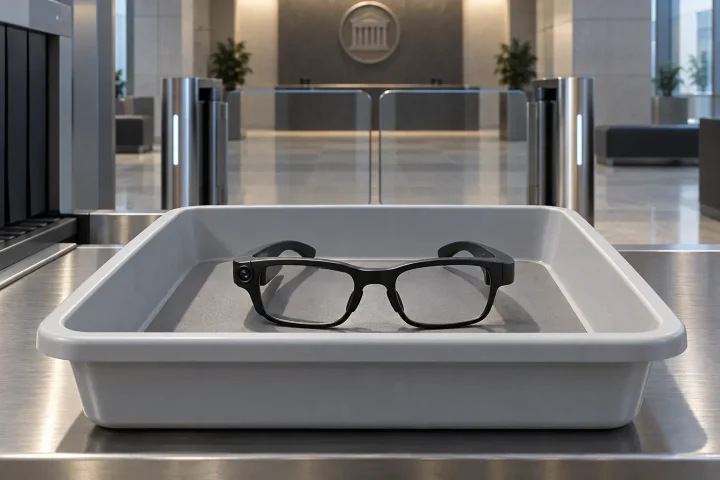
AI-generated editorial illustration; not a documentary photograph.
Australia is considering a broad ban on smart glasses across government workplaces, expanding beyond the current system in which individual offices set their own policies. Public service minister Katy Gallagher said the government is seeking public feedback because devices capable of recording and capturing information create privacy and security concerns.
Scope of the proposal
The proposed restrictions would cover government offices, service centers, laboratories and local councils. Government-run schools and hospitals would remain able to determine their own policies, according to TechRadar. The Albanese government has described the planned standard as world-leading, but no final ban has been announced.
For public servants and visitors, a national policy would replace inconsistent workplace-level rules across much of the public sector. The source does not specify when the consultation will end or when any restrictions could take effect.
Recording concerns
The debate includes devices such as Ray-Ban Meta smart glasses, which can record people from a wearable form factor. Critics have raised concerns about recording without consent and the potential use of the devices in harassment.
A University of Sydney study cited by TechRadar examined 350 public Instagram videos recorded with the glasses and classified around 60% as potentially containing harassment involving one or more people. That finding forms part of the wider privacy controversy, rather than a government assessment of every smart-glasses user or device.
Existing restrictions
Australia would not be the first jurisdiction to restrict the technology in sensitive settings. TechRadar reports that courts in England, Wales and New York state, as well as US Immigration and Customs Enforcement, have banned smart glasses. Some Australian cities and councils already prohibit them in locations including playgrounds, childcare centers, gyms and public swimming pools.
The Australian proposal would go further by establishing a consistent rule across a wide range of government agencies. However, it remains under consideration, and the reported exemptions for schools and hospitals mean it would not cover every state-operated workplace.
 SIGNAL TITANS
Leave a Reply