
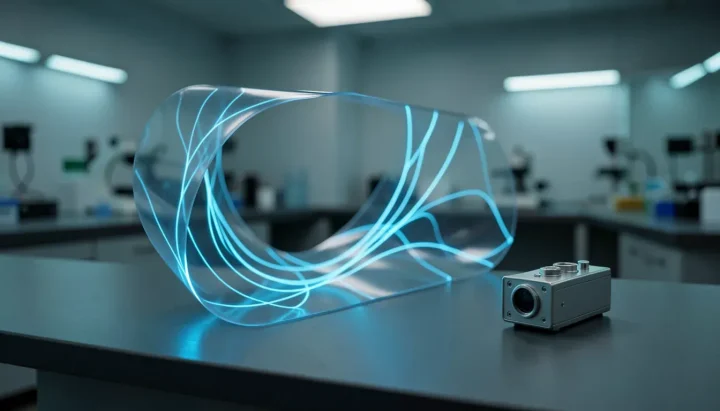
Engineers at the Massachusetts Institute of Technology (MIT) have developed a flexible, shape-sensing material that could transform how digital systems track complex physical movements. Detailed in research published in Advanced Intelligent Systems, the technology utilizes a soft silicone sheet embedded with specially designed optical fibers that digitally reconstruct its three-dimensional form in real time as the material twists and bends.
How the Shape-Sensing Waveguide Works
Traditional motion capture systems rely on rigid sensors stitched into bulky suits at fixed tracking points. In contrast, the MIT team adapted optical fibers, also known as waveguides, which typically channel light efficiently through a transparent core enclosed by an opaque cladding. Instead of rigid glass, the researchers fabricated their fibers using a clear, flexible rubber core surrounded by a black-dyed rubber cladding. To make the fibers sensitive to directional bending, they intentionally roughened one side of the core so that bending in different directions scatters light uniquely, allowing the strand to function as a bidirectional shape sensor.
These half-roughened fibers are arranged in a zig-zag pattern across a stretchable silicone sheet. Each fiber integrates an LED at one end and a light sensor at the other, connected to an external circuit board. As the sheet flexes, the bending fibers alter the amount and pattern of light passing through them. A custom algorithm developed by the team automatically translates these optical changes into a real-time virtual reconstruction of the sheet's exact three-dimensional configuration.
Precision, Resilience, and Current Limitations
In experimental tests using 3D-printed molds, the MIT researchers evaluated the precision of their prototype. According to mechanical engineering graduate student and co-author Qifan Yu, the shape-sensing sheet achieved a margin of error of less than 0.4 centimeters. This represents a significant improvement over traditional rigid-sensor designs, which typically record errors ranging from 1 to 2 centimeters. Furthermore, demonstration tests showed that the sheet maintains its functionality even when subjected to physical damage, such as being punctured with a hole puncher or having individual fibers disconnected, because the remaining network can still accurately calculate the overall shape.
Despite its promise, the current prototype remains bulky. The optical fibers currently measure 1 millimeter in thickness. To transition the technology into a comfortable, wearable garment, the team is exploring alternative fabrication methods aimed at shrinking the fibers down to tens of micrometers—making them thinner than a human hair and suitable for embedding densely into fabric.
Why Continuous Surface Sensing Matters for Future Interfaces
The development of continuous surface-sensing materials addresses longstanding mechanical limitations in human-computer interaction, motion capture, and remote monitoring. Existing motion capture setups track discrete points on the body, which can miss nuanced muscle deformations and surface transformations. By utilizing a continuous, stretchable medium that acts like a second skin, engineers can capture comprehensive volumetric data rather than relying on sparse point measurements. For the virtual reality and gaming sectors, this technology offers a compelling pathway toward untethered, full-body motion tracking that mimics real-world movements with high fidelity, potentially eliminating the need for rigid exoskeletons or restrictive camera setups. Beyond entertainment, the medical and therapeutic applications are substantial. Physical therapy requires meticulous tracking of patient mobility and range of motion over extended treatment timelines. As co-author Kaitlyn Becker notes, shape-sensing garments could allow clinicians to objectively record how a patient stretches and moves an arm or leg during rehabilitation, creating a precise historical record to compare recovery progress across months of appointments. While scaling the manufacturing process from a prototype sheet to a reliable, hair-thin fiber garment remains an engineering hurdle, the foundational breakthrough bridges a critical gap between soft robotics, wearable computing, and immersive digital interfaces.
AI-generated editorial illustration; not a documentary photograph.
Source: I am the controller now: MIT engineers have created a 'second skin' that could one day track whole bodies in VR · Shape-sensing sheet digitally tracks its movement as it bends and twists | MIT News | Massachusetts Institute of Technology
 SIGNAL TITANS
Leave a Reply