
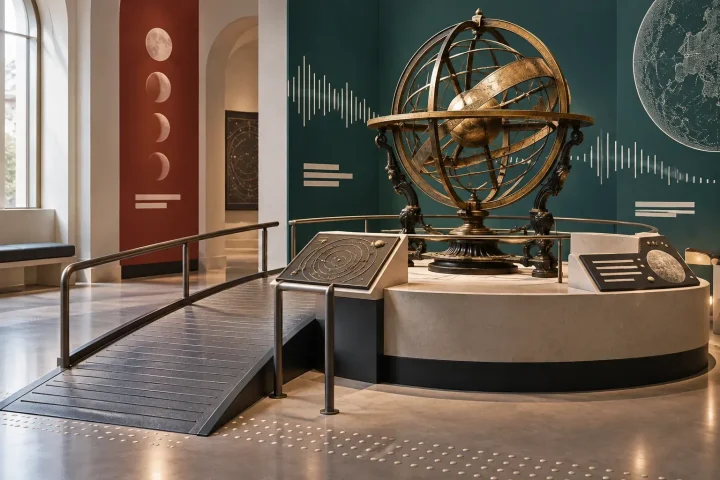
A museum can preserve the history of science while quietly deciding who gets to encounter it. A narrow entrance, an unlabeled video, or an exhibit designed for sight alone can turn a shared collection into a private experience. The Science History Institute in Philadelphia approaches accessibility as part of its responsibility to the public: everyone should be able to find a place in the history of science and in the future of STEM.
A value made physical
The Institute’s accessibility work is expressed through ordinary details that have significant consequences. Visitors can use a wheelchair-accessible pedestrian gate at the parking lot entrance, request assistance with access and parking, and enter through an intercom at the East Entrance. Elevators serve the building, wheelchair-accessible restrooms and water fountains are available on every floor, and portable stools and limited bench seating give museum visitors more options while exploring the galleries.
These features are not presented as a separate destination from the museum. They are part of the route into it. The same principle appears in the exhibits: videos on display include closed captioning, and service animals are welcome. Accessibility becomes less an announcement than a set of conditions that lets more people spend time with the objects and stories being preserved.
Designing for different ways of knowing
The Institute also offers a touch tour on the second Tuesday of every month for guests who are blind or visually impaired. The private, personally guided experience combines exploration of selected gallery exhibits with hands-on study of objects from the collections. That format recognizes that historical understanding does not have to arrive through vision alone. A scientific artifact can be encountered through touch, description, context, and conversation.
At events, the practical approach continues through assistive listening devices in the Ullyot and Haas conference rooms. When American Sign Language interpreters are already scheduled, event descriptions note it. Guests can also request interpretation, captioning, listening devices, or other assistance by contacting an organizer several business days before an event.
Listening as infrastructure
The Institute’s accessibility page does something equally important: it asks visitors to describe what is still missing. Through Project 76, an Art-Reach initiative, the organization invited people to complete an anonymous visitor assessment survey intended to identify areas of greatest need. It also invites direct feedback by email or phone and acknowledges that work on digital accessibility is ongoing, including efforts aligned with WCAG 2.0 Level A and Level AA guidelines.
The broader lesson is an editorial one, not a universal formula: inclusion becomes more credible when an institution connects its values to entrances, captions, tours, equipment, contact channels, and a willingness to revise its practice. Preserving scientific history is not only about protecting objects from the past. It is also about widening the paths by which people can meet that past and recognize themselves within it.
AI-generated editorial illustration; not a documentary photograph.
Source: Accessibility
 SIGNAL TITANS
Leave a Reply