
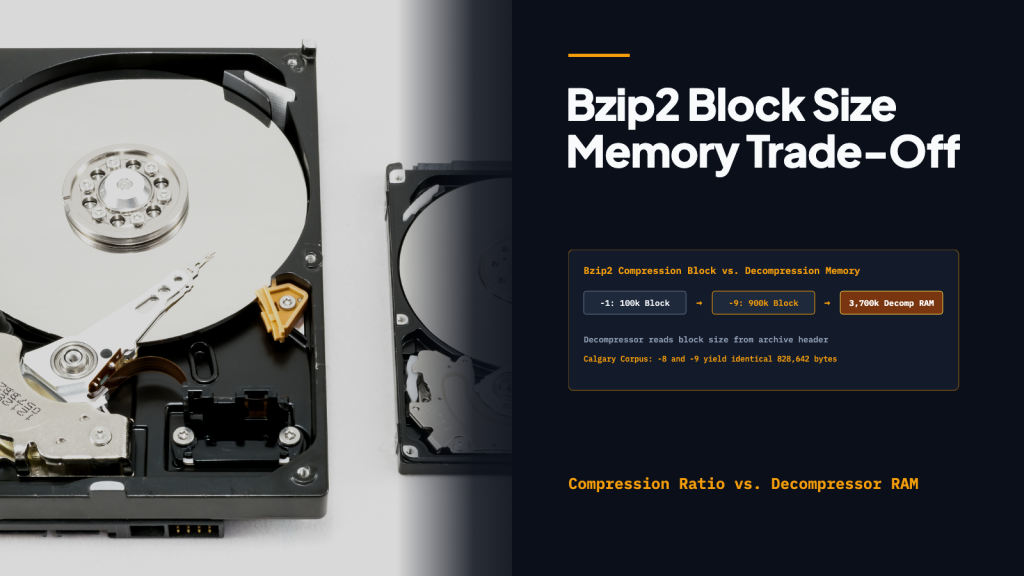
When you compress a file with bzip2 using the default settings, you make a silent decision for whoever receives it. By selecting the default 900-kilobyte block size, the compression tool leaves a marker in the file header. When the recipient later runs bunzip2 to extract the data, their computer will allocate roughly 3,700 kilobytes of memory. The recipient cannot request a smaller block during decompression: bzip2 reads the block size directly from the archive. A separate small-memory option can reduce memory use at the cost of speed.
In the official documentation for bzip2, author Julian Seward emphasized this asymmetric trade-off. Compression options from -1 to -9 set the block size from 100,000 bytes up to 900,000 bytes. Larger blocks give the algorithm a broader window of text to analyze, producing tighter archives. But because each block must be reconstructed in memory, the person who created the file effectively locks in the baseline memory budget needed to unpack it.
The Permutation Before the Huffman Tree
Traditional file compressors built on the Lempel–Ziv algorithms LZ77 or LZ78 rely on dictionary-based matching of repeated byte sequences. By contrast, bzip2 takes a radically different route based on the Burrows–Wheeler transform. Instead of shrinking data directly, the algorithm processes an entire block of text at once, permuting its characters into an order that clusters identical symbols together without losing the information required to reverse the transformation.
The transformation itself does not discard a single byte. Its power lies in preparing the data for subsequent stages. Once similar characters sit side by side in the block, intermediate steps like move-to-front coding and run-length reduction turn repetitive patterns into sequences dominated by small integers and zeros. Only then does a Huffman coder assign short bit sequences to frequent symbols, achieving compression ratios that conventional dictionary methods struggled to match on text.
Diminishing Returns on Memory Budgets
While larger blocks yield denser archives, the gains taper off rapidly. Seward noted in the software manual that most compression benefits appear within the first two or three hundred kilobytes of block capacity. Pushing from -3 up to -9 demands substantially more working memory while capturing progressively smaller marginal reductions in file size.
The documentation illustrates this plateau using the fourteen files of the Calgary Text Compression Corpus, totaling 3,141,622 bytes. Compressing the corpus with -1 produced 914,704 bytes while requiring an estimated 1,200 kilobytes for compression and 500 kilobytes for decompression. Moving to -3 dropped the archive size to 860,338 bytes. But moving all the way to -8 and -9 produced identical output of 828,642 bytes, even as the estimated decompression requirement climbed from 3,300 kilobytes to 3,700 kilobytes.
For systems operating under severe hardware constraints, Seward included an escape hatch: the -s small-memory flag. On decompression, -s switches to an alternative algorithm that trims memory usage to approximately 2.5 bytes per block byte, dropping the requirement for a 900-kilobyte block to 2,350 kilobytes. The cost of that reduction is speed: unpacking with the small-memory flag runs at roughly half the normal rate.
Independent Blocks and Damaged Archives
Splitting archives into separate blocks also provides a safeguard, alongside the memory cost. In a single continuous stream, one bit error or transmission drop can corrupt everything that follows it. In bzip2, each compressed block is delimited by a 48-bit pattern and protected by its own 32-bit cyclic redundancy check.
This separation makes possible the accompanying bzip2recover utility. When a multi-block archive suffers disk or network corruption, the utility searches for block boundaries and extracts candidate blocks into separate files. These files can then be tested with bzip2 -t, allowing undamaged blocks to be decompressed while damaged blocks are set aside. Choosing a smaller block size during compression reduces the amount of data at risk in any single corrupted block, which makes error containment another factor in the block-size decision.
Later Fixes and a New Maintainer
Later updates addressed edge cases in the sorting stage. In version 0.9.5a, Seward incorporated a fallback sorting routine to limit worst-case slowdowns on highly repetitive inputs like long repetitions of identical phrases. After more than two decades of widespread deployment across Unix distributions, maintainership transitioned to Federico Mena Quintero, a developer with the GNOME desktop project, in June 2019, followed by point releases addressing accumulated distribution patches while preserving archive compatibility.
For bzip2, choosing a larger block size can improve compression while increasing the memory allocated by the decompressor, with gains depending on the data. The Calgary corpus results illustrate the boundary: moving from -8 to -9 left total compressed size unchanged at 828,642 bytes, even as estimated decompression memory increased from 3,300 to 3,700 kilobytes.
For systems engineers, the utility illustrates how sender-side choices directly establish receiver constraints. The creator selects the block size to minimize storage or bandwidth, but the consumer’s hardware ultimately determines whether unpacking that archive is practical.
Related stories
Sources
- bzip2 and libbzip2 Manual (Version 1.0.8, Julian Seward)
- bzip2 CHANGES (Project Changelog)
- Maintaining bzip2 (Federico Mena Quintero, June 4, 2019)
- bzip2 Format Description (Library of Congress, FDD000600)
- Featured image: Jacek Halicki; Wikimedia Commons; CC BY-SA 4.0 (adapted from the original)
 SIGNAL TITANS

Leave a Reply