
Building reliable message queue consumers requires moving beyond basic asynchronous syntax to focus heavily on data safety, operational recovery, and explicit failure paths. According to broker documentation and developer guides, distributed messaging systems inherently carry delivery risks that demand confirmation mechanisms, while workers must independently own processing boundaries, retry policies, and state cleanup to prevent cascading production failures.
Managing Delivery Acknowledgements
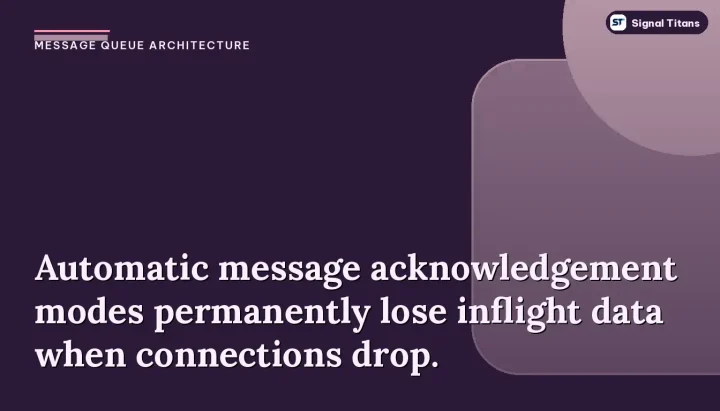
Traditional message brokers rely on protocol-level acknowledgements to ensure messages are successfully handled before deletion. RabbitMQ documentation explains that automatic acknowledgement modes trade data safety for raw throughput, immediately marking messages as delivered upon socket dispatch. If a consumer connection drops prematurely under automatic mode, the inflight message is permanently lost. Conversely, manual acknowledgement modes require developers to explicitly invoke methods like basic.ack for successful processing or basic.nack for failed deliveries. These acknowledgements use channel-scoped monotonically increasing delivery tags, ensuring that any confirmation is strictly tied to the correct communication channel. Furthermore, manual modes allow teams to enforce channel prefetch limits, preventing unexpected consumer overloads and memory exhaustion caused by unmanaged message backlogs.
Enforcing Idempotency and Worker Boundaries
At the application layer, developers must decouple incoming web requests from the background worker lifecycle to protect system stability. According to developer architecture reports, an incoming HTTP request should merely enqueue a task, allowing a dedicated worker to consume and manage the work independently. Because standard queues operate on an at-least-once delivery guarantee, duplicate messages will inevitably arrive during network retries or broker rebalances. To handle this safely, cleanup operations and state transitions must derive an idempotency key from the job identity and target scope, ensuring that executing the same side effect twice does not corrupt database records or duplicate state changes. When failures occur, workers must distinguish between permanent validation errors and transient outages, applying bounded retry limits and intentional dead-letter routing.
Why Operational Recovery Dictates Resilient Architecture
The true test of a messaging architecture occurs during an incident when an on-call engineer investigates an escalating queue backlog or a breached service level objective. Both broker-level documentation and architectural guides highlight that operational recovery is not merely a syntactic convenience; it is the fundamental boundary that separates a resilient backend from fragile data pipelines. When systems lack proper acknowledgement tracking or idempotent side effects, transient network glitches can trigger duplicate processing storms, corrupting databases and inflating error counts. Conversely, implementing rigorous instrumentation around receive rates, processing durations, and oldest-message ages allows teams to catch backlogs before they breach performance thresholds. However, balancing these safeguards introduces tricky engineering trade-offs. Overly sensitive alerts create notification fatigue, training engineers to ignore critical warnings, while poorly configured concurrency limits can cause retry storms that overwhelm recovering databases. Ultimately, designing a robust consumer means accepting that failures are inevitable, making it essential to establish visible, observable paths for every message from ingestion to final acknowledgement or rejection.
Evaluating Queue Options and Integration Surfaces
Choosing the right queue infrastructure depends heavily on an engineering team's operational capacity and specific workload constraints. Managed services like Amazon SQS offer conservative, out-of-the-box reliability for AWS-centric stacks, whereas RabbitMQ provides granular broker-level controls and routing flexibility. For Node.js ecosystems relying on Redis, libraries like BullMQ present a natural fit. Meanwhile, emerging REST-based queue alternatives simplify integration by exposing self-describing discovery endpoints and unified credential management across multiple backend capabilities. However, these REST models do not replace specialized workflow engines or Kafka-style stream replay mechanisms when complex multi-consumer topologies or extensive state joins are required, forcing teams to weigh architectural boundaries carefully against expected peak arrival rates and backlog thresholds.
Editorial graphic and headline text by Signal Titans.
Source: Message Queue Consumers in Node.js: Operational Recovery Explained · Consumer Acknowledgements and Publisher Confirms | RabbitMQ
 SIGNAL TITANS
Leave a Reply